My search for grace and meaning after a former care partnering life with a wife who suffered from Parkinson's disease and dementia giving her a confused and disorienting world.
I talked to Joyce yesterday and wished her a Happy Birthday. She and I are last of our family still awake in the natural world. She sent me these pictures of her and I sent her a picture of me. Her friends went out to celebrate her birthday and she got to meet Santa.
I sent her a text message early in the morning and wished her a happy birthday. We are the middle two in our family. Our younger sister and older brother are both gone now. It is just us. She called me back when she was walking her Mexican rescue dog. We talked about everything and nothing while she walked her dog. I commented that the crows were far away this morning and she told me it was cold in Portland so her ear phones were under her hat. She sent me a picture.
I think it is important to have family around. When our brother passed out of this life a couple years ago in the beginning of the whole covid pandemonium from something else not covid, it left another hole in our family. When our younger sister passed away from cancer in 2008 she took part of me with her. I had been her stem cell donor. Dad died the year before our sister. Mom died a few years later. Now Joyce and I are left.
We both have the same Carhartt hat. How warm is that?
Communicative processes used to discover what is needed or desired by others in business or other walks of life work well with loved ones experiencing dementia and related memory issues. And while the single most important concept to remember is that short term memory loss affects every conversation, short term memory loss greatly affects attention span. Keep it short, keep it kind and keep it simple.
Here are some tips from an article in Psychology Today’ website:
Consider the timing and mood of your recipient.
Check your own emotional level.
Be responsible for delivering clear communication.
Consider using I-messages to avoid blaming or putting others on the defensive.
Be a good listener (attentive) when receiving a communication.
And here are more from the Social Care Institute for Excellence website in UK:
Their focus is providing professional care to Alzheimer’s patients and those dealing with other sources of dementia. Their techniques are good to understand for non-professional care givers. I use this list to think about and discern how better to help Cheryl.
Minimize background noise
Relax
Think about how the person may be feeling
Always introduce yourself
Greetings or ‘verbal handshake’
Physical approach
Be aware of emotions and touch
Identify the emotional state of the response
Don’t be shy from tears or laughter
Say what you think the other feels
Keep it simple
Use the person’s name often
Use visual aids and prompts
Confirm understanding
Minimize background noise – I have noticed that Cheryl is easily distracted by almost anything that passes into her line of sight. I have noticed that Cheryl is unable to do two things simultaneously such as talk to someone and keep walking. I have noticed that Cheryl is unable to follow a conversation if two people talk animatedly about some topic in rapid succession or over the top of each other. I have noticed that Cheryl is unable to interpret words spoken with a different lilt or accent other than Midwest Cincinnati. I have noticed that she no longer watches any of her favorite shows on TV. With all of this considered if I want to gain her full attention, I remove all distractions.
Relax – I struggle with relaxing and letting go for a bit if she is out of my sight. As her disease progresses and I see her falter with balance issues, stumbling gait and postural difficulties, my anxiety about her future (and mine) often comes through in my voice. I may say things or express opinions that can easily interpreted as rude, pedantic and egotistical. For those times I apologize to her and you.
Think about how the person may be feeling – I do not do this enough. It is easy from the outside to forget that the person is not the disease. Parkinson seems to make this harder because in one moment she will be “fine” and in the next she will be “off” – not necessarily physically off, mentally off and physically fine. I find this confusing and my default is not “she’s confused – help her”. My default tends toward preachy pedantic lecture.
Always introduce yourself – Most of the time I do not need to do this. I can understand that it may be important for a professional to do this. Occasionally Cheryl is unsure of who I am. Mostly this occurs in the evening if she experiencing a bit of Sundowning. (Sometimes I am “that guy who brings the pills”) Sometimes I tell who I am if I think she will accept it. Sometimes I leave it alone. The important thing is to not be insistent that she is wrong about who I am.
Physical approach – I have noticed that Cheryl startles much more easily than she did before Parkinson (bP). This comes in many forms visually and audibly but the important thing is to not surprise her. Surprises often lead to backing up and falling down which is her usual method of falling. She will move away suddenly from the perceived surprise.
Be aware of emotions and touch; identify the emotional state of the response; do not be shy of tears or laughter – I think these fit together as emotional response to conversation. Sometimes to me it is surprising that she will have tears about telling you that Laurencia is going to Ohio State University. I can understand that talking about her deceased mother will cause tears. Nevertheless it is important to understand that a person suffering with Parkinson may have her emotions very close to the surface. Try to remain calm but it is okay to “have a moment” and be with her. One memory often elicits another more tender memory and things tumble downhill quickly.
Keep it simple; use the person’s name often or the other person’s name if telling a story; use visual aids and prompts – pictures of children; confirm understanding – I have noticed that Cheryl may lose the thread of any story or conversation easily. She will not indicate in any way that she has lost track of what you are telling her. You may detect that she has lost it by some response that she makes. Simply reiterate some part of the story to help her recall. Do not get bogged down in correcting her mistaken thinking. Do not raise your voice to emphasize the correct story, time of day, holidays coming up, time of the year or who is coming to dinner. She will not remember but she will think that you are frustrated, angry or disappointed and respond with – I’m sorry.
Finishing– Just as you prepared to start a visit and conversation, so you must think about how you will bring it to a close. I do this many times a day. (For visits) When you are leaving the our home, make sure you say goodbye. Cheryl may think that you are still here, perhaps in another room. This may cause confusion or anxiety later. Ensure you have her attention, smile, and let her know you enjoyed your time together and the conversation. Shaking her hand or hugging her is a common gesture which gives her a strong clue you are leaving. Leave her reassured and let her know you look forward to talking again.
I spend a lot of time reading articles and searching for useful ideas to help Cheryl. This post is a sort of summary of two of those and how I think I can better communicate with her.
(This picture of a fossil track called a mortichnia heads an article in Omni Magazine.)
But impressions are better. They are more general. I was thinking about this early this morning while writing in my little log where I make notes about Cheryl’s day to day.
I note sleep patterns. I write when she goes toward and eventually gets into bed. I know this intimate detail because I have been helping her get her pajamas on and positioned in bed. Most nights she stays. Sometimes she has gotten back up and we will sit for a bit while I get finished with whatever I am doing before going to bed. Many times that is writing this little blog or my “Hitchhiker’s Guide” to care giving. (I am collecting stories and thoughts in a book.)
We have been speaking untruthfully to therapists when they ask, Do you need help with getting dressed? I usually respond with sometimes but mostly not. Cheryl mentions her numb feeling fingers which get in the way of snaps and buttons. None of these are on her pajamas but late at night it is confusing to her.
I note conversation in the evening which lately is confusing. I have thought it might be interesting to capture it and transcribe it. It suffices to say that it is very odd and non-linear.
It is better to stay in the moment. It is better to reflect on those moments and write my impressions later.
i carry your heart with me(i carry it in
my heart)i am never without it(anywhere
i go you go,my dear;and whatever is done
by only me is your doing,my darling)
                                                      i fear
no fate(for you are my fate,my sweet)i want
no world(for beautiful you are my world,my true)
and it’s you are whatever a moon has always meant
and whatever a sun will always sing is you

here is the deepest secret nobody knows
(here is the root of the root and the bud of the bud
and the sky of the sky of a tree called life;which grows
higher than soul can hope or mind can hide)
and this is the wonder that's keeping the stars apart

i carry your heart(i carry it in my heart)
A couple people help me occasionally with Cheryl when I need to do other things. Today I had planned to go visit our lab area at a nearby community college but that changed early this morning. I sent a text to Linda and told that the situation changed but she was still welcome to come visit for a bit. She came and we talked about her sister who is struggling with cancer and other things going on in her life.
In a different discussion Linda revealed that Frank (My cousin, her husband who passed out of this world a decade and a half or so ago.) kept a book by E. E. Cummings on his desk in addition to books by Robert Fulghum (It was on fire when I laid down on it, and others.). I vaguely recalled that Cummings was a poet but I was not sure so I looked him up on the world wide wait. I was proven correct and I went to a poetry website that I occasionally visit. Searching for some of his work this was the first poem displayed. (I think Frank was talking to me.)
Thanks Linda and Frank. I have found another poet who speaks to me. And thank you Poetry Foundation for being there when I need words to guide my heart.
When she is running on parkie time and I manage to get her to her exercise class on time without arguments, mostly none, I get a feeling of pride of accomplishment. Seek accomplishment in the small things of life and bigger things will follow. Or I think that they will.
There are lots of life plans and platitudes similar in sentiment. Keep track of the pennies and the dollars will take care of themselves- is one from the business world. Manage the little things and big things will come your way. Yadda Yadda Yadda.
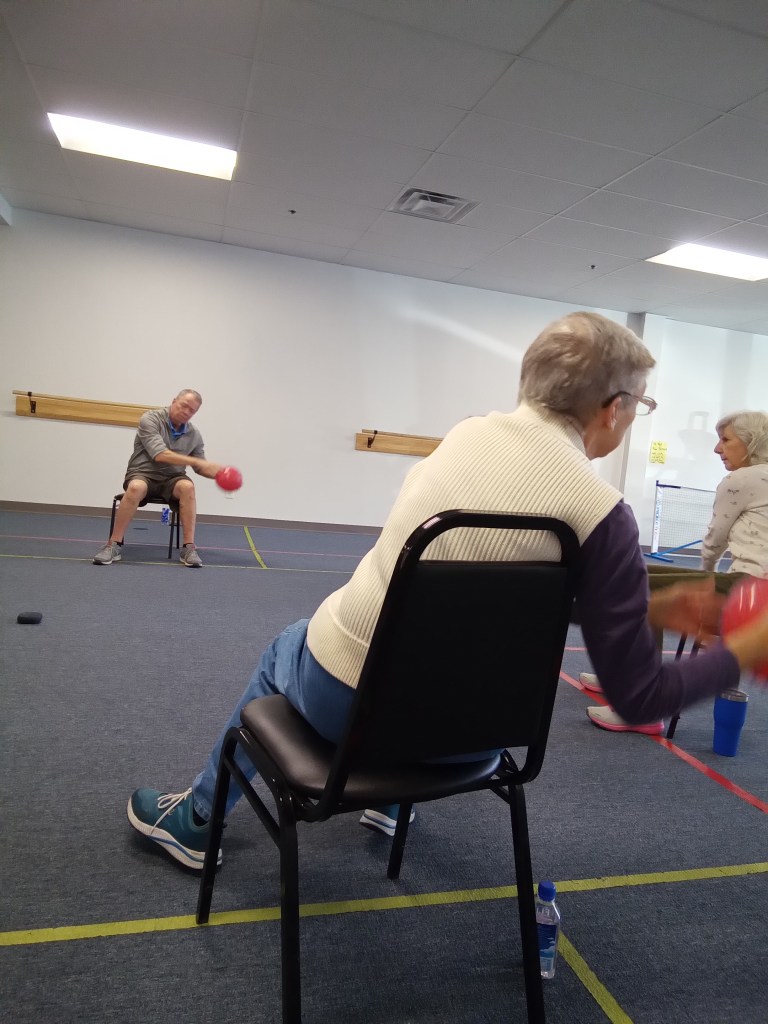
She seems to be enjoying class. It consists of a group of boxing like motions while seated. A similar class uses dancing moves. The constant motions raises the heart rate.
Friday is always a bit tricky since the class that she likes is at 11 am. All other classes are at 12 pm and later. Generally her best time of day is 10 am until about 7 pm.
Wordle is a game that makes me happy. I found that thought in my head after finding the wordle answer a couple days ago. It matters not that I needed one guess or five guesses. There is no competition. (And yet there is someone on the World Wide Wait that needs to explain to me why it is popular.) It is a personal challenge. It is the first thing I open on my tablet in the morning, well, almost. Sometimes the book I was reading the night before opens itself and I read that for a little bit.
Cheryl is semi-sleeping now. I checked on her. She is “trying to decide” about getting up. We have no scheduled activities or she does not. Actually I do.
Early in the morning while she is in this mode, I have time to look at other things, check email, see what folks are whining about on Facebook. Facebook has a strange way of posting things on my “news feed”. Calendar time seems to have little to do with it, maybe, nothing to do with it. It must be a complicated algorithm. Ho Hum. After determining that there are no email, Facebook or other emergencies, I move on. It amuses me to notice how many folks will post something on a group page which might better be solved by picking up the phone, I look at WordPress to think and gain some inspiration to add to this blog of mine.
The statistics page is often of interest since much of the display intrigues me. Today this little display in the corner seems to report that someone in Thailand looked at my blog.
That in itself is not strange. Type a random thing into Google and it returns all sorts of unrelated finds. But all seven views were of an old post I entitled “Things that make you Happy” and I reread it this morning. I found inspiration in my own words.
Over the past weekend we visited with my cousin Bettie and her husband Herb. It is always a great time with family and friends that we do not see that often. Bettie’s house is perhaps forty-five miles away south and east. It is a pleasant drive through the northern Kentucky countryside and for Cheryl it is a far away destination. On this particular weekend the hurricane that crossed Florida and came ashore at Georgetown, South Carolina had spread its cloud deck inland to eastern Ohio and Kentucky.
On the start of our trek it was bright and sunny. I aimed the car south and east towards Bettie and Herb’s place and drove under the cloud deck. Watching to sun go down from their front porch and side deck was magnificent. My son remarked to me that he had not seen a rainbow before. I do not know whether he meant ever or as brilliant as this one was. It was perfect timing for a follow up question but I did not ask him. Carpe the missed diem.
Like most things I have taken pictures of with the smartphone’s camera, the pictures do not capture the magnificent colors that were produced by nature. The rainbow produced by the narrow view the sun had of the under side of the cloud deck and upper misty air was brilliant and exceedingly bright. The pictures simply do not do it justice. But being there with family and friends and watching a unique sunset made me happy.
Happy to be alive and happy I was able to share the moment with Cheryl.
I think that when I want to do something with Cheryl, parkie time shows up to slow things down. It is inevitable. She will say- let’s go or are you ready to go- or words that convey the sentiment that she is ready. Nope. That is a incorrect interpretation of the language.
If I stop to consider parkie time though it makes sense. I thought we were headed to the car. Actually we were headed to check on several stacks of paper in her office before we go. The thing about parkie time is that it has little to do with clock time.
There’s a period of hesitation while one remembers what is happening next and what is required for that activity. If I realize what is happening I can help but sometimes the help is unappreciated. It is a delicate balance of gentle help and unintentional stress. Memory loss mingles with confusion to create stress.
The important thing is to not respond to the smart-Alec comment or to make one. Running down the road jabbing at each other with pointed sticks does not accomplish much but admittedly can be momentarily satisfying to both. Resist doing that. The road is smoother. There is less apologizing later. Certainly there is less guilt at having trod all over someone’s emotions.
The disease is not them. It is hard to remember that in the rush for the door to leave and go somewhere.
Recently a classmate and friend of Cheryl passed away. Sister Mary Claire Hausfeld was not in Cheryl’s ICA class. Cheryl went to grade school with her and Mary Claire went to OLA high school. She found her vocation after high school. But that is not what I want to tell you about.
In a wonderful and well written obituary about Mary Claire and her life of service S. Delouise Menges writes about grace in Mary Claire’s life and how to recognize grace in our lives.
This poem by Marilyn Chandler McEntyre that Mary Claire used in prayer is a beautiful and touching meditation.
How to recognize grace
It takes you by surprise
It comes in odd packages
It sometimes looks like loss
Or mistakes
It acts like rain
Or like a seed
It’s both reliable and unpredictable
It’s not what you were aiming at
Or what you thought you deserved
It supplies what you need
Not necessarily what you want
It reminds you, you’re not in control
And that not being in control is a form of freedom
I have read this over several times and the line that strikes me most is “And that not being in control is a form of freedom”.
This life of Parkinson gives that statement new perspective. Little of our life is able to be controlled and I for one would like life to at least be predictable. It is not predictable either and that can be a form of freedom if you let it.
If you are going to try to get your PwP to speed up to go somewhere make sure you have your act together first.
What ever schedule that you have in mind is busted, so, move on.
Some people sleep in occasionally. It is not apathy, just the ordinary need for luxurious life.
“Church” is merely another name for going somewhere. Just repeat the answer to: Where?
Do not panic when she asks where we are sleeping or asks if we are going home tomorrow. Tomorrow she will not remember.
Read her email once a day.
Casually look in her disorganized office once in awhile to get a feel for where things could be when “I can’t find my…” comes up.
This is a continuing list and when I stop to think about it and all the things I have had to learn and do it makes me smile. Frustration creeps in sometimes but I think that most of the time I can push it away. The times that I cannot are about what this disease has taken from her.
Frank, I know you are not with us any more and have not been for awhile but I suspect that like Google and Facebook you can watch us, so here is what I want to say to you.
Thank you ever so much for marrying Linda all those years ago when we were young. These days she is an immense help to me and a good friend. As you are aware, her simple act of kindness to Cheryl and me comes in the form of being with Cheryl while I go do something else. Lately that has been riding my bike around Lunken Airport.
When she first started doing this for us I had signed myself up for a care giving class which put great emphasis on making sure that you take care of yourself as a care partner. I asked if Linda could be with Cheryl during those class times and she agreed. I took the “take care of yourself” message to heart and make an extra effort to find help so that I can be on my own for a couple hours.
Since I am seeing Linda more these days, prior to this as you know we met for pizza Tuesday maybe four or five times a year, I think often about our conversations and ponderings in Aunt Dorothy’s kitchen. Do you remember some the questions we posed? How does one determine if sour cream is bad?, for example. I had not thought about it at the time but it was the same sort of thing that would puzzle my dad and I am guessing his brother, your dad. Sometimes small people would run through and we would wonder who they belonged to. Those are good memories. That entire older generation of our family is gone now. Aunt Bert passed away last year. But you know that. Have you talked to her yet? Does dementia go away when you get to heaven?
So, here is a couple questions for you. How are you doing in heaven these days? Is heaven a no smoking area? Is there a smoking section? Or did you give that up?
Did you know grapes are better when they are frozen? I learned that from Sarah’s Luke.
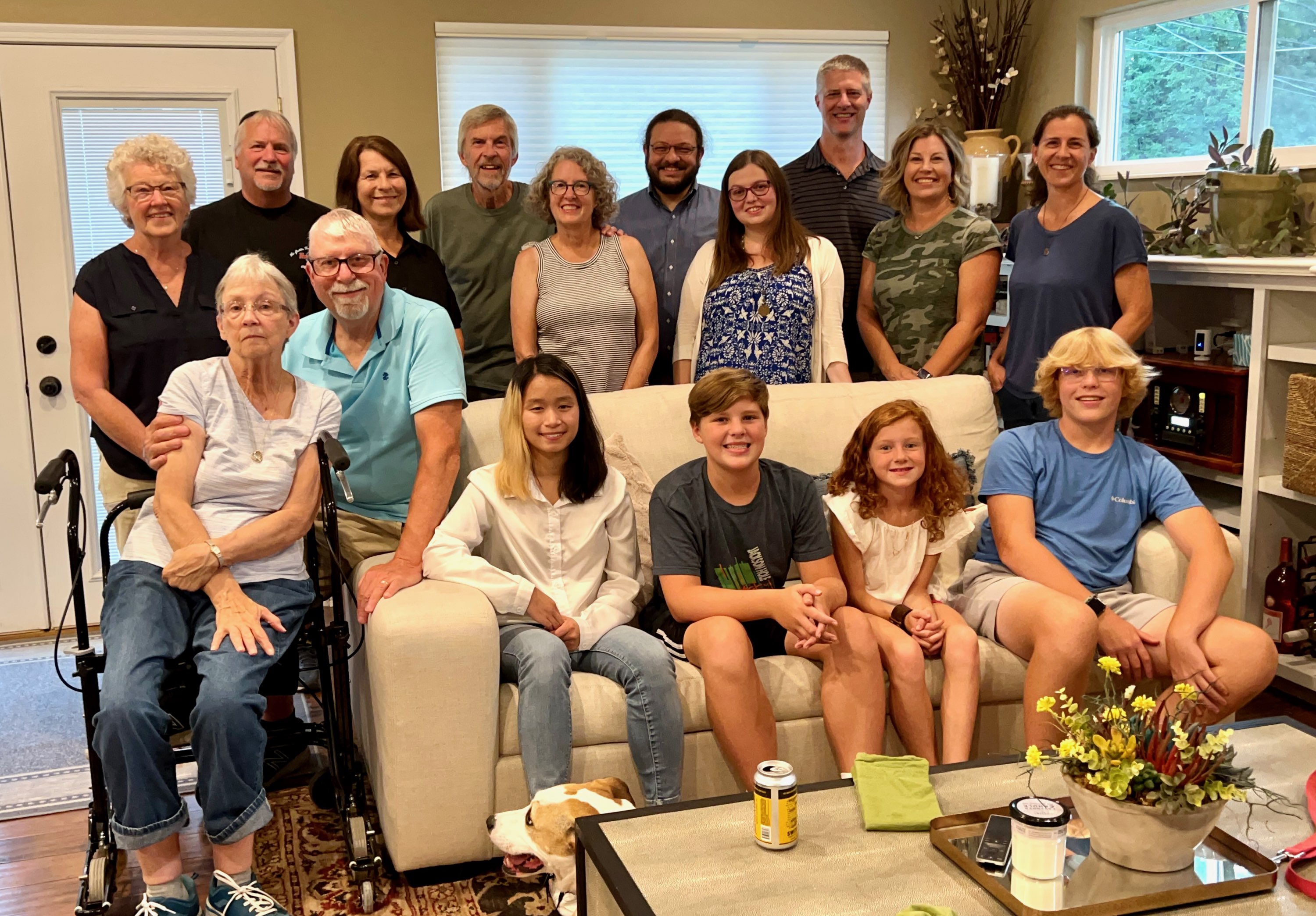
Ray and Shirley passed through town a few days ago. We gathered at Sarah’s house with as many folks as we could conjure up. Not all of your kids were there but some were. Betty and Herb came from Brooksville. Andy was not there but Kyle and Julie were. It was a great time. Ray took a picture: