My search for grace and meaning after a former care partnering life with a wife who suffered from Parkinson's disease and dementia giving her a confused and disorienting world.
Asshat is one of my favorite terms for “stinker”. When I read it in a book it makes me giggle internally.
Today I was an asshat. Cheryl had a rough night. She spent a long time feeling something in her bowel that would not happen. Sadly one of the often not talked about symptoms of Parkinson is constipation. This condition is treated with various devices, more veggies, extra fiber, fiber enhanced foods, docusate sodium (stool softener), Miralax, psyllium husk powder, and others. The result of many of these maybe all is an emergency. And sometimes a declogging device. We have been down this road many times.
Why I did not recognize it last night at 3 AM is beyond me. Maybe not.
I was an asshat. Today I am trying to recover from my overnight asshattedness.
We had an open and frank discussion about me, my death, if it was okay to date, how I died or was no longer here, Capgras Syndrome, how it was that her mom died, and other topics. I explained “impostor syndrome” and that I was not dead. it took a lot for me to not openly cry as I began to understand her terror at not knowing what was going on around her.
We talked about our love for one another. I told her I would never leave her alone or as best I could not let her miss anything important. We talked about memory and how scary it is to not know what is next.
She was anxious about being home but not thinking she was home. In the midst of that our upstairs neighbor, Joe, bought me a couple cans of beer. A couple days ago we were discussing an article in a local magazine about the best microbreweries in the area. He had found some of the stuff that won.
Cheryl added Joe into the discussion about how she and he were working on the same project at the house. We went around and talked about going home and Joe had brought her home last night. I said that when she woke up she was home? Even though when she went to bed last night she was not home? Yes she said.
I explained to her once again that we were home even though she was unsure that we were home. (Another nuance of Parkinson dementia). Capgras can occur with things and places also. In Cheryl’s case it happens with time.
She knew she was home now.
She seemed calmer afterward. It wore her out and she went to bed early and was okay with me helping her to bed.
Carpe Capgras Diem. (but what a miserable fucking disease.) (sorry)
Different events in my own life cause me to remember stories from the Bible sometimes. The Bible is full of stories. This story from the new testament, Matthew, I think, talks about two sons reaction to something that their father has asked then to do. The first kid says, Yep. I will be there. And then he does not go. I suppose he goes off to hang with his bros. The story teller does not tell us. The second kid says, not today, Pops, I am hanging with my bros. But after his father leaves he goes and does what his dad asked him to do. The elephant in the room is, which kid did the right thing? The first kid outright lied to his father. What an asshat he is. The second kid did the right thing but was grumpy with his father initially.
It always strikes me that there is not a lot of lead in to this story and the following paragraph does not seem to segue into the story about the tenant farmers killing the owner’s son. But I have digressed.
Cheryl slept poorly overnight. When we saw her neurologist he made some adjustments to the meds that are supposed to help with her dementia and memory issues. This was the second night that she had taken the new dosage. She told me at one point her mind was racing. She eventually fell asleep somewhere between 2:30 and 3 am. I did anyway and she did not disturb me awake.
In the morning I let her sleep late by turning off the 7 am alarm. I started to tease her awake at a few minutes before 10 am. She eventually got up at 11 am. While I was waiting for her to get moving, I did a few things that had to happen:
stuffed envelopes with the ninety or so Christmas cards we send out each year and added a little newsy note like the rest of us that only communicate once in awhile.
wrapped some of the presents we purchased for the grand children and for some unknown child whose request was hanging on the giving tree at church last week.
balanced the check book because I forgot to do it on Friday
paid the property taxes because the escrow account said this was the day
helped her get out of bed and into the bathroom for meds and the the toilet
got her breakfast going and helped her out of the kitchen to get freshened up for the day
helped getting the shower going and made sure she was okay to take a shower by herself
rubbed the magic stuff in her hair after her shower and hair shampoo
made the bed
And on and on – making this about me in my head. It is easy to forget and add up this huge column of pluses and equate that with one unsought request. (sad face) Cheryl in the midst of all of this activity as she was combing her hair said the garbage needed to be removed from the small receptacle next to the toilet the receives last night’s protection and the occasional Kleenex tissue. It did not I insisted in a volume and timbre that was unnecessary.
So what does all that have to do with the Matthew mystery story. The first kid could have said, yes, I will be right there. I have this other thing to get rid of first. Is that okay, Dad? (Any reasonable father would have accepted this first step to rid oneself of the prior commitment.) The second son could have taken a deep breath and gone to do what his father asked. (He was apparently intending to do it anyway.)
I for my part could chosen either one of these two reactions to Cheryl’s need to have the garbage removed. I could have said I will do that in a minute but I need to finish this thing first without the snippy response or I could have merely removed the trash right then. I did remove it a little later. There was no reason for me to feel put upon.
Before that silly reaction by me all was well. Then suddenly something misfired.
You do not know when you will learn something important. This seems especially true when care partnering with a dementia patient. Once in awhile I get a glimpse of how much Cheryl is struggling with her surroundings and may or may not understand what is happening around her.
Her friend Cathy came to visit her yesterday. They sat and talked about various topics. I left for a bit to do some grocery shopping and pick up a book from the library. When I returned we all chatted for a little bit as I finished cooking some goetta and packaging it for consumption later.
Cheryl experiences something called Capras syndrome. I only learned the name for what she seemed to be doing a few days ago. Knowing the name for something is not reassuring. My engineer head wants to know how to fix it.
A person with Capgras syndrome irrationally believes that someone they know has been replaced by an imposter. In some cases, they may also believe pets or even inanimate objects are imposters.
Usually this occurs late in the evening and she does not know who I am. Sometimes though she does not know where she is and has a strong sense of being in the wrong place. Yesterday when Cathy left she was unsure of the ending and as the afternoon went on she expressed the thought that she did not like staying in someone else’s house when they were not there. She thought we were at Cathy’s house. I did not catch on to her confusion until much later in the evening.
Finishing– Just as you prepared to start a visit and conversation, so you must think about how you will bring it to a close. If you are leaving the person’s home, make sure you say goodbye. You should not leave the person thinking you are still in their home, perhaps in another room. This may cause confusion or anxiety.
Ensure you have their attention, smile, and let them know you enjoyed your time together and the conversation. Shaking their hand or touching them is a common gesture which gives them a strong clue you are leaving. Leave them reassured and let them know you look forward to talking again. If you are likely to be speaking to them very soon, for example later that day, say when you will return and leave a note close by indicating when the next visit will be.
I do not do this as well as I probably should this many times a day. Sometimes she will come to look for me.
(For visits and visitors) When you are leaving the our home, make sure you say goodbye. Cheryl may think that you are still here, perhaps in another room. This may cause confusion or anxiety later. Ensure you have her attention, smile, and let her know you enjoyed your time together and the conversation. Shaking her hand or hugging her is a common gesture which gives her a strong clue you are leaving. Leave her reassured and let her know you look forward to talking again. She may want to accompany you to the outside door in our lobby area and check for mail.
Touch someone. How simple of a gesture. How much she is reassured.
Communicative processes used to discover what is needed or desired by others in business or other walks of life work well with loved ones experiencing dementia and related memory issues. And while the single most important concept to remember is that short term memory loss affects every conversation, short term memory loss greatly affects attention span. Keep it short, keep it kind and keep it simple.
Here are some tips from an article in Psychology Today’ website:
Consider the timing and mood of your recipient.
Check your own emotional level.
Be responsible for delivering clear communication.
Consider using I-messages to avoid blaming or putting others on the defensive.
Be a good listener (attentive) when receiving a communication.
And here are more from the Social Care Institute for Excellence website in UK:
Their focus is providing professional care to Alzheimer’s patients and those dealing with other sources of dementia. Their techniques are good to understand for non-professional care givers. I use this list to think about and discern how better to help Cheryl.
Minimize background noise
Relax
Think about how the person may be feeling
Always introduce yourself
Greetings or ‘verbal handshake’
Physical approach
Be aware of emotions and touch
Identify the emotional state of the response
Don’t be shy from tears or laughter
Say what you think the other feels
Keep it simple
Use the person’s name often
Use visual aids and prompts
Confirm understanding
Minimize background noise – I have noticed that Cheryl is easily distracted by almost anything that passes into her line of sight. I have noticed that Cheryl is unable to do two things simultaneously such as talk to someone and keep walking. I have noticed that Cheryl is unable to follow a conversation if two people talk animatedly about some topic in rapid succession or over the top of each other. I have noticed that Cheryl is unable to interpret words spoken with a different lilt or accent other than Midwest Cincinnati. I have noticed that she no longer watches any of her favorite shows on TV. With all of this considered if I want to gain her full attention, I remove all distractions.
Relax – I struggle with relaxing and letting go for a bit if she is out of my sight. As her disease progresses and I see her falter with balance issues, stumbling gait and postural difficulties, my anxiety about her future (and mine) often comes through in my voice. I may say things or express opinions that can easily interpreted as rude, pedantic and egotistical. For those times I apologize to her and you.
Think about how the person may be feeling – I do not do this enough. It is easy from the outside to forget that the person is not the disease. Parkinson seems to make this harder because in one moment she will be “fine” and in the next she will be “off” – not necessarily physically off, mentally off and physically fine. I find this confusing and my default is not “she’s confused – help her”. My default tends toward preachy pedantic lecture.
Always introduce yourself – Most of the time I do not need to do this. I can understand that it may be important for a professional to do this. Occasionally Cheryl is unsure of who I am. Mostly this occurs in the evening if she experiencing a bit of Sundowning. (Sometimes I am “that guy who brings the pills”) Sometimes I tell who I am if I think she will accept it. Sometimes I leave it alone. The important thing is to not be insistent that she is wrong about who I am.
Physical approach – I have noticed that Cheryl startles much more easily than she did before Parkinson (bP). This comes in many forms visually and audibly but the important thing is to not surprise her. Surprises often lead to backing up and falling down which is her usual method of falling. She will move away suddenly from the perceived surprise.
Be aware of emotions and touch; identify the emotional state of the response; do not be shy of tears or laughter – I think these fit together as emotional response to conversation. Sometimes to me it is surprising that she will have tears about telling you that Laurencia is going to Ohio State University. I can understand that talking about her deceased mother will cause tears. Nevertheless it is important to understand that a person suffering with Parkinson may have her emotions very close to the surface. Try to remain calm but it is okay to “have a moment” and be with her. One memory often elicits another more tender memory and things tumble downhill quickly.
Keep it simple; use the person’s name often or the other person’s name if telling a story; use visual aids and prompts – pictures of children; confirm understanding – I have noticed that Cheryl may lose the thread of any story or conversation easily. She will not indicate in any way that she has lost track of what you are telling her. You may detect that she has lost it by some response that she makes. Simply reiterate some part of the story to help her recall. Do not get bogged down in correcting her mistaken thinking. Do not raise your voice to emphasize the correct story, time of day, holidays coming up, time of the year or who is coming to dinner. She will not remember but she will think that you are frustrated, angry or disappointed and respond with – I’m sorry.
Finishing– Just as you prepared to start a visit and conversation, so you must think about how you will bring it to a close. I do this many times a day. (For visits) When you are leaving the our home, make sure you say goodbye. Cheryl may think that you are still here, perhaps in another room. This may cause confusion or anxiety later. Ensure you have her attention, smile, and let her know you enjoyed your time together and the conversation. Shaking her hand or hugging her is a common gesture which gives her a strong clue you are leaving. Leave her reassured and let her know you look forward to talking again.
I spend a lot of time reading articles and searching for useful ideas to help Cheryl. This post is a sort of summary of two of those and how I think I can better communicate with her.
In an amazing amount of support for our dear friend Linda, Cheryl was able to fall asleep and stay asleep over night. She slept well and this morning she awakened to the 7AM alarm put out by the loud and annoying alarm clock. The past few weeks she has trained herself to ignore it.
Diana, Linda’s sister and very special best friend, left us last week. Visitation for friends and family happened yesterday evening in the afternoon. I thought that would be enough for Cheryl. On the way home from the funeral home we stopped for a bit to eat. Between mouthfuls of hamburger and a review of the dessert menu she told me that she wanted to go to the funeral tomorrow. I reiterated the fact that the funeral mass was across town and at 10AM meant that we would be leaving the house at 9AM. No matter she said she wanted to go.
I told Cheryl she would have to trust me that I would get her up and moving in time to make it. It is very important that you sleep well overnight, I told her. She said she would and she did.
This day is to remember Diana Sehlhorst. Diana came to our condo a couple times. Once after her husband Dan passed away Linda was having a conversation with her about moving to a smaller place. Linda did that after my cousin Frank died many years ago. Linda bought a condo as part of an old home overlooking the Ohio river. Ours is a newer building overlooking the trees in the back and a great view of the sunset across the valley from our parking lot in the front. Diana was looking at options. What she eventually selected was way different than both of those.
I wrote the event on our calendar and posted it on the morning erasable board. I got Cheryl up, helped her to toilet, found her comb and glasses. I went off to get Frosted Mini-Wheats as requested. I asked again if she wanted to go to the funeral mass. Cheryl insisted that she still wanted to go. We left in good time and Google maps guided us to the back of the church property because that was the swiftest way there (allegedly). I navigated my way around the block to the front of church.
Sitting in church waiting for the start of the ceremony I noticed that even at a sad event as a funeral some folks naturally smile. Even with despondency, tiredness and family sadness smiles appear. Little children make older folks smile. Diana had many grandchildren. Not everyone is capable of smiling at somber events. I think that I am not. Even in death there is rejoicing. The comment, “She’s in a better place.” is a tribute to death as a state to aspire to. Funerals sadden me.
We arrived in good time about twenty minutes ahead of the scheduled start. As the ceremony got started and Diana came by in the casket, Cheryl needed the restroom. As Diana came in we headed out to the restroom in back. And we forgot the purse.
At communion Cheryl told me she did not want to go up for communion. After the restroom we sat in one of the rear pews. St. Lawrence church is a long narrow building constructed in the old form of shaped like a cross. It would be a long walk. I went to communion , collected the purse on the way by our previous pew and returned with host. I broke it in two and gave her half. She said, amen.
Diana’s son at the end of mass delivered a small discussion of a lesson he learned from his mother in his impressionable early teen years; If everyone gives 100 percent it’s easier to meet in the middle. Words to live by, I think.
In the morning after she has had her meds and has had something to eat and has been up for a little bit, she seems like her old self for awhile. It’s different on different days but this day she is like her old self for an hour or two.
It is interesting and calming to me when it happens. We have little teasers in the morning. I ask her if she wants coffee. She says no. I don’t drink coffee. She used to drink tea but she has not for several months, maybe a couple years. But I always ask her still.
When we were still working for someone else it is how we started our day. She never drank coffee in any form. It was how I got through college and everyday since. I stopped using sugar in about 1974 or so as a protest against the sugar industry. I am able to remember when sugar was ten cents for a five pound bag. I have not seen five pound bags in our little IGA for some time.
Cheryl always drank tea. I have some year-old tea bags in the pantry. Occasionally I will drink tea. Iced tea in the summer is pretty good. Dad used to drink iced tea. I think that I drink iced tea in his memory.
These days Cheryl drinks orange juice with breakfast whatever breakfast may be. Nothing else is satisfactory for breakfast. No milk, no coffee, no tea only orange juice satisfies.
In the evening and on this particular evening she wants to go home. She seems to understand that she is home and somehow not home as I explain why all her pictures, papers and clothes are here. She will say, yes but I want to go home. My heart sinks when she says this. It used to make me panicky. There is no answer. I explain that we are home already and we will sleep here. If she wants we can go home tomorrow. That is okay with her but sometimes we have to call her sister to tell her where we are overnight.
In the morning she had been so much like her old self. In the evening she is different, unsure of where we are, uncertain of who I am, and wants to go home. The ups and downs and general upheaval in the same twelve hours or so of wakefulness is remarkable. Parkinson is scary stuff. (Some would say “shit” but I will not.)
…And whether or not it is clear to you, no doubt the universe is unfolding as it should. Therefore be at peace with God, whatever you conceive Him to be. And whatever your labors and aspirations, in the noisy confusion of life, keep peace in your soul. With all its sham, drudgery and broken dreams, it is still a beautiful world. Be cheerful. Strive to be happy.
This one – The Criminal Intent of Parkinson’s jumped into my email from parkinsonsdisease.net. The writer Dan Glass makes a great point. The premise of Parkinson’s will not kill you but you will die with it – is the perfect example of a distinction without a difference. He uses funnier tongue-in-cheek language than me.
Falls are Scary
Falls can occur anywhere and for any reason to anyone but parkies struggle with balancing; those tiny muscle motions that keep our center of gravity over our feet and heels. Parkies with dementia struggle to remember and use the techniques taught by the physical therapists.
For me as care partner, I am guilty of getting overly upset and excited when I watch Cheryl move around without her walker in our condo. We have a standard looking walking frame for use inside our house. She is using it more but learning is individual and until she wants to do it exclusively or feels wobbly enough, it is not habit and I will have to gently nudge and remind her. Her retort is often, you are always telling me what to do. I guess I am. I fear for her safety. We have a U Step walker for when we leave and go anywhere else. She is used to having it with her but sometimes she will walk around it to get to the garage and into the car. I give her a reminder nudge.
She fell two times this week. I hope this is not a omen. Both in the bedroom doing various activities associated with daily living. The first time our niece Natalie was here cleaning and I was in the bedroom collecting towels for the Wednesday laundry towel load. My perception is that Cheryl was backing away from the dresser after getting something from a drawer. She passed behind me and landed on the floor to my right. As I watched she bent her knees and collapsed on the floor.
I showed Natalie how to help her up by getting a wooden chair to place near her and hold on to stabilize the chair. Cheryl knows how to get up. She maneuvers to get her strong side (right) under her and then pulls on the chair. Sometimes she sits on the chair for a bit to rest.
The second fall happened while she was folding shirts on the bed a couple days later. I had dumped the laundry basket onto the bed and she became interested in folding the laundry. Fortuitously she fell onto the bed sort of face first and did not bend her glasses.
Pneumonia
Aspirational pneumonia is something that I worry about with Cheryl but her cough reflex seems strong for now. I listen to her when she coughs. It does not seem deep or struggled. She does seem to be drooling more.
Angst
Coming from the care partner point of view raising tension between cared for person and care partner person seems at best counter productive. Sometimes saying, “Let me know if I can help” is more calming and useful than barging in to take over the situation. When I think about events that have occurred along the path of this journey with parkinson I tell myself that over and over. Many times I listen to myself. It is easy to carpe the angst of some situation and slip into know-it-all pedantic care giver mode. (Lately i have been catching myself and stopping mid-lecture.)
And doing the best you can to continue with a life not driven by Parkinson is hard work. There is extra laundry. There is extra equipment. There is extra travel time. There is extra time associated with any social event. There is disrupted sleep associated with any specific morning time event. There is menu confusion. There is mental confusion. There is resistance to help sometimes. Nevertheless, as much as you are able to do it, live life.
Or what woman, if she had ten drachma coins, if she lost one drachma coin, wouldn’t light a lamp, sweep the house, and seek diligently until she found it? When she has found it, she calls together her friends and neighbors, saying, ‘Rejoice with me, for I have found the drachma which I had lost.’
Luke 15:8-10
In December of last year I purchased a chain of gold for Cheryl to put her 25 year wedding band and her engagement ring onto and wear as a necklace. She had complained for months that her rings were falling off her fingers. She wanted a chain to put them on.
The woman who waited on us at Effler’s Jewelers smiled when I told her what we wanted. I told her to think high school and a senior ring on a chain. (The memory makes me smile. Cheryl is my high school sweetheart, my prom date, where I am home.) She tried it on and pronounced it good, maybe perfect. After a week or so she determined that the clasp was a bit too tiny for her numb and shaking hands to manipulate when getting it on and off her neck. We returned and the jeweler was able to attach a larger clasp. Later she discovered that she was able to ease it up over her head without unclasping it.
She unconsciously would touch her rings and put her fingers through the rings while the chain was around her neck. It would occasionally become tangled and knotted. With another trip to the jeweler I was trained to unknot delicate gold chains. (wooden tooth picks work great) The occasional dissension broke out about wearing it to bed at night. Eventually it was carefully placed in the special box that came from the jeweler originally. The placing in the box became a nightly ritual.
As time went on she added a couple other special rings that she had in her jewelry box. For the past couple of months she has been wearing it with four rings.
In October of this year they are lost. A few days ago as we were traveling somewhere, I noticed that she was putting on a different necklace and I asked her where her ring necklace was and she said, “It’s in my pocket.” I now suspect it was not but at the time I thought nothing of it.
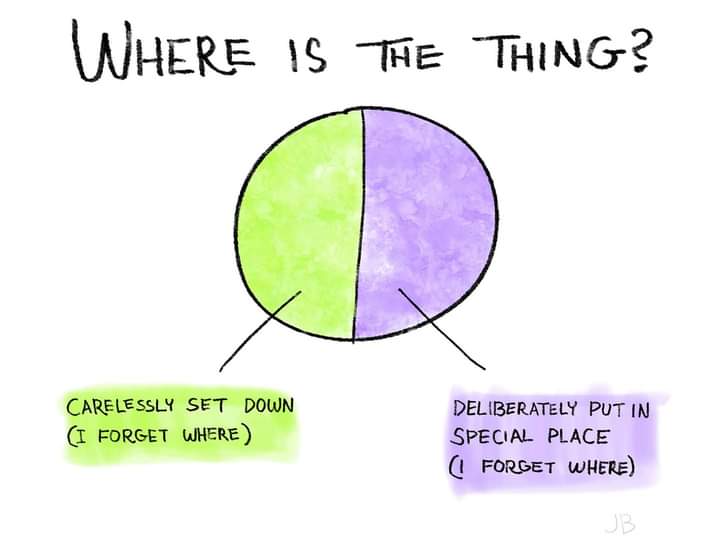
I know that I should not feel guilty about the disappearance of the necklace but I do. I suppose it is the care partner, the 50 years of marriage partner, the help mate, the one who panics most when she falls, the one who is not losing their memory – in me. I feel like I have let her down. I have made it my job to keep track of her stuff and mine.
Tony! Don’t be a phony. Help us out her. THE NECKLACE IS GONE.
Carpe the St. Anthony Diem.
the necklace is BACK!
Update: The necklace is back. It was recovered from the chair she is sitting on. Moral of the story – Don’t make the disease harder than it is. Sometimes stuff just falls in the crack between the cushion and the arm of a chair. (Sorry Tony. You are not a phony.)
No matter how slight in the daylight hours her dementia which is characterized by memory loss, confusion, inability to understand implied ideas (The garbage is getting full vs. Take out the garbage.), following instructions (recipes), calendar time even when displayed (Monday, October 10, 2022 at the top of the newspaper) and random association of objects (old birthday cards paper clipped to new magazines), it seems to affect every minute of every waking moment of her life. I struggle to keep her informed about what is happening or going to happen soon. It is stressful to remember my stuff and her stuff too.
Today’s topic which started at 4:20 AM this morning was a problem with the computer. Which computer I do not know but I assume it is the on in her office. It was stuck working on some background process and that was clogging up the workflow. If I had to guess it was some Norton Defender thing going on tying up resources. She has a Windows 7 operating system and takes very little to befuddle the processor. None of this happened by the way. It was all a dream that popped her out of bed at 4:20 AM. It popped me out of bed too.
After a little discussion and a trip to the toilet, I got her back to bed and I made a pseudo-check on the computer and reported to her that it would be okay in the morning. It was running a background cleanup process. She should get some more sleep and wait.
When these episodes happen in the middle of the night, I worry about her vivid dreams. She called it a nightmare probably because in her dream she had to get something done quickly. The computer was not cooperating. Lately she has had several discussions about work projects for the church and as memories about her working career. Navigating the discussion is tricky when I point out that she no longer works beyond our little condo. What few little officey jobs she did for the parish evaporated with the do over of the parish hierarchy when the Catholic Church in our area discovered they had too many buildings and not enough people.
A lot of old files and booklets still exist in her office. Lately I have been closing the door to her office at night and reporting to her that it will keep the kiddos out of her area overnight. She usually says, “Good. Thanks.”
I did not speak about the computer although I did point out that she was sleeping pretty soundly when I woke her at 9 AM and she remarked that yes she did not get up at all overnight. (She truly was dreaming when I talked to her at 4:20 AM.) I affirmed her comment and helped her get up. I did not mention 4:20 AM. (Am I harping on 4:20 AM? Yep.)
After she ate her cereal and as I was passing through the coffee pot one more time, she remarked that she hoped the computer was okay. I did not expound on that but suggested she should check later when she had a chance. She did and reported all was well.














 Adjunct_Wizard