My search for grace and meaning after a former care partnering life with a wife who suffered from Parkinson's disease and dementia giving her a confused and disorienting world.
There is lots of discussion about apathy and Parkinson. This morning I decided that Parkinson merely enabled Cheryl’s brain with a different sense of urgency or importance. Perhaps I needed to embrace that.
Last night as I coaxed her to bed her impostor syndrome was strong. We drove around for a few minutes and looked at the Christmas decorations while we “drove home”. It usually works and she thinks she is home. It did not work completely that night but she seemed to accept the fact that she was very tired and needed to rest. She went to bed with pajamas on the bottom and her normal daytime shirt on the top (just in case).
In the morning she slept late. When I woke her and got her going I pointed out that she had about two hours until her exercise class started, so she had to move it along unless she did not want to go. She refused to be speeded up and responded that I have been late before. She thinks exercise is important and wants to do it and enjoys it once she gets started. I know that it helps her too. But my sense of urgency and lateness is much different than hers.
I shifted my schedule to agree with her parkie time. My urgency evaporated along with my stress associated with getting her moving.
With this ring I thee wed. It was a long time ago and I do not remember the actual wording of our vows as I slid the wedding band on her finger. Lately she has the delusion that her wedding band belonged to her deceased sister Janice and was give given to her by her mother for safe keeping. Last evening she told me that she wanted to give it to her sister’s granddaughter.
Stories and delusional narratives like this that she makes up out of whole cloth disturb me. And, at the same time, they are very interesting to me. They are a kind of window into her confused mind.
In the past few months, Janice, is on her mind a lot. She talks to her in her sleep. She talks to her in her head during the day. She will find an old photo of Eric or Kevin and remember Jan. At night if I awaken her when I visit the bathroom, she might say, “Jan, what’s going on?”
She mixes up her sister Nancy with Janice. Nancy was very close to Janice in life. That thought mingles the two sisters in her current mind.
Occasionally she will say to me, I should call Jan and see how she is doing but I don’t know her number so I’ll call Mom first. With people dealing with dementia and confusion the experts say to go with the conversation and accept what the delusion may be at the moment. I do mostly but I avoid promotion or continuation of a mistruth. I respond with, “Think about Jan for a minute” and she will say, “oh, yeah she’s gone isn’t she?” To which I respond yes, she is but you can still talk to her in your head. You can say Hi to your Mom too. (I always worry that it will make her sad. It does not seem to do that. She seems calm with the fact that she remembers her mother and sister’s passing.)
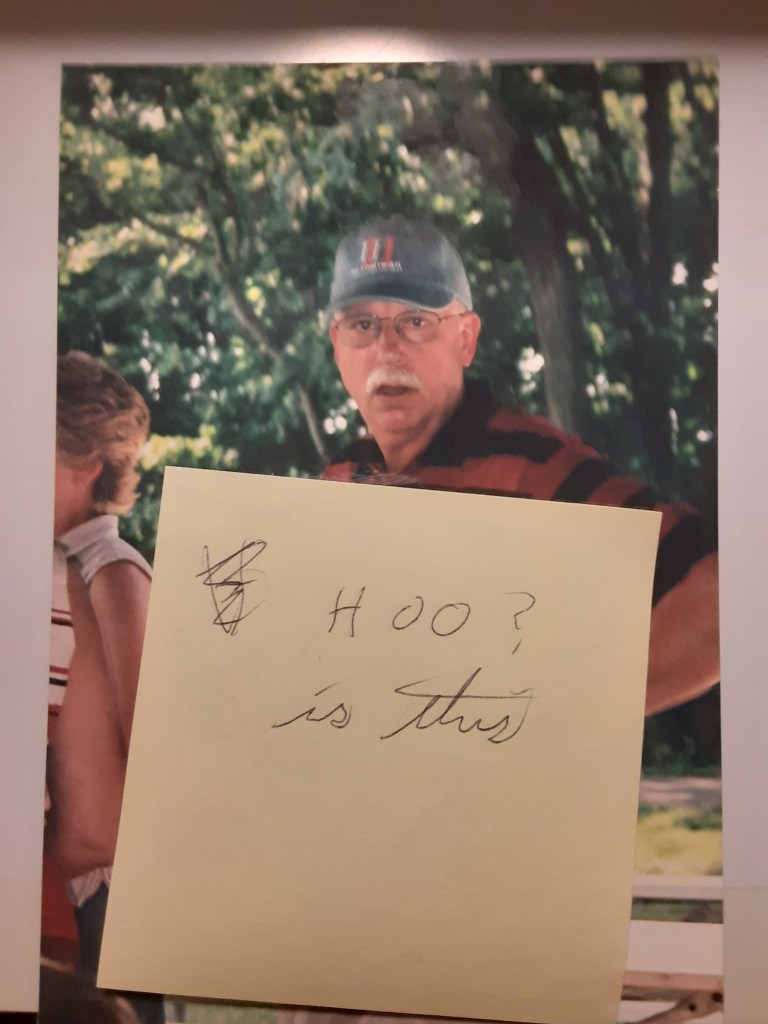
She brought me this photograph last night that she had found in her office. Her little note “Hoo? is this” made me chuckle. I still have that Hilton Head hat and occasionally wear it in the summertime. That is her shoulder off the left of her posty note. I have a gray mustache but Cheryl’s hair is still brown. I put it on my desk to look at and remind me where we are on this road.
I have no idea who took the picture. the print date on the back is June of 2006, so, it is pre-parkinson and his damned disease.
After we had been married twenty-five years we gave each other new wedding bands to commemorate the occasion. The inscription reads Cheryl to Paul 8-29-70/95 on mine. (This is so I would not forget our wedding date. We met on the 30th of August, so, I always have had a little mental confusion about the date.) Twenty-five years down the road her fingers were more robust as were mine.
Our 25th commemorative bands are larger. About a year ago she complained that her wedding band would simply fall off her finger and she wanted to get a chain to put it on to wear around her neck like a necklace. I took her to the jeweler and we found a chain. She later discovered her original wedding band and found that it fit again after losing Parkinson weight. She has been wearing it for many months.
In the past couple days she believes it to be Jan’s wedding ring.
It occurred to me this morning (early afternoon) as I was cleaning up the breakfast dishes that often we want our friends, lovers, significant others to be on our schedule. This is especially true if they rely on us for help. Cheryl has not been on my schedule for a long time. She is on parkie time.
Her dementia seems to have added a special aspect to her conception of time and place. Following instructions in a linear fashion is very hard for her to do. Even if you are not interested in doing what she has decided that she wants to do, it is simply easier to go along. It is actually able to steer the activity if you plan a little bit.
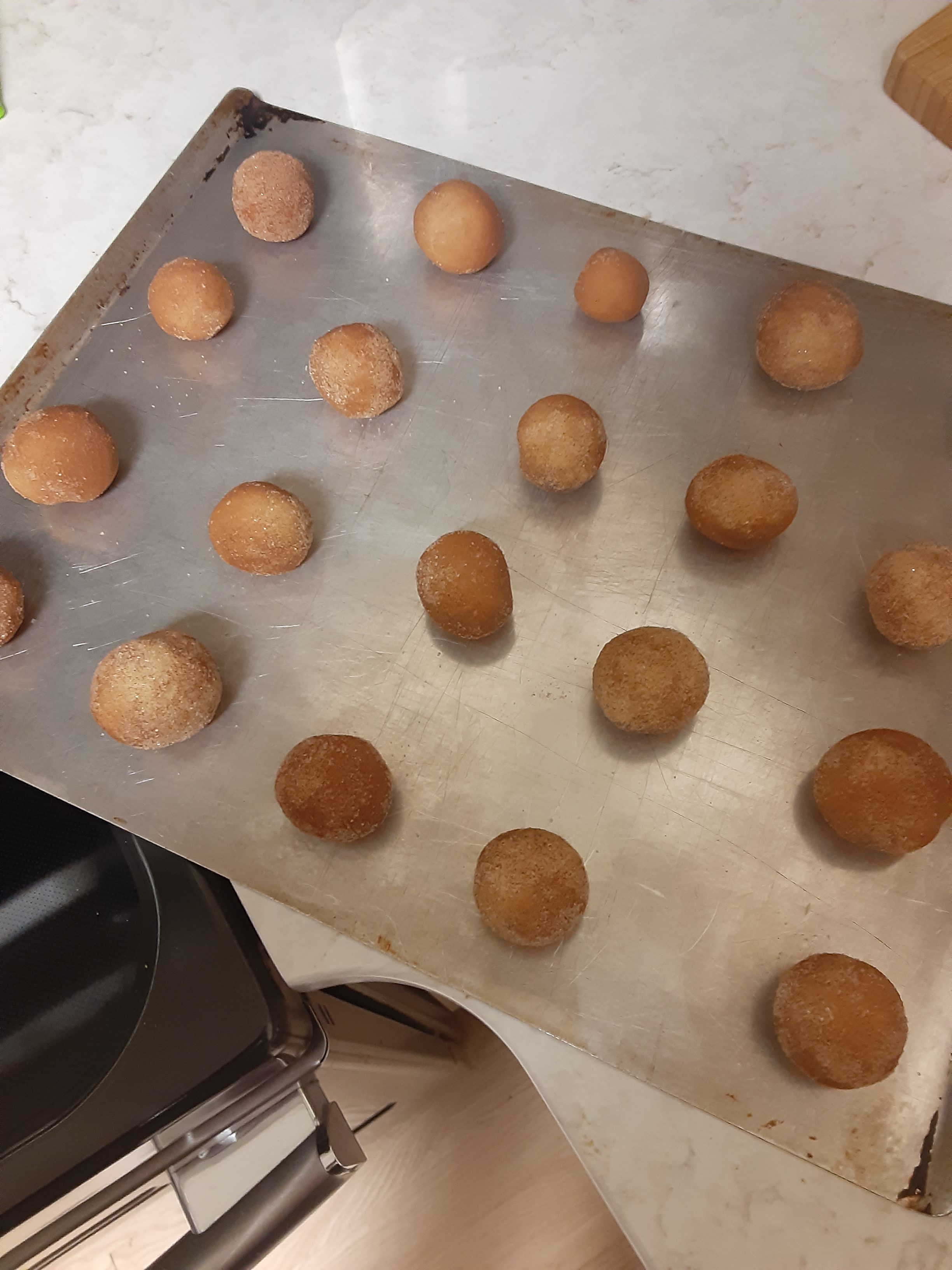
There are three things on Cheryl’s agenda for today; Christmas cards, snicker doodle cookies and a list of complaints for the doctor when we see him next week. For me it is merely laundry day. (But these are all things I will do in some part.)
I got up on my typical schedule at about 7:15 am or so. I figured out the Wordle but used up all of my guesses and got a “whew” for my effort. The morning news was not keeping my attention so I printed the address labels for the Christmas cards and placed them in a prominent spot on the dining room table. I made a boo-boo. More about this later.
At 9 am or so I finally encouraged Cheryl to get out of bed. She had gone to bed at 10 pm but I could hear her moving around while I was learning how to align the address information with the Avery labels that I had selected earlier in the day. I came to bed about 11:30 pm. She was up once after that.
Even though I was making every attempt I could think of without a direct command to get her interested in making the cookies, nothing happened. I gave in and finished the cookies.
The labels however was a businesslike activity and she selected that. All was well until she became confused. I had duplicated a page of the labels when I printed them. UGH! The silver-lining was that she recognized the error. She merely did not know how to react to it. (sad face here) In an earlier life she would have said, “Hey you duplicated a page we need to print the missing page.” (She might have added “dummy” as a tease.)
She discovered this just as I was leaving to take a walk and Cindy had come to sit with her. I took the offending page out of the rotation and suggested that she continue with the rest while I took my walk. While I was gone she just stopped. She was unable to continue. It did not occur to her that she could do the page of labels that was unduplicated. And my suggestion that she do that did not register in her mind.
Later in the afternoon I stayed nearby and repeatedly showed her what to do. She finished one more sheet of labels. We have only thirty to go. Last evening I wrote a small newsy letter to put inside of the cards. I had the cards and envelopes pre-printed with our names and return address.
You do not know when you will learn something important. This seems especially true when care partnering with a dementia patient. Once in awhile I get a glimpse of how much Cheryl is struggling with her surroundings and may or may not understand what is happening around her.
Her friend Cathy came to visit her yesterday. They sat and talked about various topics. I left for a bit to do some grocery shopping and pick up a book from the library. When I returned we all chatted for a little bit as I finished cooking some goetta and packaging it for consumption later.
Cheryl experiences something called Capras syndrome. I only learned the name for what she seemed to be doing a few days ago. Knowing the name for something is not reassuring. My engineer head wants to know how to fix it.
A person with Capgras syndrome irrationally believes that someone they know has been replaced by an imposter. In some cases, they may also believe pets or even inanimate objects are imposters.
Usually this occurs late in the evening and she does not know who I am. Sometimes though she does not know where she is and has a strong sense of being in the wrong place. Yesterday when Cathy left she was unsure of the ending and as the afternoon went on she expressed the thought that she did not like staying in someone else’s house when they were not there. She thought we were at Cathy’s house. I did not catch on to her confusion until much later in the evening.
Finishing– Just as you prepared to start a visit and conversation, so you must think about how you will bring it to a close. If you are leaving the person’s home, make sure you say goodbye. You should not leave the person thinking you are still in their home, perhaps in another room. This may cause confusion or anxiety.
Ensure you have their attention, smile, and let them know you enjoyed your time together and the conversation. Shaking their hand or touching them is a common gesture which gives them a strong clue you are leaving. Leave them reassured and let them know you look forward to talking again. If you are likely to be speaking to them very soon, for example later that day, say when you will return and leave a note close by indicating when the next visit will be.
I do not do this as well as I probably should this many times a day. Sometimes she will come to look for me.
(For visits and visitors) When you are leaving the our home, make sure you say goodbye. Cheryl may think that you are still here, perhaps in another room. This may cause confusion or anxiety later. Ensure you have her attention, smile, and let her know you enjoyed your time together and the conversation. Shaking her hand or hugging her is a common gesture which gives her a strong clue you are leaving. Leave her reassured and let her know you look forward to talking again. She may want to accompany you to the outside door in our lobby area and check for mail.
Touch someone. How simple of a gesture. How much she is reassured.
This is a term associated with the Friday after Thanksgiving Day. (2022) We had been at Anna’s house. Anna hosted. Almost everyone was there. Cheryl sat at the end of the table near Anna. Anna read a wonderful prayer. I sat at the other end of the table near Scott and Gavin. A great meal surrounded by family was enjoyed by everyone.
Today – black Friday – Cheryl was a little down this morning after breakfast. She talked about not understanding what was going on about her yesterday.
She did not remember that she had forgotten being there last night as we went to bed and I talked about the meal and conversation at Anna’s house. — Last night as she was crawling into bed she asked about going to Anna’s house for Thanksgiving dinner. Without thinking I responded with we were there all afternoon. Do you not remember having dinner at Anna’s? Luke had really long hair. She became upset. She could not find that memory and it seemed that for a moment it terrified her. (I knew immediately I had made a terrible mistake of assuming she knew.)
She talked about “losing her mind” this morning. She talked about her granddaughters who were sitting all around her not understanding the surroundings. We had another moment were we sat for a minute to recognize the changes in her memory and cognition. (I am losing her more and more and she recognizes that and it makes us both sad.)
Thank you Lord for the moments we both still have. Even if we cannot remember.
Communicative processes used to discover what is needed or desired by others in business or other walks of life work well with loved ones experiencing dementia and related memory issues. And while the single most important concept to remember is that short term memory loss affects every conversation, short term memory loss greatly affects attention span. Keep it short, keep it kind and keep it simple.
Here are some tips from an article in Psychology Today’ website:
Consider the timing and mood of your recipient.
Check your own emotional level.
Be responsible for delivering clear communication.
Consider using I-messages to avoid blaming or putting others on the defensive.
Be a good listener (attentive) when receiving a communication.
And here are more from the Social Care Institute for Excellence website in UK:
Their focus is providing professional care to Alzheimer’s patients and those dealing with other sources of dementia. Their techniques are good to understand for non-professional care givers. I use this list to think about and discern how better to help Cheryl.
Minimize background noise
Relax
Think about how the person may be feeling
Always introduce yourself
Greetings or ‘verbal handshake’
Physical approach
Be aware of emotions and touch
Identify the emotional state of the response
Don’t be shy from tears or laughter
Say what you think the other feels
Keep it simple
Use the person’s name often
Use visual aids and prompts
Confirm understanding
Minimize background noise – I have noticed that Cheryl is easily distracted by almost anything that passes into her line of sight. I have noticed that Cheryl is unable to do two things simultaneously such as talk to someone and keep walking. I have noticed that Cheryl is unable to follow a conversation if two people talk animatedly about some topic in rapid succession or over the top of each other. I have noticed that Cheryl is unable to interpret words spoken with a different lilt or accent other than Midwest Cincinnati. I have noticed that she no longer watches any of her favorite shows on TV. With all of this considered if I want to gain her full attention, I remove all distractions.
Relax – I struggle with relaxing and letting go for a bit if she is out of my sight. As her disease progresses and I see her falter with balance issues, stumbling gait and postural difficulties, my anxiety about her future (and mine) often comes through in my voice. I may say things or express opinions that can easily interpreted as rude, pedantic and egotistical. For those times I apologize to her and you.
Think about how the person may be feeling – I do not do this enough. It is easy from the outside to forget that the person is not the disease. Parkinson seems to make this harder because in one moment she will be “fine” and in the next she will be “off” – not necessarily physically off, mentally off and physically fine. I find this confusing and my default is not “she’s confused – help her”. My default tends toward preachy pedantic lecture.
Always introduce yourself – Most of the time I do not need to do this. I can understand that it may be important for a professional to do this. Occasionally Cheryl is unsure of who I am. Mostly this occurs in the evening if she experiencing a bit of Sundowning. (Sometimes I am “that guy who brings the pills”) Sometimes I tell who I am if I think she will accept it. Sometimes I leave it alone. The important thing is to not be insistent that she is wrong about who I am.
Physical approach – I have noticed that Cheryl startles much more easily than she did before Parkinson (bP). This comes in many forms visually and audibly but the important thing is to not surprise her. Surprises often lead to backing up and falling down which is her usual method of falling. She will move away suddenly from the perceived surprise.
Be aware of emotions and touch; identify the emotional state of the response; do not be shy of tears or laughter – I think these fit together as emotional response to conversation. Sometimes to me it is surprising that she will have tears about telling you that Laurencia is going to Ohio State University. I can understand that talking about her deceased mother will cause tears. Nevertheless it is important to understand that a person suffering with Parkinson may have her emotions very close to the surface. Try to remain calm but it is okay to “have a moment” and be with her. One memory often elicits another more tender memory and things tumble downhill quickly.
Keep it simple; use the person’s name often or the other person’s name if telling a story; use visual aids and prompts – pictures of children; confirm understanding – I have noticed that Cheryl may lose the thread of any story or conversation easily. She will not indicate in any way that she has lost track of what you are telling her. You may detect that she has lost it by some response that she makes. Simply reiterate some part of the story to help her recall. Do not get bogged down in correcting her mistaken thinking. Do not raise your voice to emphasize the correct story, time of day, holidays coming up, time of the year or who is coming to dinner. She will not remember but she will think that you are frustrated, angry or disappointed and respond with – I’m sorry.
Finishing– Just as you prepared to start a visit and conversation, so you must think about how you will bring it to a close. I do this many times a day. (For visits) When you are leaving the our home, make sure you say goodbye. Cheryl may think that you are still here, perhaps in another room. This may cause confusion or anxiety later. Ensure you have her attention, smile, and let her know you enjoyed your time together and the conversation. Shaking her hand or hugging her is a common gesture which gives her a strong clue you are leaving. Leave her reassured and let her know you look forward to talking again.
I spend a lot of time reading articles and searching for useful ideas to help Cheryl. This post is a sort of summary of two of those and how I think I can better communicate with her.
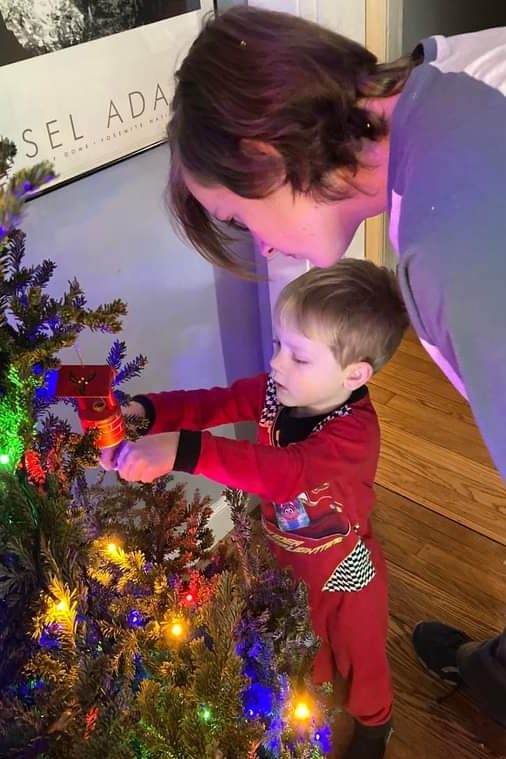
I gave in yesterday as it slowly dawned on me that the tree decoration activity was becoming an overwhelming task for Cheryl. It was her idea and has been for a couple of weeks. “We have to get the Christmas tree up, Easter will be here next week” she told me one day. I had resisted but I thought – who cares? I got the boxed tree out of the garage and put it up. I got the tubs of decorations out and parked them on the dining room table for the next couple weeks. We maneuvered around them. Once in a while she would put up a ornament or two. Many of these are one the dining room ceiling fixture because it was near to the tub on the table.
I have to admit it makes me smile.
Yesterday I had little to do while I was waiting for the laundry to get finished, so, I put up the rest of the tree decorations on the tree. I put the empty tub back in the garage with a small sigh. And the last glass ornament on the ceiling fixture over the table. Our house says Christmas now.
The tree went up today. Perhaps a bit early but hey, according to Cheryl Easter is in a couple days. We have to get ready. Some ornaments are placed in a special circumstance like a lamp or the chandelier that in the picture below. The twelve days of Christmas garland was placed on the china cabinet. That is a new position this year. Much like the trip to the shoe store it is an overwhelming task.
The dementia and associated cognitive decline keeps her from maintaining any focus for more than a few minutes. It also adds a twist of spontaneous creativity. We have had this floor lamp for years. today she said, How can I hang these on the pull chains?
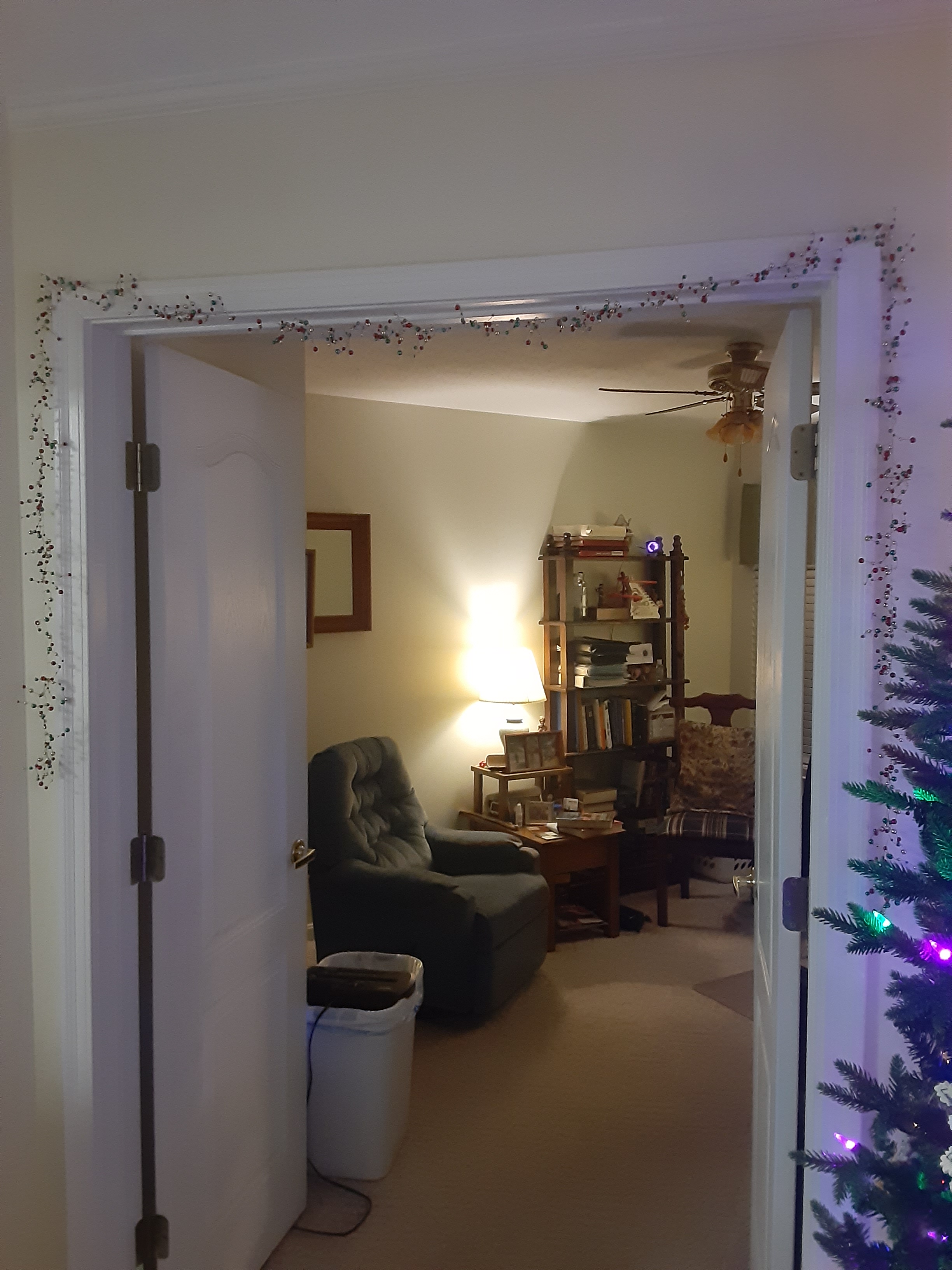
Some ornaments were hung on it with care. The beaded garland went over the door to my hideout. There are more to come sometime. Late night punding has commingled with hanging ornaments. Sometimes the ornaments are viewed and reviewed and replaced in their storage container. So far the tree has captured about seven ornaments.
Not bad for three hours of activity. It can be dumfungling to her. (Use a new word often and it becomes yours.)
In her blog, Cheryl Hughes, writes that many times it is better to “just let go”. She spent many years as care partner for her husband.
I have decided to do that in many ways. If I decide that we are having salad for dinner, I buy a bag of salad. Salad kits are available. It is way easier than chopping stuff. And there is enough for four typically so if you want lunch the next day you are good.
It can cost a little more but what is the harm in embracing the changes as a care partner. My Cheryl believes that Christmas is any minute now. Until a week or so ago I was resistant and felt the need to correct her thinking. What ever for? Why generate artificial stress? She will not remember being incorrect, she only remember that I think her to be wrong when she is certain that she is correct. I could embrace the fact that Christmas is next week and we should put up the decorations.
We got a catalog from Amazon which is unusual by itself but it has kid’s toys in it. I cynically remarked sometime ago about getting Raggedy Ann for our daughter and Anna chided me with – I am totally okay with Raggedy Ann! It could be fun. Between decorating actions my Cheryl searches through several cookie options in the Cheryl’s cookies catalog (too many Cheryl’s in this story) and looks for the perfect Christmas cards in the Printery catalog. Sometimes she is telling me about cards, sometimes cookies. What could be the best one or two? Of each?
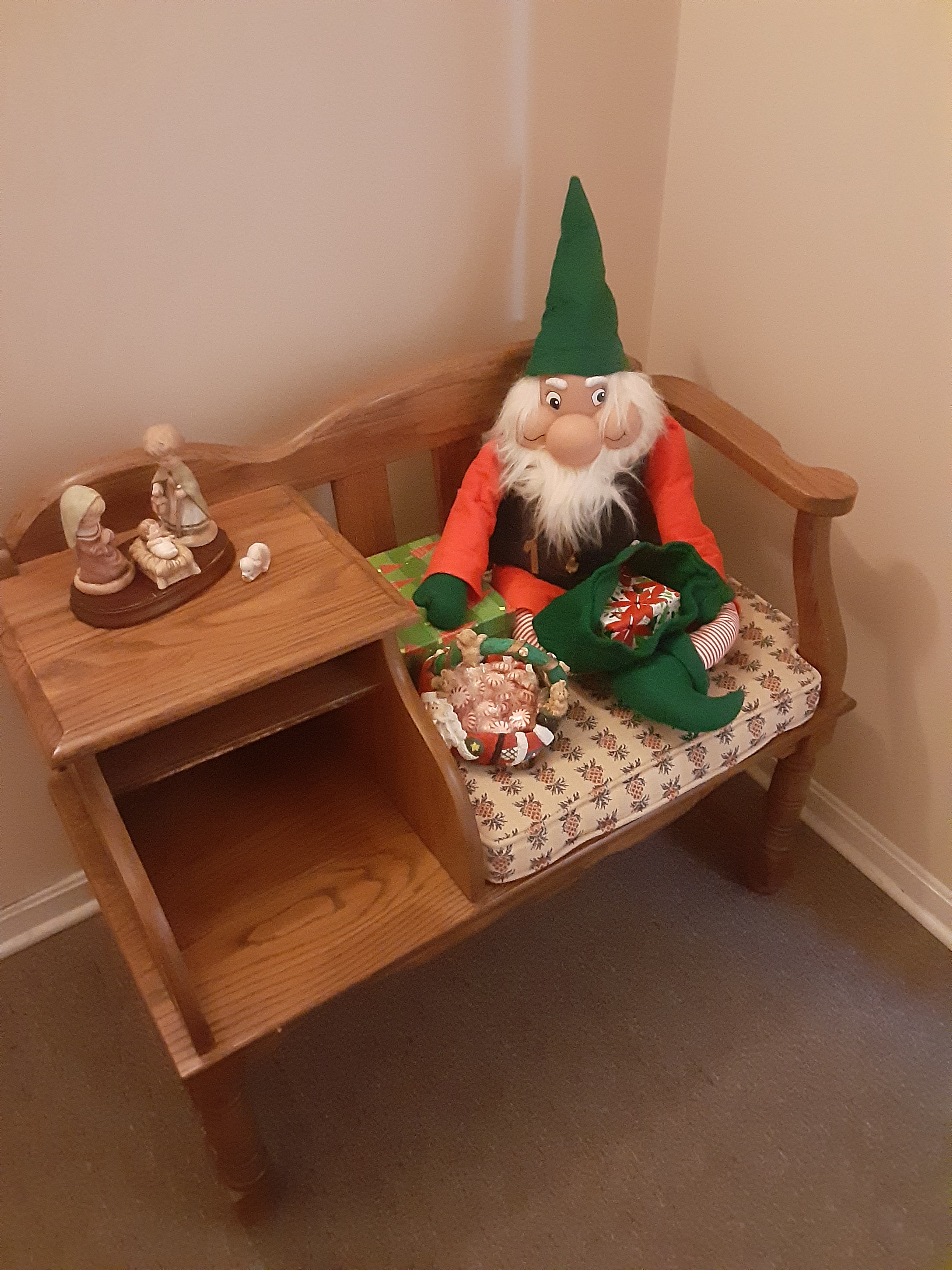
The Christmas elf is sitting in the chair ready to help Santa. HO HO HO is on the front door. The little wooden Santa is falling off the closet door. Knitted Santa is on the clock. The inside of the front and side doors are decorated so that Santa cannot get in without being noticed. The decorations are moving along nicely.
Eddie bear always gets booted from his seat next to the telephone. He lost his telephone long ago. He seems to be okay with the rocker and he has a place to hang his elf hat.
Anna makes me smile as I think about it and she is right. It could be fun to shop for gifts for the kids and grandkids. Perhaps I should embrace it. What difference is it if Christmas is a months long event? So I told myself a few days ago that we would go for it.
Now that the decision is made, we should be shopping for the kids.
We need to find sizes or which toys suit which kid best. Laurencia likes puzzles and building things. Virginia is crafty and plays trumpet. Vinny likes Lego kits. Gavin is into online gaming. Regan is off to college next year. Audrey is a dancer. Ellie? Dillon? Luke delivers pizza but his passion is photographic art. Lots to think about. Have I forgot anyone? I have got to find Raggedy Ann for Anna. Yep, lots to think about.
Cheryl has powerful childhood memories about the holiday season. There were many good times, parties, family gatherings and fun. Perhaps it is time to make some new ones.
In the morning after she has had her meds and has had something to eat and has been up for a little bit, she seems like her old self for awhile. It’s different on different days but this day she is like her old self for an hour or two.
It is interesting and calming to me when it happens. We have little teasers in the morning. I ask her if she wants coffee. She says no. I don’t drink coffee. She used to drink tea but she has not for several months, maybe a couple years. But I always ask her still.
When we were still working for someone else it is how we started our day. She never drank coffee in any form. It was how I got through college and everyday since. I stopped using sugar in about 1974 or so as a protest against the sugar industry. I am able to remember when sugar was ten cents for a five pound bag. I have not seen five pound bags in our little IGA for some time.
Cheryl always drank tea. I have some year-old tea bags in the pantry. Occasionally I will drink tea. Iced tea in the summer is pretty good. Dad used to drink iced tea. I think that I drink iced tea in his memory.
These days Cheryl drinks orange juice with breakfast whatever breakfast may be. Nothing else is satisfactory for breakfast. No milk, no coffee, no tea only orange juice satisfies.
In the evening and on this particular evening she wants to go home. She seems to understand that she is home and somehow not home as I explain why all her pictures, papers and clothes are here. She will say, yes but I want to go home. My heart sinks when she says this. It used to make me panicky. There is no answer. I explain that we are home already and we will sleep here. If she wants we can go home tomorrow. That is okay with her but sometimes we have to call her sister to tell her where we are overnight.
In the morning she had been so much like her old self. In the evening she is different, unsure of where we are, uncertain of who I am, and wants to go home. The ups and downs and general upheaval in the same twelve hours or so of wakefulness is remarkable. Parkinson is scary stuff. (Some would say “shit” but I will not.)
…And whether or not it is clear to you, no doubt the universe is unfolding as it should. Therefore be at peace with God, whatever you conceive Him to be. And whatever your labors and aspirations, in the noisy confusion of life, keep peace in your soul. With all its sham, drudgery and broken dreams, it is still a beautiful world. Be cheerful. Strive to be happy.






















 Adjunct_Wizard