Little Incremental Changes

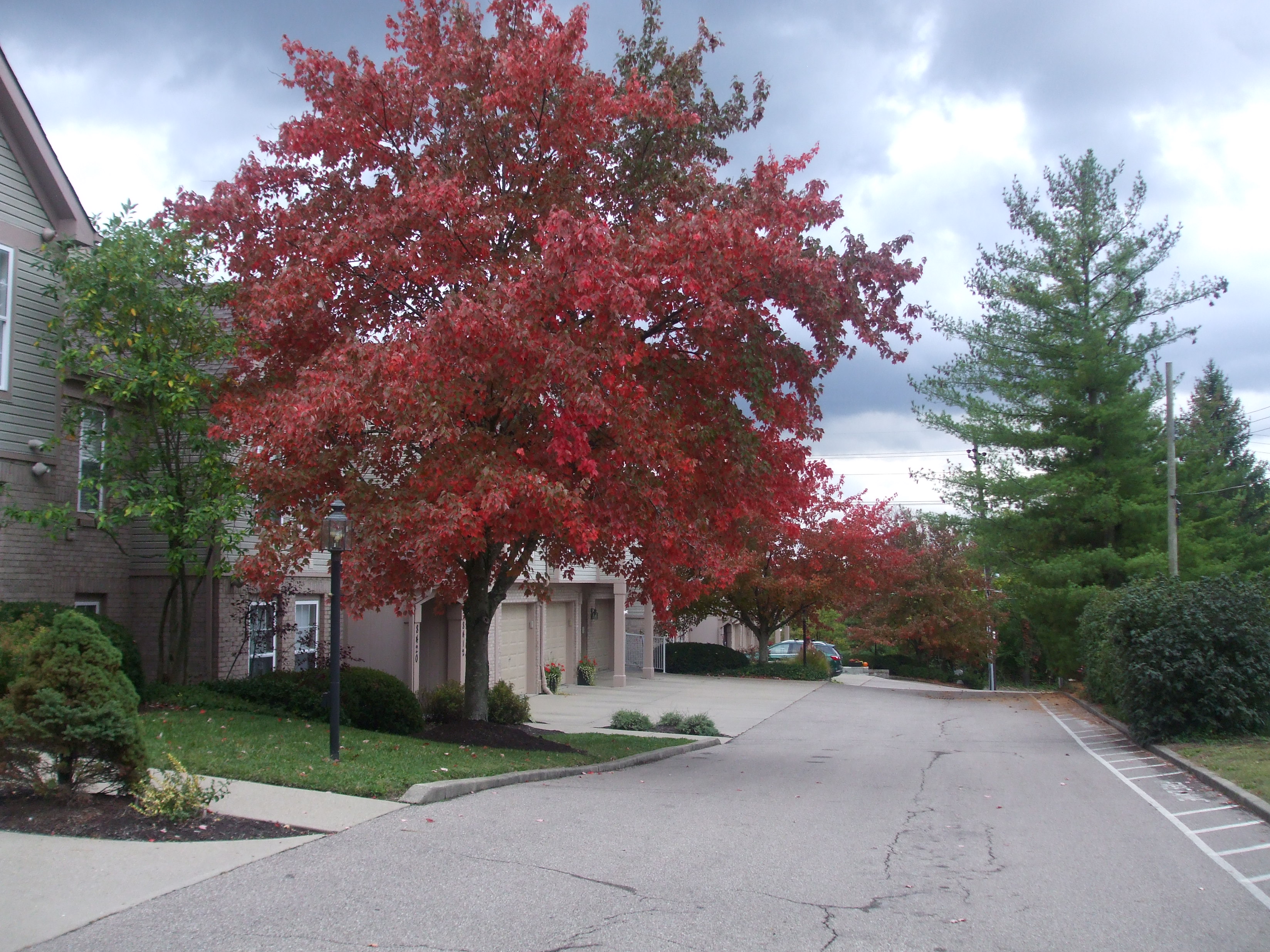
This morning I am thinking about the little incremental changes this disease of Parkinson caused in Cheryl. The trees in these pictures are maples and they are turning with the season. It is not apparent in the big picture as they show below but zoom in and each individual leaf has a tinge of red around the edge of the leaf. The green still remains in the core of the leaf. Little incremental changes as the leaf begins to shutdown for the season.

Tonight and on days since I started this essay, I am thinking about the little incremental changes this disease of Parkinson that has invaded the person I most want to be with, the person where I am home, has caused in me. Our green area is smaller. And yet at the same time it is still green.

It is my goal to talk to her on a level that is her. Sometimes her behavioral response to some situation can appear childish to me. It has only recently come to me that I must ignore that perception and talk to her as I once did. Almost every morning when I wake her she will ask, “Can we still get to church?” or “What time is church?” I used to respond with, “There is no church today.” Sometime in the past I decided that response was unhelpful. These days when she asks me about church I take that to mean, “What is on the agenda for today?” She has little memory of what we may have discussed doing on the previous evening when we went to bed.

Aphasia appears often. When she is telling a story it is very important to her to get the names dates and places correct, even if she is way off the mark. Her mother is no longer on this Earth nor is her sister Janice. Cheryl tells stories about them or visiting with them in the present tense. Once in awhile I might tell her that her mom is in heaven. She will respond, “Are you sure?” That question reminds me that it is unimportant to correct her perceptions. I have a difficult time resisting the natural male response of – bullshit that is not the way it is.

It appears to me – just observation – that although she can read, the words are mostly meaningless. It the morning over breakfast we look at the newspapers. For me that is the Wall Street Journal. For her that is the Cincinnati Enquirer. I have two observations; She does not recognize that they are two different papers. She is unable to comment on articles that she may be looking at in the paper. (I have asked.) The particular article might be about some city council fiasco. She will tell a story about Sr. Janet and what the newspaper tells Cheryl about her job with the parish office.

I know there is some green still left in the middle.

I am thinking about how it has changed my focus. I used to worry about how late she slept in the morning. The why of that worry always comes back to how much sleep I will get that night. Those two ideas are connected only in my mind. They are not connected in practice.

It changes my perspective. There is a bigger picture. Just like these trees on our property, when one zooms in one sees the differences in the leaves but when one zooms out one sees beauty.

It changes my interest. What can I do to enable her to reminisce even if her memory is weak? Perhaps I can aid her reminiscence. Comment about her stories to get her to tell me more.

It changes my observation of the universe. There is beauty everywhere you look. Cheryl is always telling me about the moon when we are driving somewhere. I look too. She can see the moon in the clouds. So can I if I look carefully and listen to where she says she sees it. A shape in the clouds looks to her like the moon. I long to see through her eyes.

Maybe I could read to her rather than watching her struggle to understand printed words.

Carpe Diem.

It is Important to Listen

Research study questions are I opening (I know you think eye opening) but I meant I as in me. Before the pandemic pandemonium Cheryl agreed to participate in a longitudinal study on Parkinson’s disease.

There is an initial evaluation of mobility and mental agility. There is a blood test, urine test and stool sample test.

Much of the mental agility data collection effort is question and answer style. Several different instruments are used, one of which is the Beck Depression Inventory. As Cynthia (study tester) asked Cheryl the questions and marked her answers, Cheryl began to cry. Cynthia decided to skip the test. She did the same thing with the MOCA test. Cheryl could not draw a clock last time she took it.

As Cheryl was using the restroom I remarked to Cynthia that this might be the last time that Cheryl would be able to come and participate in Dr. Espay’s study. It was not that I thought she did not want to, rather, her mind is gone to the point that she may be of no help to them. Perhaps I should not impose on Cheryl’s desire to help others. A year from now she probably will not remember this visit.

The Beck instrument starts with questions such as:

1.
0 I do not feel sad.
1 I feel sad
2 I am sad all the time and I can’t snap out of it.
3 I am so sad and unhappy that I can’t stand it.
2.
0 I am not particularly discouraged about the future.
1 I feel discouraged about the future.
2 I feel I have nothing to look forward to.
3 I feel the future is hopeless and that things cannot improve.

… etc.

Cheryl teared up on question 2. In each question the participant selects the answer that they feel at the time. At the end a score is computed that evaluates the participant’s depression. Cheryl’s emotional level was strong on the second question and Cynthia stopped the instrument.

I had not realized how this disease was weighing on her emotions. As the disease progresses Cheryl needs more help physically. She relies more on me and others around her. She is very resistant to accept help from others constantly. She gave up driving long ago. A big part of her independence left her when she gave up driving.

It has proven to be a very emotional disease. Cheryl becomes angry with me when I help her “too much”. We have been together too long for me to ignore her needs. I help her anyway. She gets angry with me. I get angry with the disease and what it has stolen from us.

And then my heart melts.

Carpe Diem.

More on Parkie Time

There is lots of discussion about apathy and Parkinson. This morning I decided that Parkinson merely enabled Cheryl’s brain with a different sense of urgency or importance. Perhaps I needed to embrace that.

Last night as I coaxed her to bed her impostor syndrome was strong. We drove around for a few minutes and looked at the Christmas decorations while we “drove home”. It usually works and she thinks she is home. It did not work completely that night but she seemed to accept the fact that she was very tired and needed to rest. She went to bed with pajamas on the bottom and her normal daytime shirt on the top (just in case).

In the morning she slept late. When I woke her and got her going I pointed out that she had about two hours until her exercise class started, so she had to move it along unless she did not want to go. She refused to be speeded up and responded that I have been late before. She thinks exercise is important and wants to do it and enjoys it once she gets started. I know that it helps her too. But my sense of urgency and lateness is much different than hers.

I shifted my schedule to agree with her parkie time. My urgency evaporated along with my stress associated with getting her moving.

Small adjustments reduce stress

Carpe late Diem.

Memory Loss

Lately i have been reading Gwendy’s Final Task by Richard Chizmar and Stephen King. I became tired of violent crime novels and this book claims to be the final volume of a trilogy. Perfect I thought. Stephen can be wordy although I think he is a good story teller. And Maine is apparently a mess, Castle Rock anyway.

Gwendy the main character is losing her memory and is very aware of it. She maybe dealing with beginning Alzheimer’s or something like it. It is disturbing to her. I wonder if it is realistic to think that folks like Gwendy or Cheryl or others dealing with a chronic illness that destroys one memory are aware of it happening. It is a scary thing to Gwendy in the novel. She talks of how names just disappear from her head and the struggle she has to get the thought back.

There is a lot more to the story but Gwendy is actively hiding her memory issues. Initially she forgets names and her neurologist and psychiatrist doctor has taught her a little memory association technique that helps her through most situations. And Stephen King has a device in his story that works even better. I wish there was such a device for Cheryl. I wish the device did not require the ending that Stephen has worked out for Gwendy.

More and more I hunt for memory tricks to help her. It may be too late for many of those to be useful. Getting out of the car I repeat, “One hand on the door and one hand on the chair and you are out of there.” I have little knowledge of whether that’s working but more and more she reaches for the car door inner handle and puts her left hand on the seat back to propel herself up to a standing position. She often does not need me to repeat it.

Maybe that is helpful. Repetition and repeated talking about what to do makes a new connection in her brain. I often repeat the ABC song in my head to find alphabetical order. The sing-song about the months never stuck with me. So, the connection does not always happen.

Memory loss is discouraging to the care partner. Memory loss is mostly unknown to the parkie that has it. It shows up constantly. — Who put these papers here? Why is someone messing with my papers? Those little girls are always playing with my papers. I better put my papers in my office and close the door. Substitute any valid noun for papers. She puts on two pairs of socks because she forgot to take one pair off before putting a clean pair on.

It (memory loss) destroys any planning skills. The holiday season is next week we better start making cookies. I don’t know why they keep moving the months around. When I see the doctor next week I want to talk about my medicines. (It is a December appointment.) Sometimes anger appears because people keep changing things around.

Fortunately not all parkies experience this memory thing.

Carpe Diem.

More Things I have Learned

After a sleepless night and an early rising at 5:30 am I begin to doubt my great idea of buying a new bed so we could sleep better. The last couple of nights have been a build up to last night’s insomnia.

After that experience I notice a couple of things. We are both on edge. She is upset that I am angry that she could not sleep and wants to offer an explanation. I am only-one-cup-of-coffee cranky and unwilling to accept any explanation made up out of whole cloth. As the day continues we will ease up and move on as we recognize that we both are very tired.

Most nights the big new bed has made a huge difference in our sleep. Lately I have been letting her sleep in a bit because it seemed to me that she was very tired in the morning. The LOUD AND ANNOYING clock did not wake her up. I think that will change.

I Have Learned

  • Kindness returns after 2 mugs of black coffee
  • Cheeriness requires more coffee
  • Grumpy can last all day if you allow it to.
  • Maybe listen to the explanation while getting more coffee
  • Get her to take 7am meds and get breakfast
  • If she wants to make Christmas cookies, let her.
  • Her conversations will wander all over the place when she has slept poorly.

Carpe Diem.

An August Evening

Rainy days in August have produced sundowner’s confusion and dementia. On this particular day it seems a bit worse.

Cheryl has had a particularly busy week. Two physical therapy visits and an exercise class happened this week. On Monday evening our HOA board had a meeting to discuss maintenance schedules and what new projects we could take on with the money on hand. Jane came across the hall and sat with Cheryl on our back porch while I attended. (Jane is a wonderful neighbor.)

On anything goes pizza Tuesday we had dinner with our neighbor Jane as usual and in addition our new upstairs neighbor Joe joined us. Joe moved into the front condo over the garage spaces. Much of getting to know you conversation happened. Cheryl knew of a woman which she attended high school with who had the same last name. Her name was Kathy. As it turned out she was Joe’s younger sister. Jane’s husband used to play in several bands when he was still alive many years ago and Joe’s last name was familiar to her also. As the story developed it became apparent that her husband John had played in a band with Joe’s father.

It was a great getting-to-know-the-neighbor conversation. There were lots of memories for Joe and from Jane and Cheryl. When we got home Cheryl was exhausted.

Wednesday, I had arranged for my cousin-in-law, Linda, to come and take Cheryl to her physical therapy appointment. I went to visit the lab of a local community college program that I am still involved with. That facility is twenty minutes or so down the highway and I was gone for about two hours. We later met back up in a local diner for lunch.

Thursday it was my intention to attend a exercise-for-care-partners class at Parkinson Community Fitness after Cheryl’s twelve pm exercise class. I had previously arranged for my daughter to pick up her mom so that Cheryl would not have to stay. I found out my class was canceled at the last minute so when Anna showed up we all went to lunch. Our grandson Max was with his mom and he showed off his new laptop he purchased for college. He will start in a couple weeks.

I had hoped to ride my bike for a bit so Anna and Max remained with Cheryl. Alas, the weather did not cooperate. As I entered our condo Anna was helping her mom sort coins. These had been residing on the dining room table for several days but the project was several weeks old. Cheryl found them back in her office a few days ago. Cheryl told her daughter that when they were finished they would give the coins to her dad. She used to help her dad roll coins from his gas station business many years ago.

Max was frustrated with his new laptop. The camera no longer worked. What ensued afterward was a chat via the internet with some Microsoft expert and ultimately a complete reload of the operating system. That seemed extreme to me but I am an old retired electrical guy whose been fooling around with systems, software and computers for fifty years or so. We are living in a new age now. Ultimately it was discovered that Lenovo had placed a privacy slider to cover the camera on the upper edge of the case. It was a mechanical failure or an operational one depending on who is characterizing the action.

On Friday I was still hoping to ride my bike and the weather was still not cooperating. Cindy came anyway And I went to get a haircut and run a few other errands. I returned about an hour later.

This whole week was generally gray and overcast. It was not gloomy like the wintertime but gray and rainy nevertheless. It is still rainy and poopy outside as I write this.

The rest of the day was filled with visions and stories of her family. She was looking for Scott. Later in the evening she told me a story about Easter eggs, coloring them and Mavis. She eventually called our daughter-in-law Mavis to ask about what her objection was to coloring Easter eggs.

Earlier in the evening she asked, “Where is Ken?” I told her that Ken was probably home but I was not sure. She should call him and talk to him. She did not take that suggestion.

It was a frustrating afternoon and evening for me. Later I realized after she had exhausted herself with a very busy sundowner episode that for the first time this week only I was here with her and she could relax and let all that out.

As she laid in the bed she asked me to make sure the kids all got home okay. This morning she slept until 10 am.

Carpe Diem.

Old Married Couple

It occurs to me that old married couples have heard each other’s stories many times. Idle pleasantries between acquaintances and friends usually lead into a story about some past experience. It is harder to do with old married couples. They have heard the stories. Often they both participated. Aging and PD memory loss have changed our conversation about trips, children, childhood, food, children’s sports, many things.

I am a pretender often. She may forget who I am as she is talking. She may forget I was there; an hour ago, a week ago, a decade ago. I might forget I was there a decade ago. She wants to remind me of someone else from her childhood, someone I should know.

I work on my small talk with her because she will find a story from her childhood and it is calming to her to tell me the story.

As I think past all of that and how I can help and respond to Cheryl I still worry when she says to me, ” I’m ready to go home now.” She does this near bed time.

Lately she seems to merely mean that she is tired and wants to go to bed and rest.

Carpe Diem.

Apathy and Living

Has she apathy? As we move forward it seems to me that she cares less about day to day activities. She seems to recede into her own thoughts but not as a prevailing occupation. I think of it as apathy-not-quite. When she gets in this mode it’s often temporary.  She is tired from some activity.

Specifically activities like taking a shower,  getting cleaned up,   physical therapy sessions or exercise classes are obviously tiring for a PD sufferer. Something as easy as thinking about what is next seems to tire her out also. It like a temporary apathy.  Procrastination?

It starts with, ” I don’t think I can go to… exercise class, church, physical therapy…” Admittedly it takes a lot for anyone to be motivated to exercise. It was not a big part of our lives when we were younger. Neither of us were sports buffs. My main sport riding my bike. There is a solitude to doing that which I am unwilling to give up or share. As her care partner, it is frustrating for me that she cannot observe how much she is helped by exercise and her PT sessions. She seems to not remember. It seems like she is going merely because I am taking her there.

When Cheryl gets in this mode (mood?), I turn the corner to something else. I am resistant to letting her go on and isolate herself in her little office area thinking, punding and organizing. I take her out. Anywhere works as long as it is out of our condo.

Yesterday I took her one of our local county parks that we have not visited for a long time. Afterward we went for ice cream at a nearby Dairy Queen. I had planned to make dinner at home but she suggested we find barbecue somewhere. This being an odd suggestion because it seems to upset her stomach often and she says never again later in the evening. We did not find the barbecue place to be amenable to folks with mobility issues so we landed at one of our old favorites and ordered something different than we usually get so the newness was preserved. On the way home she thanked me for taking her to Lake Erie and she told me a story about when she was very young.

In the early days of her father running his own gas station which was a life long dream of his, he rarely took any vacation time. It seems one of his friends had a vacation cabin up near Lake Erie and not far from Port Clinton. There is a park nearby called East Harbor State Park. Our walk by the shore of a much smaller lake in the park much closer than Lake Erie must have taken her mentally back to her childhood and a very fond memory. We visited the same area a few years ago and visited East Harbor. She talked at length about the trip with her mom and dad. She thanked me for getting her there and back in the same day.

I started this writing and contemplating apathy, but maybe it’s projective (mine) apathy? Or predictive apathy? Or apathy is the wrong word? (indifference? passivity?) Or is it poor sleeping patterns? This morning she got up at quarter til ten which means that she was in bed for about eleven hours. She awakened this morning from the same position she fell into when she got in bed. On the previous evening she went to bed very late after midnight and slept very little. (As a result I slept little also.)

Is apathy and memory related? I wonder about ideas like this. Perhaps she cannot remember that she seemed to enjoy herself the last time we went there? Wherever there is.

When I finally teased Cheryl awake this morning, she opened her eyes and asked, “Is Mary Pat here?” An amusing opening question about the day. I smiled and told her, ” No Mary Pat is not here. I think you were dreaming about her.” I have no idea where the Mary Pat (a childhood and current) friend thought came from but she has talked to her a couple times over the past few weeks.

I encourage her to talk to her friends when she gets excited about some memory or misconceived thought. Many of them have had strange conversations with her about things. I used to be embarrassed for her and, at first, discouraged these phone calls which she often decides to do later in the evening. But as I thought about it I decided that it was not my place to absorb or accept or become embarrassed for her. Her friends know her state of mind. They are wonderful people and she is blessed to have them as life long friends.

Focus, cognitive abilities, caring, likes and dislikes are all related to memory issues. Staying active no matter how small that activity is helps.

Carpe Diem.

I Want to go Home

A recurring theme in Cheryl’s head is “when are we going home?” I try at first to answer this by saying that’s good because we are already there. This rarely works. Sometimes it merely makes her angry with me.

The conversation is confusing when we reach this point. I can say to her, okay put on some clothes and we will get some lunch and come home. So, how would you find clothes for you in a place where you did not live? This is the first confusion but she accepts the fact that she has all her clothes here without accepting the truth of “home”. Even I am confused.

Later today, she is dressing now, we will go find some lunch somewhere and come home again.

Physical therapy is on the schedule for later this afternoon. Hopefully she will be tired after this activity.

Carpe Diem.