My search for grace and meaning after a former care partnering life with a wife who suffered from Parkinson's disease and dementia giving her a confused and disorienting world.
This appeared from James Clear in his email newsletter.
It spoke to me. Deeply.
I do feel small when I allow Cheryl’s disease to become her. It boils over into anger and guilt. I forget often that she is not her disease.
She has been getting physical therapy to help her with movements like getting out of a chair. Sit to Stand is the notation on the PT’s notes. This motion is natural to non-PD people. One does not even think about the mechanics of it. Cheryl has to think and remember the sequence of moves. Depending on the time of day and how she is feeling, thinking and memory are difficult. So she simply cannot remember how to get out of a chair.
When she has fallen and when she falls it is always backwards. I encourage her to lean forward at her waist and push off the chair as the PT told her. Nose over toes is the mantra. But in view of anything, walker, table, person, nearby grab bar or whatever grip, grab and pull easily win over N-O-T. I encourage by telling her where to put her hands and how to position her body. She responds with don’t-tell-me-what-to-do anger. I respond in kind and then feel bad because I was to her unkind.
I love her dearly (big). I am annoyed with her disease (small) and I allow it to be her (smaller).
My personal reason for writing this is to hold that idea up in the light and discern how to be better next time. I am grateful for all the next times even though anger anxiety and anxiousness might creep back in. It is hard work and I am not that good at it.
It was early afternoon. It was about an hour after she had taken a dose of meds. She was standing at the kitchen sink. Her dyskinesia was noticeable. Her conversation was anxious.
She was worried about what was going to happen with the occupational therapist … I think. I tried to convince her to sit and rest for a bit until we had to go there.
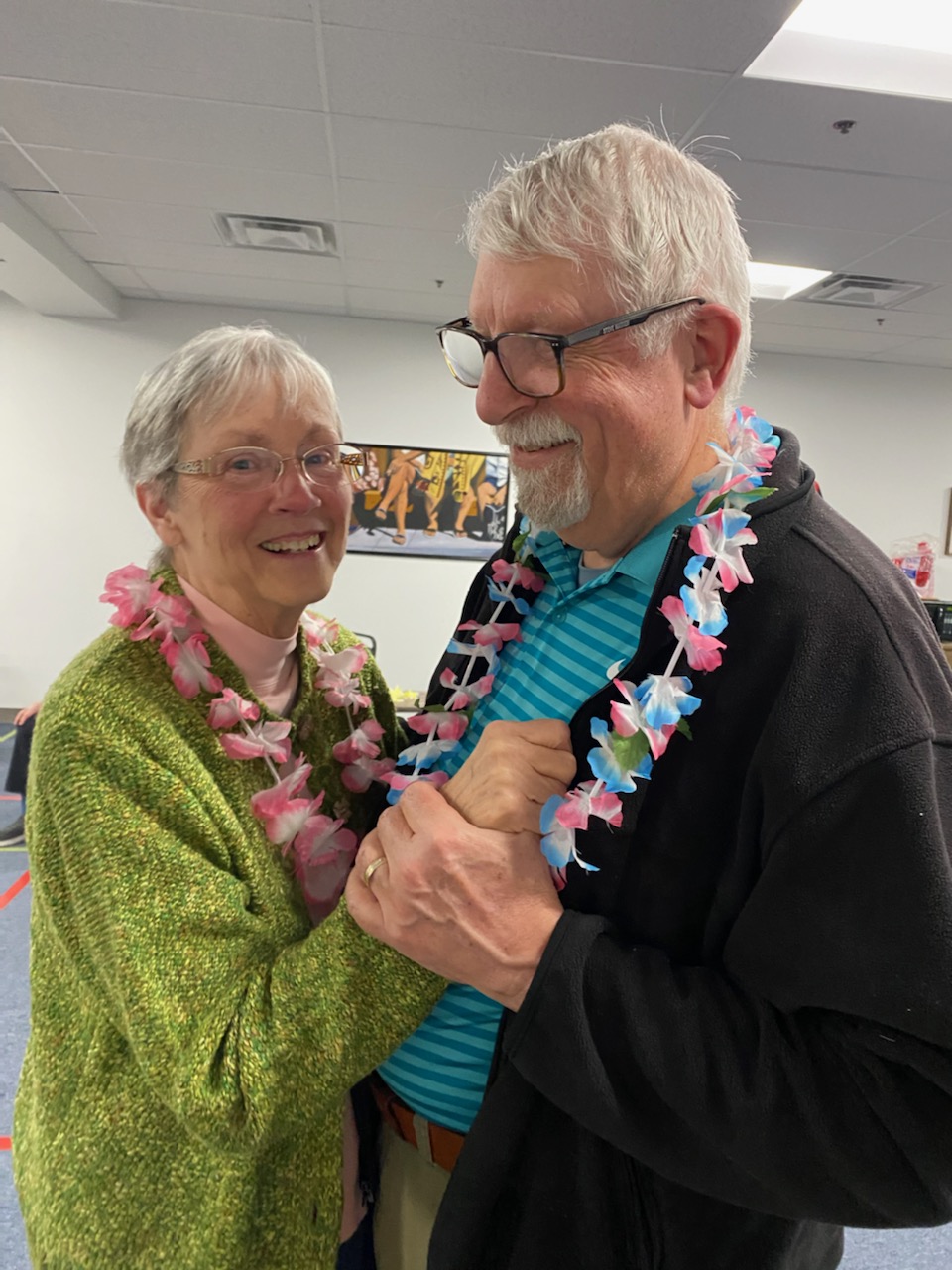
I went to putz in my office. Alexa was playing Rod Stewart old standards from his Great American Songbook album. Time after Time came on “… so lucky to be loving you” a waltz or foxtrot. I asked her if she wanted to dance. The song was a favorite of ours. I turned it up a bit and coaxed her into the space between the dining and living area. She put her arms up around me and I did the same. We hugged and danced in place. She burst into tears as some Parkinson’s emotions took over.
Me too. We took a moment to feel a little sad about our current situation. We took a moment to let the emotion wash over us. At that point in time life was overwhelming. We had to let it be overwhelming in order to move forward with life some more. It is okay to lament life for a bit.
The song ended and we sat in the living room. Rod started singing, “I see fields of green, red roses too…” She watched some of the pictures go by on the Frameo that Anna gave her a couple years ago. She cried a little bit more and enjoyed the nostalgia. And then we were ready for life again.
An empathetic and caring atmosphere for your partner with Parkinson and dementia, like a good marriage, must be created. In the art of marriage the little things are the big things. The same is true for care partnering. Small things are meaningful to both.
It is never being too old to hold hands. Physical touch is a comfort. Holding hands and helping someone you love up a step or into the car or into a chair at the restaurant is a sign of love. Doing those things without complaint and without request is a sign of grace. Look for grace in your life.
Remembering to say, “I love you” at least once each day to a spouse who is also graced with a chronic disease is reassuring. She did not ask for this disease. Reassure her that she is not an annoyance to you by saying this often. As a care partner there will be times when you do not feel that way in that moment, breathe deep and remember how it was and use those thoughts to see her as she is now.
Never go to sleep angry. Anger is available every day. It has no place in the bedroom at night. (This may be the hardest lesson to learn.) Just remember that everything seems worse at night. Sleep later into the morning hours. There is always light after the darkness.
Discussing and having a mutual sense of values and common objectives that are important to the partner who is burdened with Parkinson is essential for helping her to manage the disease. Occasionally anxiety creeps into my thoughts and voice. When that happens I become a naggy care pusher and not a helpful encouraging care partner. If you can, resist becoming a naggy care pusher.
We are standing together facing the world. This is a joint effort. (A platitude – many hands make for light work.) Care partnering is forming a circle of love that gathers in the whole family. It gathers in your circle of friends. It affects the person with Parkinson directly both physically and sometimes mentally. Parkinson is a change. Parkinson is not a purgatory.
Care partnering is speaking words of appreciation and demonstrating gratitude in thoughtful ways. These words are exchanged in both directions. These words are not expected. These words are freely given.
Care-giving has the capacity to forgive and forget. Give each other an atmosphere in which each can grow. Share your thoughts and ideas with each other.
Find room for the things of the spirit. And when the spirit moves, search for the good and the beautiful. Keep on the lookout for those “Aha” moments to learn from.
As it is with marriage, care-giving is not only partnering with the right helpmate. It is being the right partner. Parkinson’s sucks is the phrase Michael J. Fox uses. By helping each other PD sucks less.
Tonight as she was going to bed Cheryl asked me some questions because she wanted to understand.
C – There is one thing that I really want to understand. So, I have a question.
Me – Sure. What’s your question?
C – Well I know Jan is in heaven so she doesn’t sleep here. Right?
Me – Yes that is right.
C – Well who sleeps there? she said as she pointed to my side of the bed.
Me – I sleep there.
C – Good. You sleep there?
Me – Yes.
C – Okay. Good night then. I love you.
Me – Goodnight. I love you too. I am going to unload the dishwasher and read for a bit. I’ll be in later.
This exchange left me speechless for a minute. Cheryl often thinks Jan is in bed with her. In the early morning hours she will call out to her. They slept in the same double bed as kids until Cheryl left to go away to high school. Even then they shared a bed in the summers.
When we got married she went from sharing a bed with Janice to sharing a bed with me. I had not slept with anyone when I was a child. I may have shared a room with my sister when we were very small but I do not remember.
Cheryl talks to Jan often. When Jan appears to her she is very real. A few nights ago she wanted to get her on the phone to talk about the upcoming Sunflower Walk/Run.
Tonight she recognized that Jan is in heaven. She has not recognized that for some time.
She was still awake when I came to bed after reading for awhile. This conversation ensued.
C. – Dan is that you?
me – No it is me Paul.
C. – Oh. You’re here now?
me – Yes. Is that okay?
C. – Where are Jan and the rest of the kids?
me – Gone now I guess. They must have gone home.
C. – Okay. Are you staying here?
me. – Yes. Try to get some sleep. I’ll stay here with you.
In the morning as I got her awake. I had checked on her a few times earlier but at quarter ’til ten I gently urged her awake. She said, “There were a lot of people around here last night.” I replied, “Who did you see?” She replied, ” I didn’t see anybody but I could hear them.”
When she sees people they are very real to her. Before going to bed we had tried to play Scrabble for a bit. Scrabble was her favorite game for many years. We had not played it for about a year and a half. I thought I made a cool discovery. I tripped over a Merriam website called scrabble.merriam.com that helps to find words with certain letters at the beginning, end or containing them. I told her about it and showed her how to search on the website look up page on the laptop. It was too much for her.
She became tired and put on pajamas and got ready for bed. As i helped her take her bedtime meds, she asked me something about her sister Jan. She wanted to save some information for her about the upcoming Sunflower Rev it up for Parkinson’s fund raiser. She then asked me for Jan’s phone number.
It is hard for me to get a grip on conversations like this. I start first by asking if she knows where Jan is. Sometimes she remembers Jan is deceased. When she remembers this I tell her to merely close her eyes and talk to her. This time however she did not remember that Jan was no longer here. I reminded her that Jan was in heaven to which she replied, “Yes, she is talking to mom about it. Do you think you can find a number?” I told her I would look for it in the morning.
It is morning and she has not asked me for the telephone number yet. But there were a lot of people here last night in her head.
But did she lie on purpose or did she merely confuse real actions with thinking about them? Dementia and memory issues interfere with answering simple questions.
The physical therapist asked her about doing the same exercises at home when she was not seeing the therapist. Oh yes she replied, ” Every day.” This was probably an hour after her meds and she moves pretty well. Talking to her is much like a regular conversation. The mistruth just rolled off her tongue. In her head, she had done the exercises.
For a statement to be a lie it must have the added ingredient of intent. One must intend to mislead. Cheryl has no such intent. Her intent was to please. Eventually with my urging she will practice some of the exercises.
Switching from a siting position to a standing position is a struggle for her. At physical therapy Morgan and Stephanie practice this with her. She struggles to remember the sequence of small moves. We will keep practicing at home. I wonder if she will eventually will forget how to feed herself. I wonder if her body will no longer sense hunger.
Cheryl has lots of stories. Many of these stories are embellished memories. We all have some of these. Many of these stories are explanations of motive. Many of these stories are to please the listener. None of the stories are intentional lies.
Scooch forward in the chair, Heels behind your knees, Lean forward from your waist (nose over toes), push off the chair with your hands, straighten your legs — grab the walker on the way up. Practice.
Has she apathy? As we move forward it seems to me that she cares less about day to day activities. She seems to recede into her own thoughts but not as a prevailing occupation. I think of it as apathy-not-quite. When she gets in this mode it’s often temporary. She is tired from some activity.
Specifically activities like taking a shower, getting cleaned up, physical therapy sessions or exercise classes are obviously tiring for a PD sufferer. Something as easy as thinking about what is next seems to tire her out also. It like a temporary apathy. Procrastination?
It starts with, ” I don’t think I can go to… exercise class, church, physical therapy…” Admittedly it takes a lot for anyone to be motivated to exercise. It was not a big part of our lives when we were younger. Neither of us were sports buffs. My main sport riding my bike. There is a solitude to doing that which I am unwilling to give up or share. As her care partner, it is frustrating for me that she cannot observe how much she is helped by exercise and her PT sessions. She seems to not remember. It seems like she is going merely because I am taking her there.
When Cheryl gets in this mode (mood?), I turn the corner to something else. I am resistant to letting her go on and isolate herself in her little office area thinking, punding and organizing. I take her out. Anywhere works as long as it is out of our condo.
Yesterday I took her one of our local county parks that we have not visited for a long time. Afterward we went for ice cream at a nearby Dairy Queen. I had planned to make dinner at home but she suggested we find barbecue somewhere. This being an odd suggestion because it seems to upset her stomach often and she says never again later in the evening. We did not find the barbecue place to be amenable to folks with mobility issues so we landed at one of our old favorites and ordered something different than we usually get so the newness was preserved. On the way home she thanked me for taking her to Lake Erie and she told me a story about when she was very young.
In the early days of her father running his own gas station which was a life long dream of his, he rarely took any vacation time. It seems one of his friends had a vacation cabin up near Lake Erie and not far from Port Clinton. There is a park nearby called East Harbor State Park. Our walk by the shore of a much smaller lake in the park much closer than Lake Erie must have taken her mentally back to her childhood and a very fond memory. We visited the same area a few years ago and visited East Harbor. She talked at length about the trip with her mom and dad. She thanked me for getting her there and back in the same day.
I started this writing and contemplating apathy, but maybe it’s projective (mine) apathy? Or predictive apathy? Or apathy is the wrong word? (indifference? passivity?) Or is it poor sleeping patterns? This morning she got up at quarter til ten which means that she was in bed for about eleven hours. She awakened this morning from the same position she fell into when she got in bed. On the previous evening she went to bed very late after midnight and slept very little. (As a result I slept little also.)
Is apathy and memory related? I wonder about ideas like this. Perhaps she cannot remember that she seemed to enjoy herself the last time we went there? Wherever there is.
When I finally teased Cheryl awake this morning, she opened her eyes and asked, “Is Mary Pat here?” An amusing opening question about the day. I smiled and told her, ” No Mary Pat is not here. I think you were dreaming about her.” I have no idea where the Mary Pat (a childhood and current) friend thought came from but she has talked to her a couple times over the past few weeks.
I encourage her to talk to her friends when she gets excited about some memory or misconceived thought. Many of them have had strange conversations with her about things. I used to be embarrassed for her and, at first, discouraged these phone calls which she often decides to do later in the evening. But as I thought about it I decided that it was not my place to absorb or accept or become embarrassed for her. Her friends know her state of mind. They are wonderful people and she is blessed to have them as life long friends.
Focus, cognitive abilities, caring, likes and dislikes are all related to memory issues. Staying active no matter how small that activity is helps.
A couple of months ago I seriously doubted my ability to care for Cheryl on a long term basis and looked into memory care facilities around where we live. There are a lot of them.
Now, after having clicked on the wrong thing on the internet of all knowledge, I am deluged with calls from the marketing folks of all the facilities within a twenty mile radius. The world wide social media network – Facebook (aka Meta) – sends me two types of ads on every other post on my “news feed” advertisements about Parkinson stuff and memory care places.
I suppose I should be smarter about see more when I see it dimly printed at the end of some paragraph I started reading. I suppose I should be smarter about a lot of things but sometimes you want to just see more of the text. Sometimes you merely want to have one question answered up front, “how much?” Used car guys know enough to not answer that question directly. The trick is to keep ’em on the lot and find the lowest possible number where the client says, “I can do that.” It is the whole reason for, “For 50 cents a day, you can feed this orphan in some obscure country.” – ads on television early in the morning. The Shriner’s hospital ads are especially compelling. (Oops, I have digressed.)
I fell for it and probably always will.
On the heels of making that mistake, I did sign myself up for a care giving (care partnering) class that also produced a fount of valuable information without the “scam likely” phone calls coming to my cellphone while driving somewhere.
The class itself has given me new insight into how important it is for me to seek out help from others around me, take time for myself to do the things that I enjoy doing, and to give those things and myself priority in my (and our) life. I have at the same time become aware of not dumping on friends and family to “take care of Cheryl” for me. Most of the time in the daylight Cheryl can take care of herself.
I do not have Parkinson disease but Cheryl does. In order for me to stay healthy enough to care for her, I have to stay healthy both physically and emotionally. I thought to write mentally also but emotionally covers it. I use the term anger but that to me means -frustration, disappointment, anxiety, sadness mixed with a little collegiality and a lot of empathy and love. And maybe a little grief is there too.
I have written this before I truly hate this affliction and what it has taken from her but I have to be as upbeat as I can about things. Some days that is harder than others.
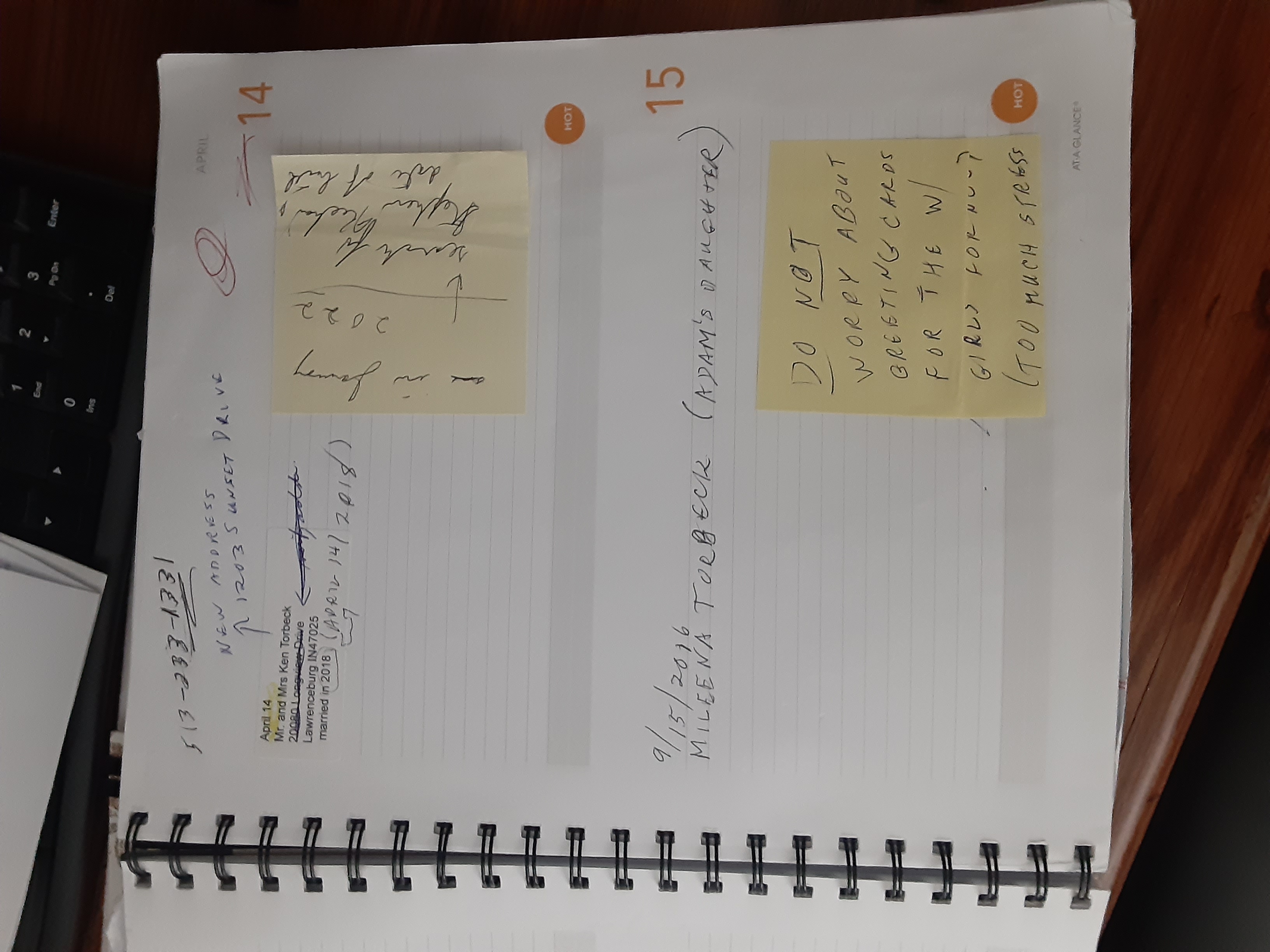
Anna was looking for ideas about what to get her mom for her birthday in May of 2022. I suggested a box of blank cards to send for any reason. Cheryl has always kept greeting cards that are sent through the mail for fund raising purposes from various religious and chronic illness organizations. Some would be sent to her mom when Elaine was still alive. Some of these are still in residence in Cheryl’s office.
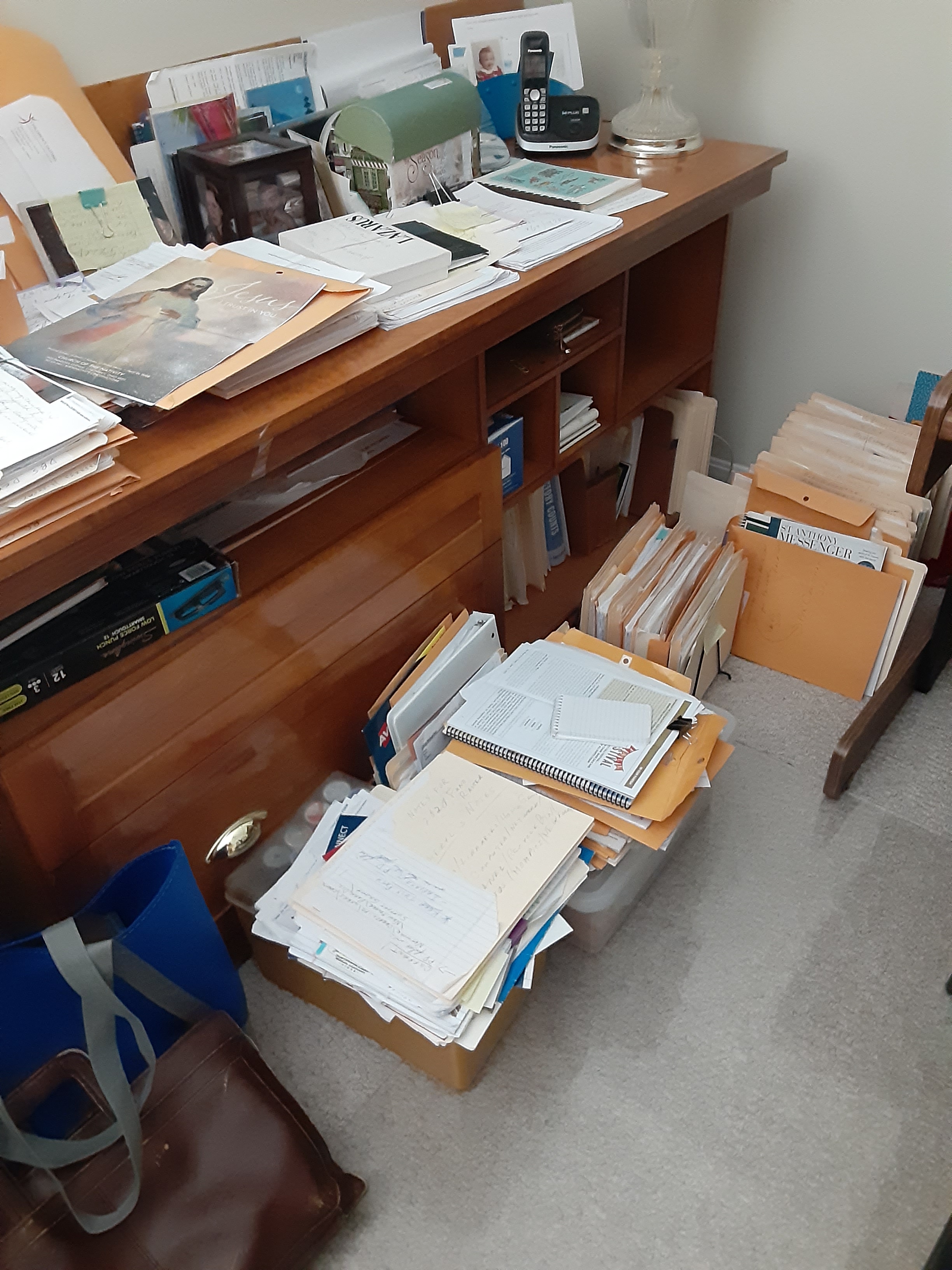
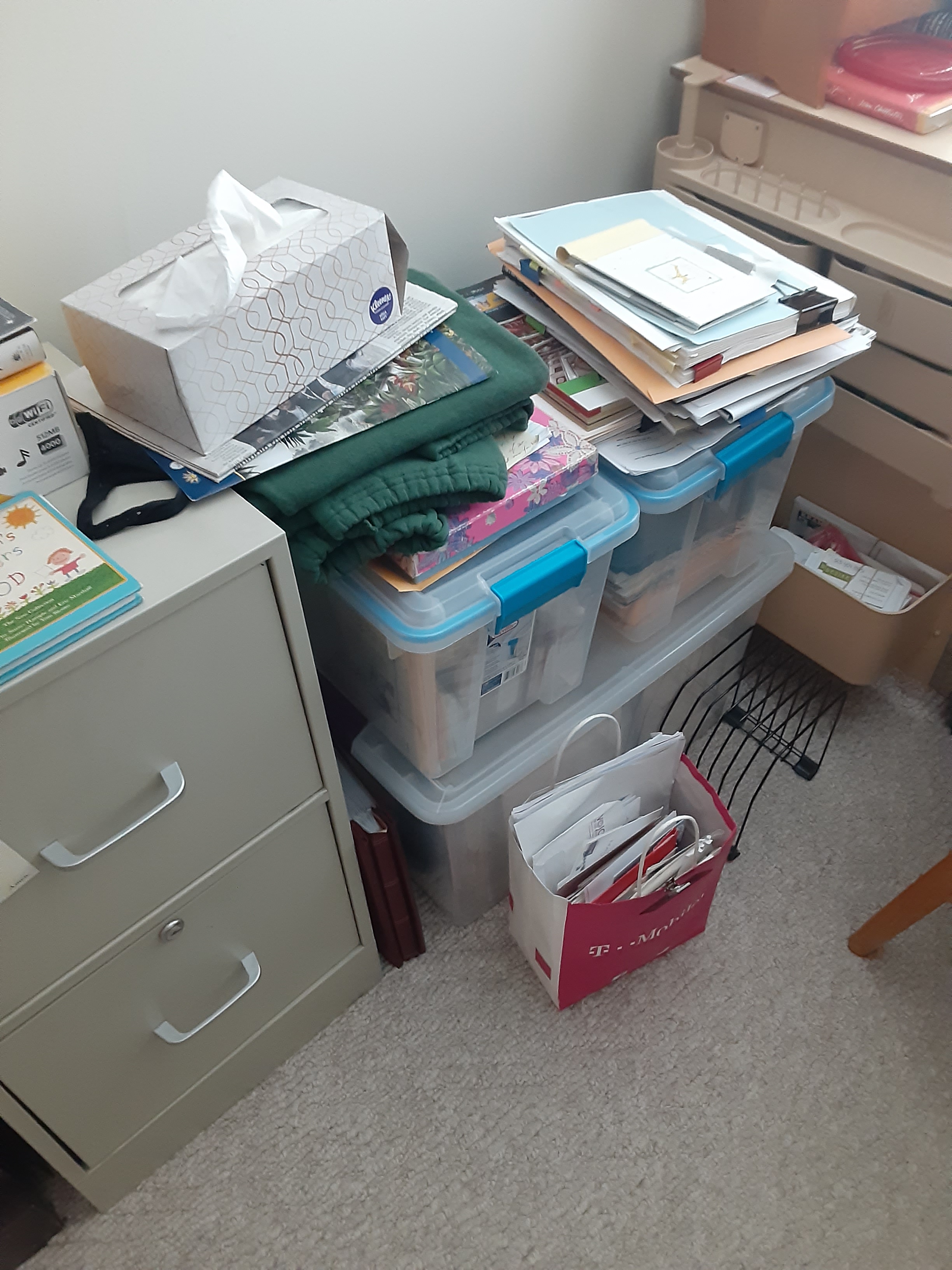
There is a small green box shaped like an old country mailbox near the phone in which these cards used to reside. They are no longer there but are spread here and there amongst other paper and chaff in her office. I had hoped that Anna’s present would take up residence in the mail box topped box but that did not happen.
In mid-April of 2022, I suggested that she should make a list of the May birthdays and we would make a trip to the store to get some cards to send. The idea of making a list is hers. She readily agrees with this idea but as her Parkinson took hold of her cognitive centers she is unable to do this.
A few months back her engineer husband suggested that rather than a list she should write each name on a post-it note and as she selected cards in the store, she could put the post-it note inside and she would know who the card was for. Later when she wrote the card and addressed the envelope she could note what date she wanted to mail it and stick it to the front when she sealed the envelope. That solution met resistance because of the NIH factor. (not invented here) But over time she adapted it to her way and used it for awhile.
In April I helped her make a stack of post-it notes with names and we went to the store for cards. Few of those cards were ever mailed to anyone.
In May I waited to see if there would be a panic mailing of cards. May came and went.
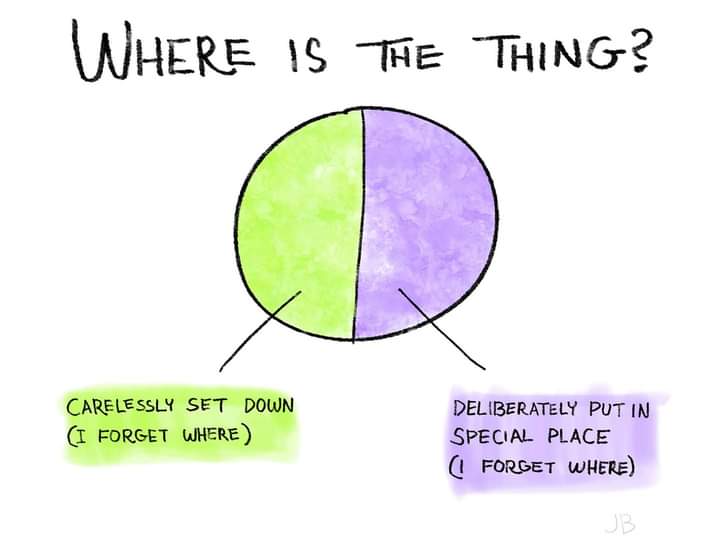
Our daughter-in-law Mavis’s birthday is the 1st of May. Hers was the only May birthday card sent. How do I know? In a previous month there was panic as Cheryl realized she had forgotten where she had put the stamps. I now keep track of the stamps. I often have written about her punding. Sometimes she will pund stuff into obscure places. We all do this – not punding – but set things down in obscure places. With PD it is merely harder to find out where it was parked. The stamps turned back up a week or so later after I had bought a new roll.
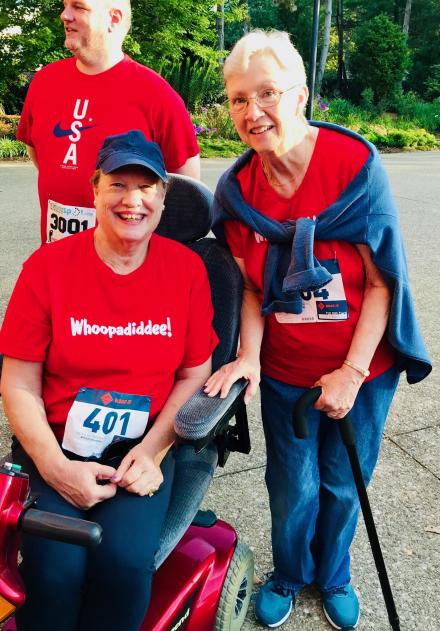
Cheryl’s birthday is in May also and her brothers and sisters often gather for a “sibs” dinner to celebrate such an event. These pictures are from that gathering at Gabbey’s cafe.
The birthday cards acknowledgement of the family birthdays seems to have been forgotten. It is probably another nuance to he loss of sense of time, calendar, day, week. Our son Scott’s birthday is the 6th of June. We were at our daughter Anna’s house on his birthday. Anna asked her mom whose birthday was today. Cheryl looked at her with a confused look.
I felt sad about several things. I have been writing significant events on a white board that I put on the table each morning so that Cheryl knows what is happening this day. I have not been writing down birthdays. She forgot Scott’s birthday. Of the few cards that I think she should send we forgot to send one to our son. A few other sad thoughts drifted through my head. But most of all I realized that she had lost the birthday card duty. She had forgotten it. This is a long time thing that she did for our family and her mother while Elaine was alive. This is a longtime activity for her. Her short term memory has been off or fading for sometime. I had gotten used to the fact that it is necessary for me to remind her of events constantly. (It is annoying but over time one gets used to it.)
Christmas, birthday, invitation, funeral cards are all gone. An actual paper card with a USPS stamp is how Cheryl learned to acknowledge things. She never adopted Facebook or any other social media platform for those.
Parkinson is a series of small setbacks. Sometimes it is so gradual it merely seems like life going by. It is easy to attribute all behavior changes to Parkinson, after all, he entered our lives about a dozen years ago and has made dramatic changes to how we now do things. Lot’s of older folks develop an apathy for life. They do not need Parkinson’s disease to help them. It is a kind of disinterest in life. Doctor’s have recently discovered this. Geriatric doctors ask specific questions about it when visited by their patients.
This topic about the birthday cards occurred to me in early May when no panic mailing of birthday cards or frantic searching of the black book or of the old address books that we had in our old house or her mom’s address book. It was a sudden occurrence in her behavior.
Could I be watching apathy creep out from behind the curtain? I will have to be alert to this behavior. So far Cheryl does not seem apathetic. She does have a fading memory. Are they the same?
Cheryl Hughes posted this article in her blog which made me think about the helpful folks around us.
Last evening we had dinner with Cheryl’s sister Nancy. We have been doing this more and more. It is helpful to me in a couple ways that Nancy might not think about. Nancy, firstly, is not dealing with any dementia. Her conversation seems to go in a straight line. That fact by itself often provides relief to me. Over the course of my working career I traveled to other countries and many of these did not have english as their base language. It was always a great relief to hear American english from the people around you waiting for an airplane back to the states. Cheryl’s mingled conversation is much like trying to make sense of a foreign language with little preparation.
The second thing is that when Nancy talks to Cheryl she is accepting of whatever Cheryl might say. Cheryl tells her about the children in our house, their sister Janice and other thoughts as they occur. Nancy does not correct or suggest anything different. Sometimes she will ask for clarification if Cheryl has mixed up names or dates. Cheryl recognizes that she does mix things up but she does not have the stress of keeping the story straight. That is stressful to her, saying the right thing; giving the right answer; not offending anyone. She learned those from her mother and they are deeply ingrained in her personality. When talking to Nancy she relaxes. (Thanks, Nancy.)
Cheryl’s cousin’s wife Cindy began coming over to sit with Cheryl or take her to one of her exercise classes once a week for a couple hours. I am free to do whatever. (Thanks, Cindy.) These days in the warm summer Ohio air, I often go ride my bike somewhere. Cindy surprised me last Fall by asking me what I did for exercise after a discussion about Cheryl’s exercise classes. One of Cheryl’s instructors was a friend of Cindy’s. Cindy spontaneously offered to come and be with Cheryl while I did something else other than care give. It took me several weeks to figure out what to do with my new found freedom and now I look forward to it.
My son David and his wife Melissa have a wonderful patio and a big green backyard. Many times with little warning I have asked to come visit for a bit with Cheryl. Cheryl likes to visit her children and see how they are doing. Sitting on their patio in the sun brightens her mood. It gets us out of our little condo and does not require a lot of preparation by me. It is a sort of little day trip for her and I can chat with my son who is a fellow engineer. (smiley face)
They have always responded with yes. (One time they were out of town on a spontaneous getaway weekend.) Thanks, David and Melissa.
My son Scott sits with his mom while I go to my stock-club meeting once a month. (Thanks, Scott.) In 1984 several of us engineers decided to make ourselves rich by speculating in the stock market. We started meeting in March of that year. The markets have soared and ebbed. We languished through “black Friday”. We bought gold mining companies. We sold gold mining companies. We drank a lot of beer discussing and criticizing corporate management. We have won big (ABBV) and lost big (F). Good friends and lots of beer with dinner in the back room of the bar makes for a fun evening. (Thanks again, Scott.)
I have also parked Cheryl at Scott and Mavis’s house near us so that I could ride my new ebike around our old neighborhood. Cheryl could see Zachary – the newest grandchild – run around while I was riding. (Thanks, Zachary.)
My daughter Anna visit’s with her mom and in the summertime when her high school is on break takes her mom to exercise class. Last summer Anna stayed with her mom for a week while I went to visit my sister on the west coast and we attended my nephew’s wedding. Jeff and Stephanie have a new baby girl. (Thanks, Anna.)
Our next door neighbor, Jane, comes on Mondays typically to sit with Cheryl for a bit while I go ride my bike around somewhere. Cheryl sometimes walks across the hallway to visit with Jane. She is a good friend and close. Often Jane goes with us on “anything goes pizza Tuesday”. She reacts to Cheryl’s discussion much like Nancy does. Over the years Jane has had issues with her health and Cheryl’s first thought is to see how Jane is doing. Jane has pointed out things to me that she notices about Cheryl and has suggested solutions for those without any judgement. (Thanks, Jane.)
My cousin’s widow, Linda sits with Cheryl while I go do something else. Most recently I signed myself up for a caregiver’s class to find out about other services that were available. Linda came over fairly early in the morning so that I could attend this class. I found the class itself very useful. It was primarily oriented towards care partner health and well-being. (Thanks, Linda.)
I appreciate everyone’s help whether it is a small thing or a big thing. Sometimes it is a phone call. Sometimes it is merely joining us for dinner after church. Sometimes it is taking the roll of care partner for a couple hours. Sometimes it is staying with mom while dad goes somewhere for an hour or a week. I love you all. Thanks so much for helping.














 Adjunct_Wizard