Black Friday

This is a term associated with the Friday after Thanksgiving Day. (2022) We had been at Anna’s house. Anna hosted. Almost everyone was there. Cheryl sat at the end of the table near Anna. Anna read a wonderful prayer. I sat at the other end of the table near Scott and Gavin. A great meal surrounded by family was enjoyed by everyone.

Today – black Friday – Cheryl was a little down this morning after breakfast. She talked about not understanding what was going on about her yesterday.

She did not remember that she had forgotten being there last night as we went to bed and I talked about the meal and conversation at Anna’s house. — Last night as she was crawling into bed she asked about going to Anna’s house for Thanksgiving dinner. Without thinking I responded with we were there all afternoon. Do you not remember having dinner at Anna’s? Luke had really long hair. She became upset. She could not find that memory and it seemed that for a moment it terrified her. (I knew immediately I had made a terrible mistake of assuming she knew.)

She talked about “losing her mind” this morning. She talked about her granddaughters who were sitting all around her not understanding the surroundings. We had another moment were we sat for a minute to recognize the changes in her memory and cognition. (I am losing her more and more and she recognizes that and it makes us both sad.)

Thank you Lord for the moments we both still have. Even if we cannot remember.

Carpe Diem.

Conversational Receptiveness and Dementia

Communicative processes used to discover what is needed or desired by others in business or other walks of life work well with loved ones experiencing dementia and related memory issues. And while the single most important concept to remember is that short term memory loss affects every conversation, short term memory loss greatly affects attention span. Keep it short, keep it kind and keep it simple.

Here are some tips from an article in Psychology Today’ website:

  1. Consider the timing and mood of your recipient.
  2. Check your own emotional level.
  3. Be responsible for delivering clear communication.
  4. Consider using I-messages to avoid blaming or putting others on the defensive.
  5. Be a good listener (attentive) when receiving a communication.

And here are more from the Social Care Institute for Excellence website in UK:

Their focus is providing professional care to Alzheimer’s patients and those dealing with other sources of dementia. Their techniques are good to understand for non-professional care givers. I use this list to think about and discern how better to help Cheryl.

  • Minimize background noise
  • Relax
  • Think about how the person may be feeling
  • Always introduce yourself
  • Greetings or ‘verbal handshake’
  • Physical approach
  • Be aware of emotions and touch
  • Identify the emotional state of the response
  • Don’t be shy from tears or laughter
  • Say what you think the other feels
  • Keep it simple
  • Use the person’s name often
  • Use visual aids and prompts
  • Confirm understanding

Minimize background noise – I have noticed that Cheryl is easily distracted by almost anything that passes into her line of sight. I have noticed that Cheryl is unable to do two things simultaneously such as talk to someone and keep walking. I have noticed that Cheryl is unable to follow a conversation if two people talk animatedly about some topic in rapid succession or over the top of each other. I have noticed that Cheryl is unable to interpret words spoken with a different lilt or accent other than Midwest Cincinnati. I have noticed that she no longer watches any of her favorite shows on TV. With all of this considered if I want to gain her full attention, I remove all distractions.

Relax – I struggle with relaxing and letting go for a bit if she is out of my sight. As her disease progresses and I see her falter with balance issues, stumbling gait and postural difficulties, my anxiety about her future (and mine) often comes through in my voice. I may say things or express opinions that can easily interpreted as rude, pedantic and egotistical. For those times I apologize to her and you.

Think about how the person may be feeling – I do not do this enough. It is easy from the outside to forget that the person is not the disease. Parkinson seems to make this harder because in one moment she will be “fine” and in the next she will be “off” – not necessarily physically off, mentally off and physically fine. I find this confusing and my default is not “she’s confused – help her”. My default tends toward preachy pedantic lecture.

Always introduce yourself – Most of the time I do not need to do this. I can understand that it may be important for a professional to do this. Occasionally Cheryl is unsure of who I am. Mostly this occurs in the evening if she experiencing a bit of Sundowning. (Sometimes I am “that guy who brings the pills”) Sometimes I tell who I am if I think she will accept it. Sometimes I leave it alone. The important thing is to not be insistent that she is wrong about who I am.

Physical approach – I have noticed that Cheryl startles much more easily than she did before Parkinson (bP). This comes in many forms visually and audibly but the important thing is to not surprise her. Surprises often lead to backing up and falling down which is her usual method of falling. She will move away suddenly from the perceived surprise.

Be aware of emotions and touch; identify the emotional state of the response; do not be shy of tears or laughter – I think these fit together as emotional response to conversation. Sometimes to me it is surprising that she will have tears about telling you that Laurencia is going to Ohio State University. I can understand that talking about her deceased mother will cause tears. Nevertheless it is important to understand that a person suffering with Parkinson may have her emotions very close to the surface. Try to remain calm but it is okay to “have a moment” and be with her. One memory often elicits another more tender memory and things tumble downhill quickly.

Keep it simple; use the person’s name often or the other person’s name if telling a story; use visual aids and prompts – pictures of children; confirm understanding – I have noticed that Cheryl may lose the thread of any story or conversation easily. She will not indicate in any way that she has lost track of what you are telling her. You may detect that she has lost it by some response that she makes. Simply reiterate some part of the story to help her recall. Do not get bogged down in correcting her mistaken thinking. Do not raise your voice to emphasize the correct story, time of day, holidays coming up, time of the year or who is coming to dinner. She will not remember but she will think that you are frustrated, angry or disappointed and respond with – I’m sorry.

Finishing– Just as you prepared to start a visit and conversation, so you must think about how you will bring it to a close. I do this many times a day. (For visits) When you are leaving the our home, make sure you say goodbye. Cheryl may think that you are still here, perhaps in another room. This may cause confusion or anxiety later. Ensure you have her attention, smile, and let her know you enjoyed your time together and the conversation. Shaking her hand or hugging her is a common gesture which gives her a strong clue you are leaving. Leave her reassured and let her know you look forward to talking again.

https://www.scie.org.uk/dementia/after-diagnosis/communication/conversation.asp

https://www.psychologytoday.com/us/blog/healing-sexual-trauma/202008/5-essential-strategies-effective-communication

I spend a lot of time reading articles and searching for useful ideas to help Cheryl. This post is a sort of summary of two of those and how I think I can better communicate with her.

I am still not good at that.

Carpe Diem.

Yesterday Friends Came

Yesterday several of Cheryl’s friends came to visit. It started out as a low key thing. Our friend and neighbor, Jane, organized many of Cheryl’s friends and old card playing buddies to visit on a regular basis and allow me to escape for a bit. Cathy sent a text message to me a couple days ago.  She was supposed to come last week but got too close to a child and was still recovering from whatever disease virus that kid was carrying. This week she is coming to visit. The text asked if I was okay with her coming. Sure said I.

A day or so later I got a text from Mary Jo. Was it okay if she came to visit. Sure said I. Cathy was coming that day also. Hmmm said she. I thought it was my day. Time to par-tay.

On the heels of those women, Maxine, Cheryl’s old boss and good friend called and said that she was coming. Maxine is older so she came with special requests. For a while there were two women with mobility issues in our house. Friends are great but they need to deal with their own issues themselves. That sounds a bit callous but I have one focus that consumes me.

Nevertheless all went well for a time and I snuck out to the barber for a long delayed haircut. I was starting to favor the gray haired Boris Johnson look.

Today more friends came. Nancy and Carren came over for a visit.

Most of these visits were in response to our friend and neighbor Jane’s idea of a network of friends to help with Cheryl and give me a bit of respite.

I may have to spend some time in discernment. Cheryl was very tired and confused into the evening after they left.

Carpe Diem.

Parkinson Hacks

When did the term hack get substituted for coping strategy? This is an unimportant question that jumped into my head watching the morning newsy show. The gentleman was talking about traveling and airfare and airline scheduling nuances to guarantee getting there on time and not have any trouble. He shared his ideas for traveling early on Thanksgiving day and traveling home Friday. Getting back in time to watch football for the rest of the weekend. He could have FaceTimed his family that he did not want to visit for long. It could have saved a lot of time and money. (That is a hack.)

Wouldn’t it be great to make a list of hacks for Parkinson and his damned disease? He found it. Why did he not write a manual? Even written in the flowery English of the 1800’s it may be of use today. Nevertheless if he published other than his observances to the medical community (The Shaking Palsy – An Essay), I missed it. Parkinson describes a shaking motion. Today his name is associated with a wide range of symptoms, behaviors both movement and cognitive.

In our support group meeting on of the topics posed was “Share one piece of information, a coping strategy (hack), a motivational thought you wish someone had shared with you when Parkinson disease first made an appearance.” I have several and it has taken me a long time to learn them.

Cognitive

Often but not always a person dealing with Parkinson will have cognitive issues in addition to movement issues. These can come in many forms; hallucinations, sensing others, detecting others presence, odd beliefs with little knowledge, delusions, lack of time sense, lack of calendar sense (day), short term memory loss, aphasia, to describe a few. When you detect this happening in the person whom you are helping – Don’t argue. It is very easy to fall into the trap of trying to correct things. Remember with memory loss everyday is a new day.

For me this is an ongoing learning experience. I do use argument (not quite the right term – dissension? – justification?) as a method of attaining her focus because when she is mad at me she is completely focused on what I am saying to her. Often that is when I am attempting to prevent a fall or a near fall. She wants to continue doing something that is to my mind unsatisfactory, bordering on dangerous with her worsening movement control.

I do not do this often because the side effect of having her angry with me can last until bedtime. Sleep I have found is refreshing to her in a way unlike nothing else.

Meds

As a care partner it is extremely important to control meds, medication timing and to observe any issues or effects of the meds. Is this new behavior due to her worsening Parkinson or due to the new med or aging in the old med? It involves lots of reading and observation.

Whenever a change is ordered or a new med is added, the care partner must become observer and research assistant.

Checking activities

Check, check, check on things. A task that might take ten minutes for a non-Parkinson could easily take three times as long. Allow for that when planning activities no matter how small or how large. Parkinson time is different that regular clock time. Many diversions can creep in. In fact scope creep has to be tamped down continuously. (A trip to the toilet can easily morph into putting on a whole new outfit.)

Providing Help

Interfere and help. She may not want your help. Help anyway. Apologize later for helping. Do not help before it becomes apparent that she is truly and hopelessly stuck. Mentally she might think that there is hope yet and she does not need your help. It is also possible that she will not remember you helped. Just help.

Social

Generate social activities for yourself and your partner. Go out to lunch. Go out to dinner. Visit friends and family. Take walks in the park. As much as your are able look for or create on your own opportunities to be outside and exercise. Seek out exercise venues that cater to people with movement issues. (Physical therapy is one to one. There is very little social interaction.) Specialized exercise classes are far more social.

Socializing in general stretches the brain and often requires dual activity such as eating and talking. Walking and talking in a park is an excellent form of this socialization and has a third benefit of giving the body a chance to make vitamin D. Multitasking is hard for the Parkinson brain.

Caring

You have to create a network of care. You may think you can do it alone. You cannot.

Attitude

Don’t give up. Choose to be happy. And seize the moment.

Don’t be shy – lower your expectations of people

Ask for direct help. Rarely do people when asked for help say no. Usually they say that they cannot right now. Follow up and ask when they can. This can be difficult.

Carpe Diem.

Surrounded by Wonderful Loving People

“Feeling blessed” – is a phrase I associate little with this disease of Parkinson but I am learning to understand the meaning of that phrase with respect to helping others and help from others. Cheryl used to tell her mother that there is grace in accepting help from others. (:-0) Once in a while I say this to Cheryl when she resists my aid.

It is easy to get caught up in “why me?” It is easy to not take note of all the kind and loving ways that people around you are willing to help in some small way. Most do not even hesitate. Wear your gray hair to the door of a restaurant and the guy coming the other way will hold it for you. Carry a walking aid or a cane to the same door and kids will jump up and open the door.

In our life with Parkinson we experience these small helps a lot. Cheryl wants to do for and help others even when they are helping her. There is goodness in everyone. Even when one is certain that the other person has not applied themselves and therefore did not achieve the expected benefit help is given without expectation of gratitude.

From the point of view of “little helps” everywhere often spontaneously offered to us, we are blessed.

Our friend Jane is a great help to me. She has organized a network of care around Cheryl and me. She has contacted many of the group of women that she and Cheryl used to play bridge with. Cheryl is unable to play bridge any longer. The game is simply too mentally taxing for her. We used to play Scrabble in the evening and I did not want to play because Cheryl would always, often anyway, kill me score-wise. With Scrabble and Bridge and other competitive thinking sorts of games, she excelled. Her math and logical brain rose to the challenge.

Jane and the rest have organized themselves into Wednesday visiting parties. Jane comes across the hall on Monday so that I can ride my bike or do whatever. Barb comes on the last Thursday of the month to take Cheryl to lunch. Cindy has been coming over on Thursday in the afternoon so I can go do whatever. I usually ride my bike in the warmer months. Linda has been coming on Wednesday but her sister is very ill and she needs to be with her. (She may not be with us much longer.) Jane is a blessing to us. As is Linda and Cindy and everyone of Cheryl’s friends.

Family …

My son and daughter-in-law have been a focus of my need to get Cheryl out away from our little condo on the weekend. David and Melissa are almost always available for a weekend visit. They live nearby in eastern Indiana. The drive to their place is such that I takes us through the fringe of the city into enough rural properties that here and there are planted corn and soybeans. It seems like a long trip to Cheryl. When we get home her reaction is much like coming home from a long trip.

A few evenings ago I invited a couple of Cheryl’s cousins for dinner. It was a great time. Steve and his wife Marisa sent an email just checking in on us a few weeks ago so I invited them for dinner. Cheryl insisted that I invite Lois who is another cousin from a different direction. 🙂 Lois, Steve and Risa did not know each other except through inference by family name(s). Lois and Steve are cousins to Cheryl but not to each other. Nevertheless the dinner was great. They found common reference by neighborhood. They physically do not live far apart.

Cheryl talks about Lois a lot and her mom Aunt Jean (great aunt). In her childhood she got a lot of hand me down clothes from that direction. Lois is a couple of years older. I may have mixed up the story a little. I am merely trying to track down some of these childhood stories before the people in them are gone. Marian and Tom, Steve’s mom and dad, are gone from this world. Their family is younger. I remember Steve as a boy coming to some of the long ago family gatherings at Sharon Woods Park. Lois is the last, I think, of her family. Her sister Maureen we used to see occasionally at Macy’s in Kenwood doing her supervisor shtick. She is gone.

As we move on and Cheryl resides mentally in her childhood, I have taken it upon myself to reconnect with these people. Many of whom I do not know personally except by my wife’s stories. And her memory is failing her in bits and pieces and fits and starts. I think it is becoming more urgent for me to do this and I do not know why I feel the need to do this other than it brings her great pleasure to talk and reminisce with her cousins. Her most pleasurable stories seem to revolve around the many large family gatherings and smaller group visits.

On my never ending journey to help Cheryl experience the best of her days even though Parkinson is trying to steal the memory of them from her.

Carpe Diem.

It was a Good Breakfast, Dear.

It is important to try making it into a nice day. A few weeks ago another Cheryl wrote on her blog – just let it go – or words to that effect. As we move further down this road of Parkinson I find ways to simply make life more enjoyable.

Cheryl likes egg bread. It is a memory from her childhood. My mother always called it french toast. I do not know what the French call it which sent me on a quest for knowledge from the internet of all knowledge. They call it pain perdu and that translates into lost bread. French toast (pain perdu) is always better if it is made with stale bread. It is better in my opinion if it is made from stale sourdough bread.

This morning I coaxed her awake with the thought of french toast with blue berries and a little whipped cream. This is a picture of mine. She was already eating hers when I decided to take this picture. She had slept late today but it is a good day.

French toast (aka eggbread)

“It was a good breakfast, dear”, she said to me as I was loading my plate into the dishwasher. We have no real plans for today. Perhaps I will take her for ice cream later in the afternoon. Perhaps not. We will just go with the flow today.

Carpe Diem

Reminders

Today I have taken notice of the necessity to remind Cheryl what she is doing and where she is going. On this particular morning I have reminded her that she was going to change clothes for exercise class three times so far. Once she is away from other distractions I relax a bit and wait for the next reminder time.

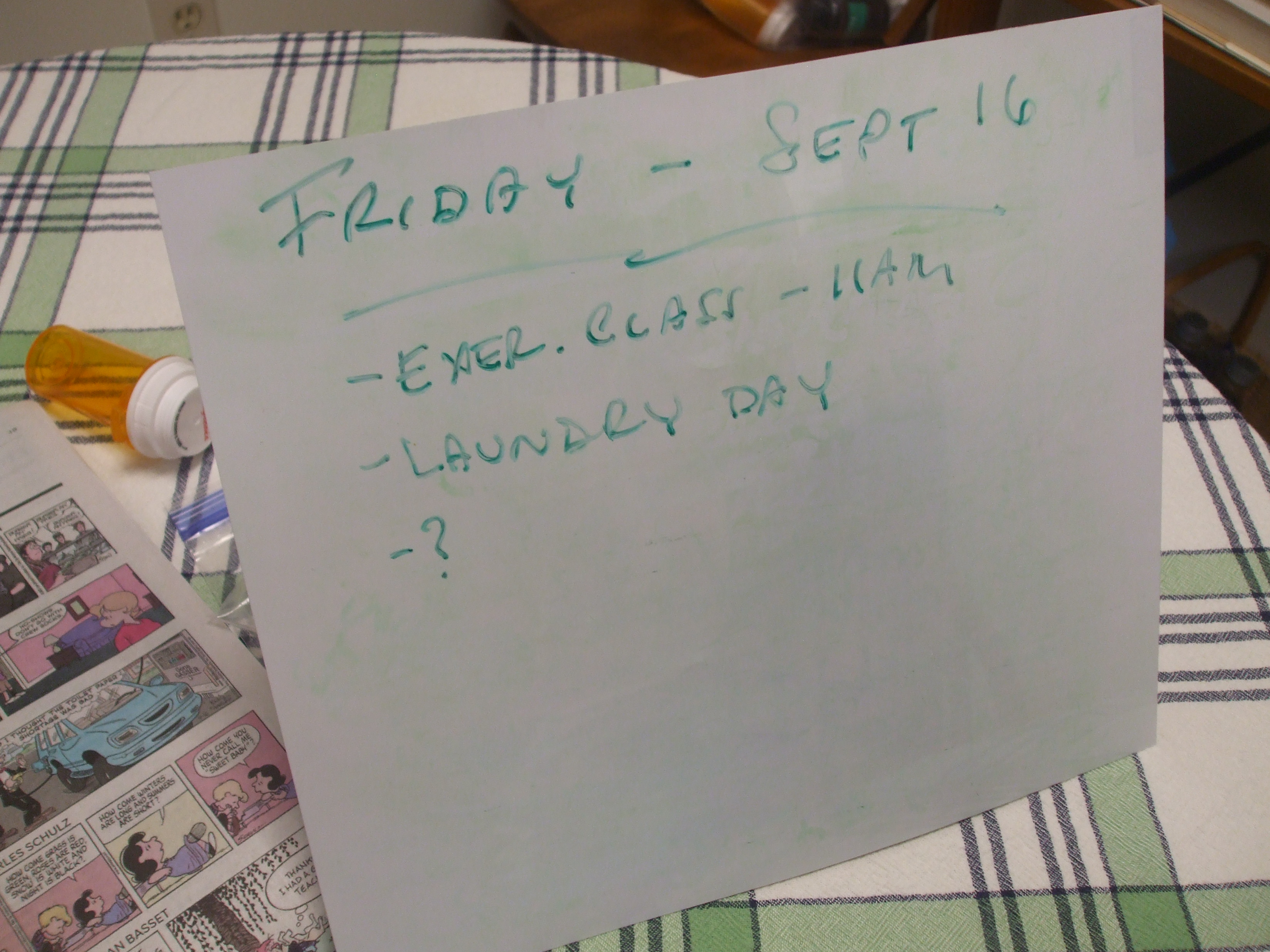
Today’s list of events

Starting sometime in May after I was into my care partnering seminar I started to post the days events on this handy piece of white plastic left over from some project. I read an article that gave some tips for helping those who are struggling with dementia. It spoke of using a small erasable white board to post events somewhere. There is one on the wall of every hospital room I have been in for twenty or more years.

I had this and it works for me. I even had dry erase and wet erase markers leftover from my teaching days. They were not dried up yet, so, I was set for awhile. Since May I have had to order more markers. This one is near the end of its useful life.

The family calendar became less and less meaningful overtime. Cheryl is no longer able to discern what week or day is applicable to today. I started transferring the days events onto this board the night before I went to bed. She reads it the next day and looks through the newspaper. Even though the date is printed at the top of the newspaper she cannot relate it to the date for today.

Dementia, confusion and memory loss is annoying to be sure but the silver lining is every day is new and fresh.

Carpe Diem.

Bump and Run

Interestingly to me anyway yesterday’s plan works today.  I suppose that overtime I will come to understand that what I want her to do and the speed I want her to do it are not hers so it can never be.

Today’s class is sitting cardiovascular motions.  I features the Beatles and the Righteous Brothers as accompaniment. Nice.

Spirit in the Sky

Carpe Diem.

bump-n-run

It Seems Counter-intuitive

Cheryl has some dementia which is a nuisance with her decision making process. Any attempt at speeding her up doesn’t seem to work well. She merely gets angry and frustrated with her husband. And it is hard for her husband to not speed her up. That must be fifty-two years of helping getting in the way of care partnership. (Smiley Face)

This morning I tried to move her along without being pushy. Yes, I can be and have been pushy.

She wakened several times overnight to go to the toilet. I got up to help her once. So, when the seven am medication alarm went off, she ignored it. I got up to remove that annoyance from my ears and get her first dose of stuff for the day. When I returned her snoring indicated disinterest in arising for the day.

I laid back down to see if she would stir again. When I awakened it was eight am. I must have been tired also.

Eventually I left the bedroom to make coffee, get the papers and turn on the news to discover which part of California is on fire. An hour or so later I kissed her awake and she asked me when church started. I told her that she had exercise class at noon. I left to drink more coffee and to listen to the interesting fact that no toilets could be flushed in Mississippi. I returned for another gentle nudge and she got up.

I suggested scrambled eggs and toast for breakfast and she readily agreed. I continued with gentle nudges and quit concerning myself with whether she would be late for her class. She was not late.

The exercise classes she takes at Parkinson Community Fitness are a benefit to her so I make every attempt to get there on time but today I tried a not pushy technique. I call today’s strategy “bump and run.” I would engage her and nudge her thoughts and then leave. I came back a few minutes later for another bump and run. It worked and neither of us was upset when we left.

Today’s class was led by Paige and Jenna. Jenna’s notes are here. The rowing person is excited to do the exercise.

Carpe Diem.

More Things that I Have Learned

  • If you are going to try to get your PwP to speed up to go somewhere make sure you have your act together first.
  • What ever schedule that you have in mind is busted, so, move on.
  • Some people sleep in occasionally. It is not apathy, just the ordinary need for luxurious life.
  • “Church” is merely another name for going somewhere. Just repeat the answer to: Where?
  • Do not panic when she asks where we are sleeping or asks if we are going home tomorrow. Tomorrow she will not remember.
  • Read her email once a day.
  • Casually look in her disorganized office once in awhile to get a feel for where things could be when “I can’t find my…” comes up.

This is a continuing list and when I stop to think about it and all the things I have had to learn and do it makes me smile. Frustration creeps in sometimes but I think that most of the time I can push it away. The times that I cannot are about what this disease has taken from her.

Carpe Diem.