Parkinson’s Help

I had a long conversation with a member of our Parkinson’s support group today. She called mostly to talk about her husband who has Parkinson’s disease (PD). And the struggles she was having as a caregiver with Parkinson’s disease care management. We talked for a long, long time. Maybe half hour, 45 minutes she was on the phone. She was pretty forthcoming, with lots of things that she was dealing within her life, I was surprised by the call and I don’t know why but I am glad she reached out and I was able to give her an ear. Afterward it made me feel good. It made me feel sad for her.

It made me think…

Think a lot about Cheryl and how I dealt with helping her deal with her disease. She had a lot of the same issues Bev was talking about. Her stories were remarkably similar to my memories of that time in our life.
Bev is dealing with it (Parkinson’s in her husband) right now. With her husband her description is very, very similar to where Cheryl was maybe 2 years or so before the end of her life. The parallels are really striking. Bev was telling me that they moved into the condo that they are now living in about 5 years ago. (Same for us.) Mostly because it was getting harder and harder for her husband. He always, you know, mowed the lawn. And he did the maintenance kind of activities that you have with the house.

She went on and on to tell me lots of stories about things and I think I’ll have to think about them for a while. But the but the whole story line is so remarkably similar and so sad and well, maybe not sad, but but frustrating, you know, the disease just kind of consumes your whole relationship with with your spouse, they’ve been married a long time too.

They’ve been married about 35 years. They were together 3 or 4 years before that. Cheryl and I were married 53 years and we had been together for 4 years before that, it’s just incredible how similar the stories are.

Anyway, I needed to take time away from what I was doing here in my class management at the Mason campus of Sinclair College. I had to go have lunch somewhere where I could sit quietly and think about things and grade papers and take my mind off of that phone conversation and the memories it conjured. That was such a debilitating part of my life and Cheryl’s. It was so all-consuming. I think that’s what gets missed when people talk about care. Giving it is so all-consuming, slow moving, frustrating and then people will still say, “Well you’re blessed to have her or your blessed to have him. There’s no fucking blessed going on in that whole Parkinson’s/dementia thing.

Just.

Not.

Happening.

Bev did tell me one other useful thing. Her family doctor told her that she needs to go outside and take a walk everyday. No phones, no music, no nothing, you need to go out and listen to the birds, enjoy the sunshine. If there is no sunshine, enjoy the rain, if there is rain take an umbrella, but for 30 minutes a day, you got to just walk away from everything, get rid of the stress, let it go. That is absolutely the best advice I’ve ever heard anybody say to anybody else about this horrible disease of Parkinson’s. It truly is a horrible disease. I remarked to her that it was the best piece of advice I had ever heard. (I got away to ride my bike whenever I could.)

Not only does PD make it so that you can’t get around easily. It’s a brain disease, so lots of times the brain goes wacko. He or she becomes a whole different person. Bev was actually talking about that too.

She and I commiserated for a bit; they like us have been married a long time. All the early on things that they and we had. They had a really good life up until just a few years ago, when she thinks he really went downhill in a hurry. But that kind of story is just so common, and somehow doctors aren’t able to describe the signs to the care partner. It seems almost like you would need to have a psychiatric version of Parkinson’s doctor. PD is a movement disorder, so one seeks out a movement disorder specialist but probably one also needs a brain specialist or its psychiatric personality disorder specialist, in other words, a brain guy to to talk about some of these issues. The sad thing is the person with Parkinson’s disease doesn’t recognize what is actually going on. The person helping a person with a dementia issue, of course, is struggling to do the right thing to get the best care. Those around him or her (the family) without the lived experience, those that aren’t dealing with it on a day to day basis, they think that everything is generally okay, because the PD person the demented person is able to actually keep it together for an hour or 2 or whatever it takes to get through the party or the social activity, and so, those people, that part of the family who is not living there does not get to see the whole picture.

They think everything is fine or mostly fine.

Whoever it is, is obviously ill with PD and can’t move so good. Maybe they look old and got arthritis…

So many things are invisible. They cannot be seen. Or we choose to not see.

Carpe Diem

On To…

I originally wrote most of this in December of 2021. The lessons I learned and techniques I developed for communicating with my wife who was dealing with Parkinson disease and associated dementia are applicable today. The lessons of life are illusory and fade if not maintained.

I am learning things about myself from Debbie that I was only beginning to learn from Cheryl and taking care of her at the end of her life. Dementia is a misunderstanding between the brain and it surroundings and the sensors it uses to detect the environment. An oversimplification to say the least but a miscommunication certainly. Missed communication is at the heart of any conflict or dispute.

Lessons from making cookies

December, 2021: Cheryl’s Cookies (Not the Commercial Venture)…

Living with a parkie (person suffering from Parkinson’s disease) makes me alert to new information when it comes up. That being said I do not always recognize my new task nor do I always recognize the information as new. This is about becoming a master cookie maker on the fly. I was not completely inept. I make bread often.

Executive function and loss of it…

Dementia occurs in about 50% of Parkinson’s sufferers who have had it for some time. Mild cognitive impairment often shows up first, followed by hallucinations, delusions, misunderstanding, memory loss and inability to follow simple directions. It is disheartening. Some behaviors are side effects of medications. Some come with build up of unpronounceable proteins in the brain. No matter the source, the behavior can be disheartening and annoying from a care partner perspective because the person you once knew is physically there and mentally not completely there. From a care partner’s perspective it seems that the medical community does not forewarn anyone about this aspect of the disease.

I am a retired engineer and have an innate curiosity about everything around me. Cooking, baking, bread making and all things requiring an oven have a particular fascination. There is practical chemistry in cooking both with the ingredients and the people cooking them. To the question, why do it that way? Near the end, my wife’s reaction often was anger to some perceived slight or merely to the wording of it. (She is the parkie in this story but that may have little to do with it. I caulked most of these reactions to her PD and her mental state at the time.)

It is an engineer’s question. It starts with me. Words and question structure are important factors. Engineers always want to ask why something is done some way or simply is some way. Why often sounds like a challenge, even to other engineers, if it is not asked properly. Tenor is detected in tone of voice both in the sound we make with vocal chords and inside our own head. Cognitive impairment interferes with interpretation of subtleties of tenor and tone of voice.

How to do…

December, 2021: Our latest challenge to our marital bliss is Christmas cookies. Baking is a hobby and a passion to me. I like to think I have perfected my meager talent at making breads of various types and shapes. I am proud of that but lately I have pushing into cakes and pies. The pandemic pandemonium gets to us all in various ways.

My perception of making cookies is one of a trivial exercise in baking. That is an incorrect perspective but one that I have internalized. December is cookie making time. Cheryl is helping me or I am helping her that is unclear in this reminisce but her Parkinson is affecting her more and more. Two cooks in the kitchen is a recipe for a challenge to peaceful coexistence. Two bakers near an oven enables battle lines to be established and defended with vigor. Starting a question with why is akin to removing one’s glove and casting it upon the dueling ground. [Emoji (:-)] Cheryl has made perhaps a giga-dozen (I just made up that word) of cookies. I have made none. What can I say to redeem myself? Engineers ask why a lot and in this exercise I learn to find a more agreeable way to get her to tell me what she knows.

The lead-in; I do not understand, why do… seems to temper the why. Small children ask why a lot until finally the because-I-say-so comes out.

Where to start…

To a skilled cookie baker the recipe is merely a guide, a refresher, a list that says these get lemon zest. Interestingly, that is much like how I view a new bread recipe. I am on familiar territory. (He thought to himself with arrogance.)

Not so fast apprentice! Nearby there is a master cookie baker. Do not question the master’s skill at her craft with disdainful utterances such as, why and how come? All will be revealed. But also keep an eye on the recipe and make answers such as, yes, we have put that in the mix and suggestions, such as, shall I add the butter?

Sometimes with creeping dementia ingredients are forgotten. Sometimes without that factor ingredients are forgotten. Try to be kind and remember that no one got up in the morning thinking, how can I mess with his mind today? Most importantly, do not raise your voice two octaves, that is a dead giveaway to your ignorance.

How does one check for doneness? (It is common sense!) Look at them. (the “fool” is left unsaid.) They will look right. What is right? (and on and on and on…) Cooking is a process. It is learned by doing. Life is random. It is learned by experience.

The 3C method – Cut out the Crap in the Conversation…

To a person standing nearby this conversation sounds rude. It sounds like one person is giving another orders and it can be that way. If done with kindness in the communicator’s heart and with understanding that a Parkinson’s patient also may be dealing with confusion issues, it is neither rude nor demeaning in any way. Often a person experiencing Parkinson’s cannot or does not get the implication or inference. Be clear. Have kindness in your voice when speaking. No teasing.

When tasting the cookies later after they have cooled, do not say, “YOU FORGOT THE SALT!” Instead say “These seem off somehow. Did we forget an ingredient?” Gentle discussion allows for thoughtful assessment rather than confrontational reaction.

The onus is on the care partner not the parkie to be patient, kind and clear. Be aware, care partner, that this is hard to do because you remember how your partner/spouse/parent/friend was before. (Good natured teasing may be misinterpreted. Be certain that your partner is not confused.) You too can be unaware of how they are now. The Parkinson’s patient may become sad or angry. Be persistent if you as care partner are very concerned about safety. Add some love to the conversation if you think you are not getting through the confusion. Strive to not become frustrated and raise your voice (two octaves).

We did wind up with our first battle batch of cookies. Although they were a motley crew, they tasted fine.

This episode came to me as I was thinking about other experiences that have cropped up in my new relationship with Debbie and I am getting to know her family and friends. Patience, kindness and clearness are useful aspects of communication with anyone, especially someone you care for deeply. Debbie has told me several times that she does not always know when I am teasing her. Perhaps I should not do that at all. The ability to tease someone comes with trust and love and familiarity. Perhaps I should remember that I do not know what I do not know and err on the side of kindness and ease, not tease.

Everyday is a winding road. I get a little bit closer. – Sheryl Crow (Good poem/song – read the lyrics)

Carpe Diem.

Wordle and Remembrance

Knowing They Can Fix Me

The gentleman said as a response to an unknown question in an advertisement about a medical institution. I was watching the morning newsy program(s) and thinking about the day. It is a concept that many, myself included, wish for. The hope is that a higher power, a greatness, a consciousness greater than one’s own will take care any difficulty and fix it whatever it is. Is that realistic? What about self reliance? All of this became too hard to think about, so, I awakened the New York Times Wordle game page and did it for a minute or two of distraction.

I inadvertently touched the archive button which I had paid no attention to previously. I found that it would let me go back and work on incomplete games. (down the rabbit hole I went) November of last year was when Cheryl moved to Bridgeway Pointe in the memory care section. There were a half dozen incomplete puzzles. I kept going backward in time working puzzles and thinking about what was happening in our life.

I got to my birthday in August of last year (2023). I did not finish the puzzle that day. I cannot recall anything about what went on that day. Perhaps it was merely another day filled with Parkinson. That goes without saying. The beauty of a journal or a blog is that often I have noted what happened on a certain day in the past. From my blog/journal:

That day I wrote about our day. Cheryl was struggling.

I am not surprised that I cannot remember my birthday last year. The event itself was unimportant to the task of keeping up with her Parkinson and her dementia. Perhaps one day an oncology style doctor will emerge to straddle the care complexities of PD, dementia and dying which no doctor seems to be able admit is the prognosis for this damnable combination of symptoms and inabilities. The phrase – no one dies from PD, usually you die with it – is very much a distinction without a difference. In fact it might peg the meter on my bullshit detector.

Perhaps next year I can recall what I did this year for my birthday and smile instead of cry.

Carpe Diem.

When She Tries To Eat Her Fidget Beads

When she tried to eat her fidget beads
I reacted not with excitement but love
When she poured her water in her lap
I came to her aid with love and caring
When she talks so soft I cannot hear
I ask her to use her outside voice
And yell with all her might

She replied I am.
I took her fidget beads with me today
I realized the meaning of out of sight,
out of mind in her case totally
I got a towel to dry her pants and sleeve
I asked her if I could help her change clothes
No, she said. I did not push.
And I am learning to read lips.

Today she tried to eat her fidget beads
To her these resemble candy.
Touch is more important than being right
Gentle touch and just being

Help Me!

This morning one of the residents who lives at the Harbor with Cheryl called for help with a deep longing in her voice. From deep inside her soul she longs for help. She does not know what that help is nor what she needs. She is mostly deaf so the aides trying to help and distract her are using their football stadium voices to communicate with her.

Another resident responds by asking about what help she needs. Her request is repeated by others. There is a deep longing for help. Cheryl is dozing off and on. Her request for help has become part of her dreaming.

They were getting organized for luncheon. The atmosphere left me with an overwhelming sense of disconnect and sadness.

Carpe Diem

Discoveries of Her View

Cheryl is safe in her room a Bridgeway Pointe and I am cleaning up and sorting through papers in her office. She has collected vast piles of birthday cards, Christmas cards, notes, emails and other writings. She has put these together in random collections of paper that, at the time in her thinking, belonged together. (Punding is the term used by the Swiss.) This collection of items is her version of it.

One of the thoughts that comes through to me is a background fear of losing her memory and remembrances of her life. Some of her notes to herself are frantic in her attempt to categorize and save memories.

In the following email she is very succinct in her experience. I uncovered it while sorting. At the time she was taking amantadine. It was prescribed to help deal with the dyskinesias (rapid uncontrolled movements). After a failed trip with lifelong friends Cheryl wrote this letter to explain. It was, I think, the first time she felt the need to explain things to others. Here is her email to Cathy:


Wed, Sep 5, 2018, 10:04 PM to Catherine

Cathy and Paul,

I hope you’re having a good time on Mackinac Island. The tour in which Paul and I participated was very informative and fun. We learned a lot about the island, the people who live there all year round, the horses and how they are cared for, the history of the island, what happens during the winter when the horses are moved to Michigan’s Upper Peninsula, and much more. The Harbor View Inn is a very comfortable hotel, the food is always good and there is plenty of it. This is why we were so excited about sharing this trip with you.

I want to explain to you what happened to me last weekend. Every 3 months, I have an appointment with either my neurologist or with his nurse practitioner. Last Tuesday, August 28, my appointment was with the nurse practitioner. During the past 10 months or so I have been taking a new medication that was prescribed for me by the nurse and doctor. It is a drug that is supposed to keep me from swaying side-to-side. By summer I was taking this drug 3 times a day in addition to my prescriptions of Sinemet (I’ve been taking Sinemet for the past 8 years ever since I was diagnosed with Parkinson’s Disease).

About a month ago, I began to experience hallucinations. They weren’t too bothersome. They usually manifested themselves as vivid, sometimes bad dreams. By the time I met with the nurse practitioner (Maureen) last week, these hallucinations were becoming a little more than dreams. I asked if I should begin to wean myself from this new drug. Maureen agreed that I should begin to do that, and we worked out a schedule … and I began to work on eliminating that drug the next day. For a week, I was to stop taking the 7am dose of the drug… I didn’t notice any bad reactions… I still had the hallucinations but they hadn’t become any worse. They were just an annoyance.

On Saturday, Paul and I had a nice drive from home to Lansing, Michigan. The weather was nice. We stopped for lunch in a nice restaurant in Van Wert, Ohio. Then we drove on to Lansing, checking into our hotel around 5pm. We found a nice Bravo restaurant near the hotel, and we had a delicious Italian dinner. We watched TV at the hotel for a while. As I was organizing my things and getting ready for bed, I began seeing things that weren’t really there. There were bed pillows piled on the bed the way they usually are… but I saw what looked like a little child peeking out from under the pillows. I knew this was an illusion, but it persisted. Paul and I talked about it, and Paul said that we should just go to bed and everything would be ok. Based on what had been happening in previous weeks, I thought he was probably right. So we went to bed. Then what I called the “hallucinations from hell” began. The little child kept appearing in and around the bed with the pillows continuing to move. What appeared to be a man wearing a long piece of fabric (I would not call it a cape, but more like a blanket) was “flying” around the ceiling. We tried turning out the lights… nothing changed… things were still moving around. Paul did not see any of this, but he believed me. Finally his solution was for me to close my eyes, since this was all apparently in my head. I tried that for a while, then became frustrated with the whole situation. I got up and walked out of the room in my pajamas. As soon as I heard the door to the room close behind me, I realized that I did not have the room key. Fortunately, Paul heard me and went right to the door and let me back in. But what I had just done frightened both of us. After that I closed my eyes and tried to sleep, repeatedly telling myself that none of this was real, but I wasn’t very convincing. Somehow we made it through that night, but with very little sleep.

When Sunday morning finally arrived, we found a nice restaurant close by and had some breakfast. We talked about the trip and what had happened Saturday night, and we decided that we could not stay and go on the tour. We had never experienced anything like that before, but decided that we did not want to expose anyone else to our troubles. We felt it would be better for us to leave… that would ensure that you would have a good time.

We both think it was a good decision because I continued to have these horrible hallucinations for a couple more nights. Since it was a holiday weekend, I had a difficult time getting in touch with my neurologist’s office. I sent a couple of emails, asking for assistance. Of course, it was not an emergency. I was certain that it was my body’s reaction to withdrawing the medication. I had not thought I would have such a violent reaction. On the other hand, I did not want to increase the dosage again – that would just cause me more problems. So we toughed it out. Each day and night things went a little better. At home at night, the ceiling fan in our bedroom would appear to be falling toward me and the windows would appear to be moving toward our bed… mind you, they never came all the way to the bed, but it was still unnerving. There were people and children moving around in our bedroom and in the living room (this went on day and night). In our master bathroom, which is of course right off the bedroom, a couple of the hand towels were turned into a puppy… I was very surprised when I saw that!

Early yesterday the nurse practitioner contacted me, answering my email messages to her. I had asked if it would be a good idea for me to speed up my withdrawal from this drug, or if it would only cause me more problems. She answered that she did not think my reaction could be much worse. So I should stop taking it all together, and contact her with frequent updates about my condition.

This seems to be working. I’m not out of the woods yet, but I’m definitely feeling better. And the hallucinations are almost gone (I’m almost afraid to say that). But I think they are no longer a problem.

Again, I’m very sorry that Paul and I could not go on the tour with you, but I think now you understand why. We will go on another trip together again sometime soon.. maybe in the spring or summer.

I thank you for your prayers.

Take care.

Love,

Cheryl


This is the best and clearest description she has ever given me of her hallucinatory apparitions. She still sees people, things, children and bugs but less so and the visions are not terrifying to her as they were on this trip.

To me, it is a gift to understand what she has been going through in her mind. This is a love story that is not finished. I think that many of her visions are of people she knows or has known. Much like the theme of the TV show “Ghosts” she may be able to see beyond this world. (Why not?)

Carpe Diem.

Blessed By Cheryl

… and help us to get to the end of our journey. And help Paul get home.

She added this to the end of the meal blessing spontaneously. I was surprised. Lately she has been struggling with a few delusions about her deceased sister Janice. (Her conversation will start, “I talked to Jan when she was here…”) I resist telling her Jan died in some of the early covid deaths. She was very close to Jan in their childhood years. They slept in the same double bed right up until we were married. Sometimes she calls me “Jan” in the middle of the night as I make my way to the toilet.

This blessing did precede another discussion about Janice. To Cheryl, Jan is not gone. Perhaps that is a good thing. We live on in those who remember us. (A quote from someone else not me.) Cheryl’s mother lives on in conversation with Cheryl too.

When she pronounced this blessing at the end of the standard, bless us oh Lord and these thy gifts – it surprised me. Perhaps in her lucidity and presence for a minute I was transported to our younger lives when occasionally extra prayers were added. Her brother always adds … may the souls of the faithful departed rest in peace.

I did not ask what she meant by her prayer. Those thoughts are private to her and if she wants she will tell me. Throughout her continuing decline with dementia these small nuggets of situational awareness bubble up to the surface for me to ponder.

Help us to get to the end of our journey… (and your thoughts here).

God, I love her.

Carpe Diem

Little Incremental Changes

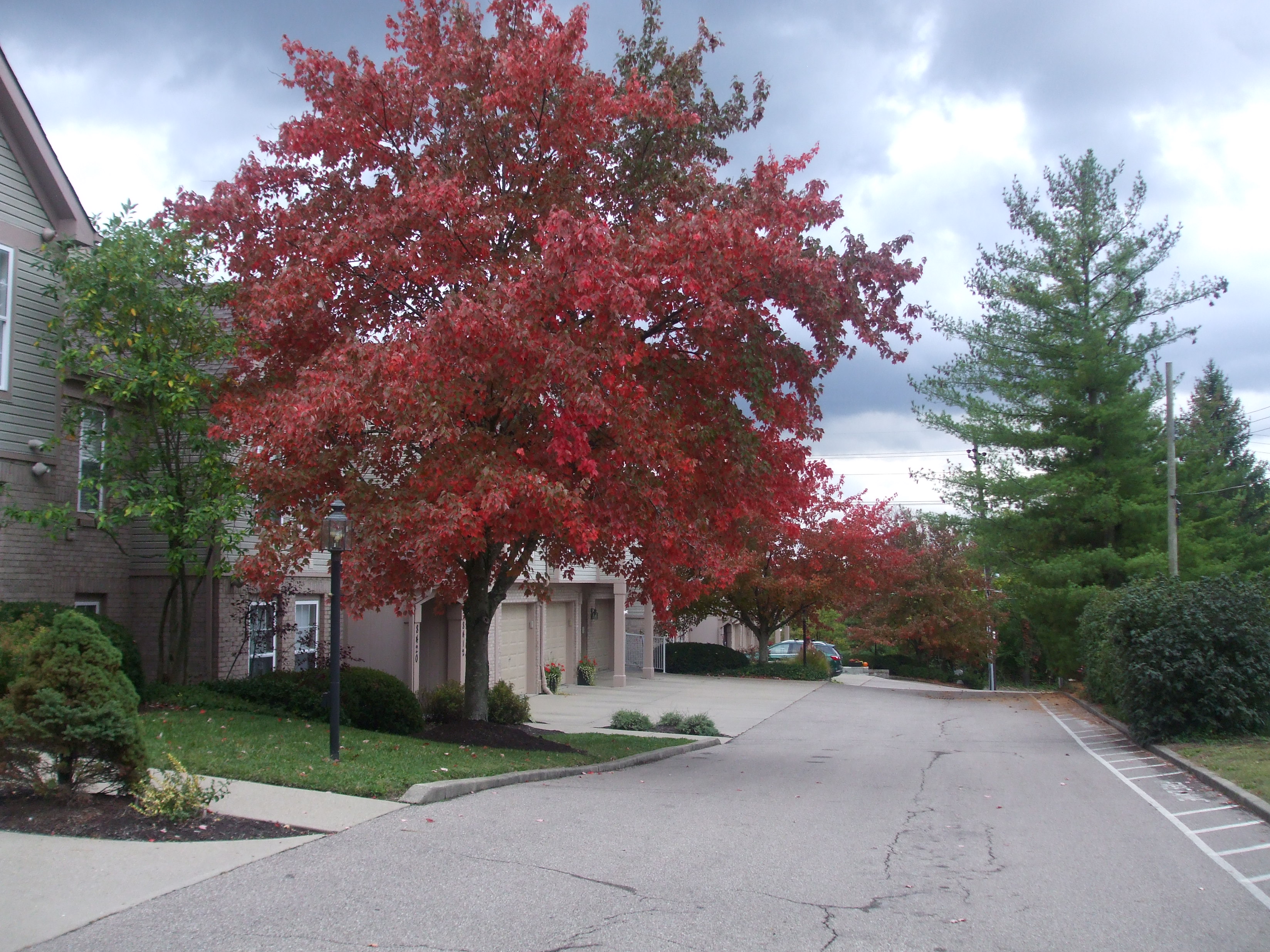
This morning I am thinking about the little incremental changes this disease of Parkinson caused in Cheryl. The trees in these pictures are maples and they are turning with the season. It is not apparent in the big picture as they show below but zoom in and each individual leaf has a tinge of red around the edge of the leaf. The green still remains in the core of the leaf. Little incremental changes as the leaf begins to shutdown for the season.

Tonight and on days since I started this essay, I am thinking about the little incremental changes this disease of Parkinson that has invaded the person I most want to be with, the person where I am home, has caused in me. Our green area is smaller. And yet at the same time it is still green.

It is my goal to talk to her on a level that is her. Sometimes her behavioral response to some situation can appear childish to me. It has only recently come to me that I must ignore that perception and talk to her as I once did. Almost every morning when I wake her she will ask, “Can we still get to church?” or “What time is church?” I used to respond with, “There is no church today.” Sometime in the past I decided that response was unhelpful. These days when she asks me about church I take that to mean, “What is on the agenda for today?” She has little memory of what we may have discussed doing on the previous evening when we went to bed.

Aphasia appears often. When she is telling a story it is very important to her to get the names dates and places correct, even if she is way off the mark. Her mother is no longer on this Earth nor is her sister Janice. Cheryl tells stories about them or visiting with them in the present tense. Once in awhile I might tell her that her mom is in heaven. She will respond, “Are you sure?” That question reminds me that it is unimportant to correct her perceptions. I have a difficult time resisting the natural male response of – bullshit that is not the way it is.

It appears to me – just observation – that although she can read, the words are mostly meaningless. It the morning over breakfast we look at the newspapers. For me that is the Wall Street Journal. For her that is the Cincinnati Enquirer. I have two observations; She does not recognize that they are two different papers. She is unable to comment on articles that she may be looking at in the paper. (I have asked.) The particular article might be about some city council fiasco. She will tell a story about Sr. Janet and what the newspaper tells Cheryl about her job with the parish office.

I know there is some green still left in the middle.

I am thinking about how it has changed my focus. I used to worry about how late she slept in the morning. The why of that worry always comes back to how much sleep I will get that night. Those two ideas are connected only in my mind. They are not connected in practice.

It changes my perspective. There is a bigger picture. Just like these trees on our property, when one zooms in one sees the differences in the leaves but when one zooms out one sees beauty.

It changes my interest. What can I do to enable her to reminisce even if her memory is weak? Perhaps I can aid her reminiscence. Comment about her stories to get her to tell me more.

It changes my observation of the universe. There is beauty everywhere you look. Cheryl is always telling me about the moon when we are driving somewhere. I look too. She can see the moon in the clouds. So can I if I look carefully and listen to where she says she sees it. A shape in the clouds looks to her like the moon. I long to see through her eyes.

Maybe I could read to her rather than watching her struggle to understand printed words.

Carpe Diem.

Another Learning Experience (God I Hate Those)

Learning and Letting Go

Care partners get practice every day at letting go of anger and frustration. In the evening and overnight cognitive decline and memory loss manifest as sun-downing and confusion. Last night was one of those and one in which the sleep helping medications did not work.

After a couple of hours of fidgety and squirmy, up to the toilet and looking for medications to take, eventually Cheryl fell asleep. Eventually, her care partner fell asleep also after hearing the living room clock chime two.

In the theme of “Carpe Diem” my thought on this morning is to be bright and cheery. I am typically not a bright and cheery person in the morning. Cheryl will not be but she has Parkinson and did not sleep well.

So where is God at 2 AM? He is probably asleep as should all of us who are not on night watch.

I learned two things from this experience. I learned these before but the lessons did not stick with me. First, I learned that anger inhibits sleepiness. I had a difficult time relaxing enough to attain sleep mostly because I was angry with Cheryl at 1 AM. And second, Cheryl will not remember today. She will be aware of only one thing in the morning and that is being tired. She may remember me being angry but will not remember about what.

As I said, this is not a new lesson. It is merely one easily forgotten because it is human to feel slighted by another. The real lesson is, “It is not her.”

Letting go of yesterday’s and early this morning’s emotions will be a better way to start this day. Yesterday is past. Today is a new day. Seize It!

Carpe Diem.

A Quiet Monday

My mother always hated Monday. Even after she was long retired from her working career she would refer to Monday as Bloody Monday. I never understood that attitude.

This Monday morning Cheryl is sleeping in the other room. Quiet after she had been up concerned about strange thoughts just before midnight. She was worried about when Jan and Nancy were going to pick her up. Jan has passed away. Her thoughts are often very jumbled up these days.

Yesterday evening she was very anxious about our nephew Mark and his girl friend Jill. This was brought on by us driving past the FedEx terminal near where we live and Cheryl asking about Max working at FedEx. I responded with the fact that Mark, our nephew, worked for FedEx. I asked if she meant him. She said yes, I think so. And this launched her into several hours of on and off conversation about him and his girlfriend Jill (I quit correcting her ideas) and birthdays and presents and on and on.

After awhile it is very hard to deal with random nonsensical conversation.

I convinced her we should practice her voice exercises. We shouted MAY, ME, MY, MOW, MOO for several minutes. And tried to make AH last for ten seconds. Parkies do not breathe deep. In Cheryl’s case she often has very little air behind her vocal chords.

We rounded out the evening by watching 60 Minutes on CBS and then the movie “80 for Brady” (for the 53rd time).

I am starting to wonder where she has gone in her mind. She has exhibited several unusual behaviors over the past couple weeks but I disregarded them to simple tiredness from her current PT schedule. Physically she seems to be moving worse so none of this seems to me to be helping her.

A few days ago she sat in the rocker in our living room and stared out the window at the bushes in the overgrown lot behind us for two and a half hours without moving. She did not speak during any of this time.

She puts together random collections of pieces of paper and photographs. Some of these I have taken out surreptitiously of her circulation and put them on my desk to look inside her mind. I think it may be scrambled but occasionally I find little gems.

These pictures of Dad were attached to one of Cheryl’s lists of stuff: Moeller; Dr. & Mrs. Fred Kraus; Jeane Krause; Mr & Mrs.; Barb Kalb; Find Barb’s Christmas card; when I find the list compare the list to current addresses for all; Lists <-> Krause, Torbeck, Driscoll, Weisgerber, Welch; Make a list – Cheryl Torbeck, Cheryl’s friends… None of this has anything to do with these pictures which were probably collected for my father’s funeral in 2007. I am glad I found them.

Maybe one day I can find her mind for her and give it back to her.

Carpe Diem.