More Things that I Have Learned

  • If you are going to try to get your PwP to speed up to go somewhere make sure you have your act together first.
  • What ever schedule that you have in mind is busted, so, move on.
  • Some people sleep in occasionally. It is not apathy, just the ordinary need for luxurious life.
  • “Church” is merely another name for going somewhere. Just repeat the answer to: Where?
  • Do not panic when she asks where we are sleeping or asks if we are going home tomorrow. Tomorrow she will not remember.
  • Read her email once a day.
  • Casually look in her disorganized office once in awhile to get a feel for where things could be when “I can’t find my…” comes up.

This is a continuing list and when I stop to think about it and all the things I have had to learn and do it makes me smile. Frustration creeps in sometimes but I think that most of the time I can push it away. The times that I cannot are about what this disease has taken from her.

Carpe Diem.

Distracted Morning

Sometimes when I am distracted in the morning and helping Cheryl along to her next task I poke around on the the internet of all knowledge and little information (aka world wide wait, world wide waste, wordle word wrestle, etc.). Google is helpful with amusing little short articles to pique your interest and use up a few minutes of your day. I tripped over this:

The Simple Trick For Removing Stuck Labels From Glassware – BY AUTUMN SWIERS/AUG. 18, 2022 2:22 PM EDT

Maybe you’ve heard recent rumors that Mason jars are the new, unofficial beverage holders of hipsters. Even CBS News says, ‘to be truly hipster, one must drink from a used Mason jar. It doesn’t count if you bought one in a store. It had to be used for another purpose, like for blueberry jam, pickles, or canned peaches. (CBS made the statement when a Chicago 7-Eleven began selling slurpees out of Mason jars, calling the move a “Hipster Apocalypse.” HuffPost expressed a similar sentiment.) A recent survey by the International Food Information Council, via Food Insight, found that younger generations care more about sustainability — and a hipster is “usually [a] young person’ It’s fitting, then, that recycling your used Mason jars, and other glassware, is an easy way to make an environmental difference. You can reuse that old jam jar to sip cold brew out of, to keep food fresh, to plant flowers in, or for storing buttons. But, maybe you simply don’t want the glass jar you’re using to hold those cute cozy overnight oats to have a big “Pepperoncini” label across the front.

Luckily, there’s a simple trick for removing stuck labels from glassware. Whip out the baking soda

To remove a stuck label from your glassware, craft supplies purveyor Avery suggests scrubbing the label off with acetone nail polish remover, rubbing alcohol, lighter fluid, or cheap vodka. Let the label soak face-down in the solution of your choice for 15 minutes, then scrub away with a sponge. Frugal Minimalist Kitchen recommends employing the help of a scraper. But, if chemicals and tools aren’t really your thing, there’s another method.

Simply submerge the glassware in a pot of warm water, add a little dish soap or baking soda, and let it soak, says The Kitchen. You can heat the pot directly on the stove. The labels, it says, should come off on their own, but spot-scrubbing with baking soda will take care of any stubborn residue. To safely remove the hot glassware from the pot, use tongs and transfer them to a dish towel to cool. (If you’re all out of baking soda, Aim Plastic Free says white vinegar works, too.)

Sustainably Kind recommends a similar technique, but with a slight variation. If you’d rather bypass the hassle of putting a pot on the stove, it says, you can simply fill those jars or other glassware with boiling water from a tea kettle. Let the water heat the jar for 3-5 minutes; This will soften the adhesive that holds the label on, and you should be able to easily remove it while the hot water is still in the jar.

Next up — HERE’S THE TRICK TO COOKING THE TASTIEST BACON ON THE PLANET — could it be fry it in a skillet?

I had to laugh at myself for spending a couple minutes reading all these words that can be summed up as wash it. I am not a hipster. Maybe hipsters do not understand washing, after all, they have apparently only recently discovered glass. (Who was Mason, anyway?) I am glad, however, that the kids have rediscovered glass. We used to drink beer from glass jars when I was in college… in 1970-ish.

Cheryl has had breakfast. Shortly we will go to her last physical therapy appointment and decide what happens next. She slept a little later this morning but she seems rested and relaxed.

Carpe Diem.

The Art of Marriage and Care Partnering

An empathetic and caring atmosphere for your partner with Parkinson and dementia, like a good marriage, must be created. In the art of marriage the little things are the big things. The same is true for care partnering. Small things are meaningful to both.

It is never being too old to hold hands. Physical touch is a comfort. Holding hands and helping someone you love up a step or into the car or into a chair at the restaurant is a sign of love. Doing those things without complaint and without request is a sign of grace. Look for grace in your life.

Remembering to say, “I love you” at least once each day to a spouse who is also graced with a chronic disease is reassuring. She did not ask for this disease. Reassure her that she is not an annoyance to you by saying this often. As a care partner there will be times when you do not feel that way in that moment, breathe deep and remember how it was and use those thoughts to see her as she is now.

Never go to sleep angry. Anger is available every day. It has no place in the bedroom at night. (This may be the hardest lesson to learn.) Just remember that everything seems worse at night. Sleep later into the morning hours. There is always light after the darkness.

Discussing and having a mutual sense of values and common objectives that are important to the partner who is burdened with Parkinson is essential for helping her to manage the disease. Occasionally anxiety creeps into my thoughts and voice. When that happens I become a naggy care pusher and not a helpful encouraging care partner. If you can, resist becoming a naggy care pusher.

We are standing together facing the world. This is a joint effort. (A platitude – many hands make for light work.) Care partnering is forming a circle of love that gathers in the whole family. It gathers in your circle of friends. It affects the person with Parkinson directly both physically and sometimes mentally. Parkinson is a change. Parkinson is not a purgatory.

Care partnering is speaking words of appreciation and demonstrating gratitude in thoughtful ways. These words are exchanged in both directions. These words are not expected. These words are freely given.

Care-giving has the capacity to forgive and forget. Give each other an atmosphere in which each can grow. Share your thoughts and ideas with each other.

Find room for the things of the spirit. And when the spirit moves, search for the good and the beautiful. Keep on the lookout for those “Aha” moments to learn from.

As it is with marriage, care-giving is not only partnering with the right helpmate. It is being the right partner. Parkinson’s sucks is the phrase Michael J. Fox uses. By helping each other PD sucks less.

Carpe Diem.

EEEEke, Get Outta Here!

House centipedes occasionally wander into the house. This morning one went to its demise after scouting for prey in our kitchen. If you read the link to family handyman at the beginning it tells you that you probably should not kill them. Cheryl did not read that article.

Watching that activity, I thought about it from the bug’s point of view…

bug – “doddy-oat doe” Humming to itself. This looks like a good place to hunt as it moves into lighted part of the kitchen floor.

Cheryl – “Eeeeke! Get outta here you!” Lot’s of thumps and bumps while she tries to get up.

bug – “Holy cow there must be some kinda earthquake going on.”, it thinks. It freezes to check its surroundings.

Paul – “What’s happening in there?”

Cheryl – “There’s one of those thousand leggers.” As I come into the kitchen she says, “There it is!”, pointing to the insect hiding under the base cabinet front. I grabbed the fly swatter hanging on the pantry door and handed it to her as Mr. Centipede scampered out of harm’s way under the refrigerator.

Paul – “Here use this it will work better.”

The centipede stayed under the fridge for a few minutes searching for prey and weighing options for escape. Soon the cry erupted, “There you are!” WHACK. WHACK WHACK.

bug – “Damn. Crazy woman. What is up with you? I’m outta here.” It retreated back under the fridge and Cheryl shoved the fly swatter under the front of the refrigerator in an effort to chase the bug out from underneath. It reappeared to the left when Cheryl was probing to the right. She whacked at it some more as it attempted to scurry away.

bug – ” Ow, ow ow. OUCH. That hurts. Why are y…” Centipedes are delicate creatures and tend to disintegrate with a direct hit. This one did just that.

Gone to centipede heaven as dust.

Cheryl – “Got it!”

There is a rule in our house. No bug of any type may live there. No benefit may ameliorate the absoluteness of none.

I laugh now. It is entertaining to watch. I used to worry because of Cheryl’s balance issues. I worried that she would fall down chasing a bug across the floor. And then I realized that often her Parkinson disappeared for a bit. The necessity to cause death to all bugs overrode any Parkinson. In fact she is pretty good at mashing ants with the tip of her cane or the tip of a walker leg. The only thing that needs improvement is her reaction time.

Bug whacking is also pretty good exercise. She will come right out of the chair to bush whack a bug.

Carpe Diem.

It is August

Cheryl asked me – When is Thanksgiving? I told her the last week in November.  We moved from there to me explaining it was still four months away. We were on the way to two appointments yesterday. It was earlier than I would typically schedule anything for Cheryl but in a weak moment on the phone with a scheduler who was trying to consolidate trips, I gave in.

Today she is part of a research study. The MOCA assessment is part of the study.  There are many other instruments used. Some of these are poorly designed but in a way that is part of the assessment overall.

Physical assessment involves weak side motion testing. Resting tremors in different positions. The neurologist researcher wanted to test her walking but she was unable to do that unaided. After all of this Cheryl donated a blood sample and a urine sample.

We went from there to a scheduled visit with the nurse practitioner who works with her movement specialist. Maureen says that physically Cheryl assesses the same as when she last saw her in January.

She complained of tiredness afterward so we went home instead of to lunch somewhere. Cheryl thanked me for taking her to all her appointments and making sure she did not miss any.

Carpe stabilized Diem.

She lied to the Therapist

But did she lie on purpose or did she merely confuse real actions with thinking about them? Dementia and memory issues interfere with answering simple questions.

The physical therapist asked her about doing the same exercises at home when she was not seeing the therapist. Oh yes she replied, ” Every day.” This was probably an hour after her meds and she moves pretty well. Talking to her is much like a regular conversation. The mistruth just rolled off her tongue. In her head, she had done the exercises.

For a statement to be a lie it must have the added ingredient of intent. One must intend to mislead. Cheryl has no such intent. Her intent was to please. Eventually with my urging she will practice some of the exercises.

Switching from a siting position to a standing position is a struggle for her. At physical therapy Morgan and Stephanie practice this with her. She struggles to remember the sequence of small moves. We will keep practicing at home. I wonder if she will eventually will forget how to feed herself. I wonder if her body will no longer sense hunger.

Cheryl has lots of stories. Many of these stories are embellished memories. We all have some of these. Many of these stories are explanations of motive. Many of these stories are to please the listener. None of the stories are intentional lies.

Scooch forward in the chair, Heels behind your knees, Lean forward from your waist (nose over toes), push off the chair with your hands, straighten your legs — grab the walker on the way up. Practice.

Carpe Diem.

The Road of Caring for Another

A couple of months ago I seriously doubted my ability to care for Cheryl on a long term basis and looked into memory care facilities around where we live. There are a lot of them.

Now, after having clicked on the wrong thing on the internet of all knowledge, I am deluged with calls from the marketing folks of all the facilities within a twenty mile radius. The world wide social media network – Facebook (aka Meta) – sends me two types of ads on every other post on my “news feed” advertisements about Parkinson stuff and memory care places.

I suppose I should be smarter about see more when I see it dimly printed at the end of some paragraph I started reading. I suppose I should be smarter about a lot of things but sometimes you want to just see more of the text. Sometimes you merely want to have one question answered up front, “how much?” Used car guys know enough to not answer that question directly. The trick is to keep ’em on the lot and find the lowest possible number where the client says, “I can do that.” It is the whole reason for, “For 50 cents a day, you can feed this orphan in some obscure country.” – ads on television early in the morning. The Shriner’s hospital ads are especially compelling. (Oops, I have digressed.)

I fell for it and probably always will.

On the heels of making that mistake, I did sign myself up for a care giving (care partnering) class that also produced a fount of valuable information without the “scam likely” phone calls coming to my cellphone while driving somewhere.

The class itself has given me new insight into how important it is for me to seek out help from others around me, take time for myself to do the things that I enjoy doing, and to give those things and myself priority in my (and our) life. I have at the same time become aware of not dumping on friends and family to “take care of Cheryl” for me. Most of the time in the daylight Cheryl can take care of herself.

I do not have Parkinson disease but Cheryl does. In order for me to stay healthy enough to care for her, I have to stay healthy both physically and emotionally. I thought to write mentally also but emotionally covers it. I use the term anger but that to me means -frustration, disappointment, anxiety, sadness mixed with a little collegiality and a lot of empathy and love. And maybe a little grief is there too.

I have written this before I truly hate this affliction and what it has taken from her but I have to be as upbeat as I can about things. Some days that is harder than others.

Carpe Diem.

PT Goals

Ten meter walk – How fast does it take to go 10 meters? (36 sec) The metric system is everywhere except in American society.

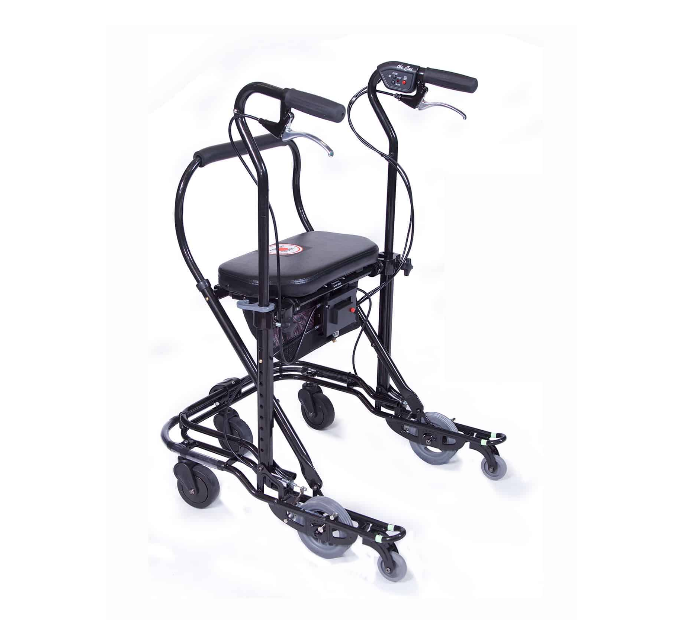
This U-Step is  a great walker. Why don’t you use it inside? It is a great question from the physical therapist. When I first brought it into the condo it merely sat next to the dining room table until we went somewhere but in Cheryl’s defense there are a lot of close by things, chairs, tables, half walls, door handles and grab bars that she ignores the walkers during the day unless she is feeling very unsteady. We have had a standard looking walker for quite some time. She worries about bumping into things.

We do use it when we go anywhere away from home. The wheels track in what ever they got pushed through elsewhere. I do not care about that. It is old carpet on the floor. It cleans up good when the carpet cleaner folks show up. It is just another maintenance item for the budget. I can encourage her but usually it sits by the dining room table. – This goal is use the walker more for safety.

Sit to stand – scooch forward, lean forward… like a rocket ship… push up off the arms of the chair. Stand to sit – lean forward and reach back, hold the chair and sit. The PT person provided this as a recipe for standing up. I have helped her with this at home but when we start it from a sitting position I can she her become anxious about making a mistake and “getting up wrong.” I am unsure about how to help her past this feeling.

Balance 7/56 — I took this note but I am unsure of its meaning now. I think it is intended to mean that of several tests for balance (56) Cheryl has a poopy score for balance. She has to think about balance. In most of us it is an autonomous function.

Difficulties with balance and walking are linked to the brain changes that take place with PD. For people who don’t have PD, balance is automatic, a reflex. But Parkinson’s affects the basal ganglia (a part of the brain essential to balance). To compensate, the brain assigns another brain area — an area used for thinking — to take over. The thinking part of the brain, mainly the frontal cortex, can’t control balance automatically. The result: for many people with PD, balance becomes less automatic.

https://www.parkinson.org/blog/research/Walking-with-Parkinsons-Freezing-Balance-and-Falls

more exercises

Stretch – lay like a T shape raised knees over to one side back to middle – one side then the other.

Sit on a chair – Reach up open the chest – bring arms to horizontal – twist trunk to one side and then the other with arms outstretched.

Carpe Diem and many trips to the PT experts. Next up – Occupational Therapy.

And Last Night was Bliss (Again)

The ups and downs of this Parkinson thing do not seem to allow for planning, comfort and looking-forward-to-ishness. I imagine it is the biggest headache we care partners have to deal with day to day.

In addition to the fact that Cheryl can be great one moment and in the next she can be off in the weeds punding or hunting around for something that does not exist or merely worrying about something that is days into the future, she sleeps fine several days in a row and then one night is up. If one does not have Parkinson one can still have sleepless nights occasionally. Parkinson merely makes it more annoying. But, holy cow, it can be really annoying and not only for the Parkinson person.

The previous night was miserable. She did not sleep until about 3 am. Last night she laid down at 11 pm and did not move from that position until 7 am when the LOUD AND ANNOYING alarm clock went off to signal TIME FOR MEDICINE. That is what it displays in two inch high bright green letters after it raises its brightness level so that it is visible on the moon.

I got her the meds. She took them and laid back down for a bit to allow them to work. I put the Kleenex box in front of the message to the lunar astronauts. I felt rested.

I went to turn on the “news” and was shocked to learn that there were sexual hi-jinks going on within the Southern Baptist Convention. Hoping for more news about the Pirates of the Caribbean star Johnny Depp and getting instead the fact that Hunter Biden was, as a husband, a stinker as told in a new tell-all memoir by his ex-wife, I turned it off to do the Wordle. Ho hum.

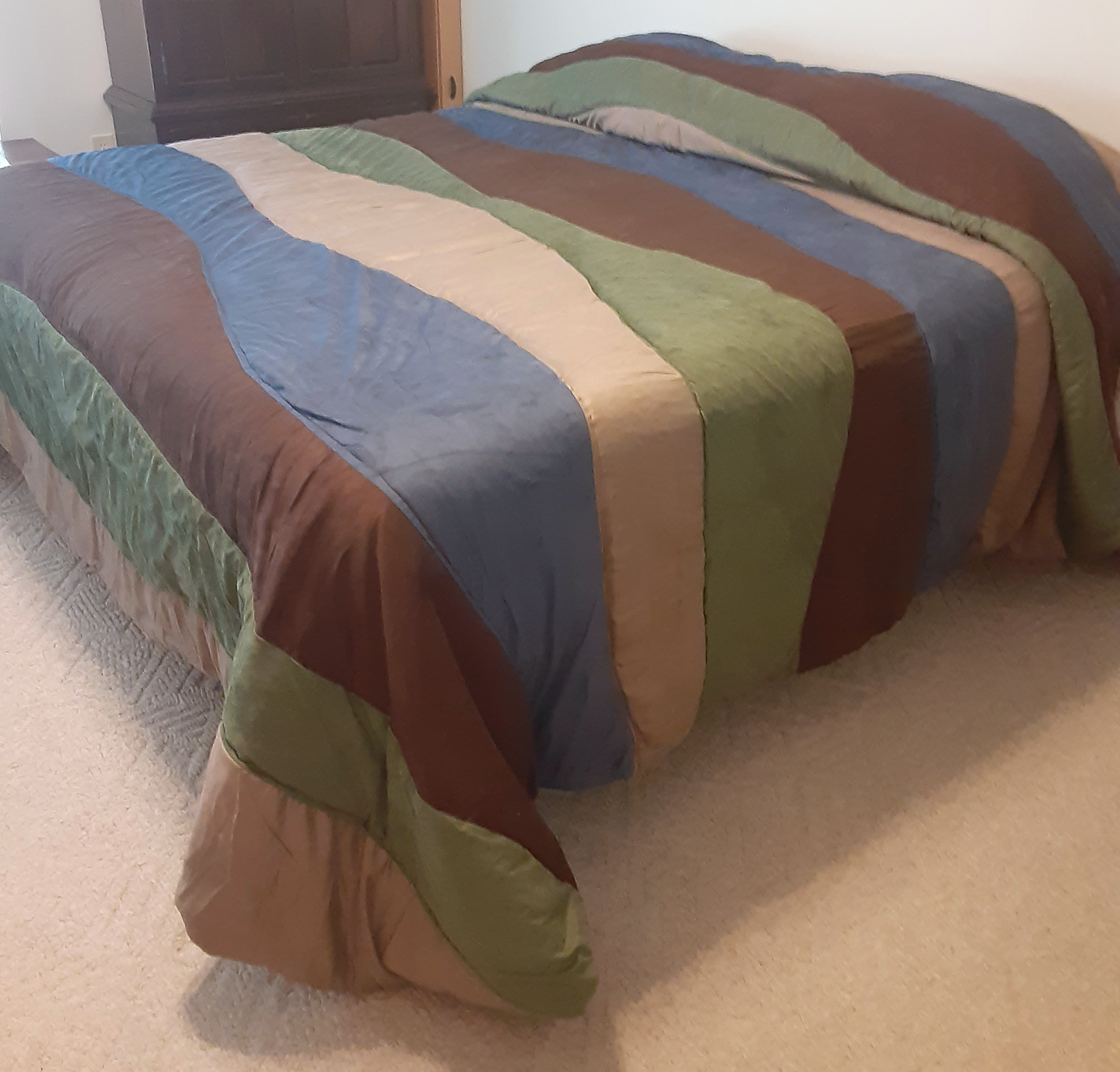
She got up a little later and put the big new bed back together.

We are up at the regular time with no extra laundry today.

Life is good.

Carpe Diem.

How Many Things Change

It occurred to me this morning as I was reaching for the Cheerios that lots of tiny things have changed in our life together. Not all of them are Parkinson changes. All can seem associated with Parkinson. I will stop using the possessive and leave Parkinson by itself.

Starting with Cheerios, Cheryl rarely ate Cheerios until recently. The why of that thought is unknown. It may or may not be a parkinson. Before Cheerios she was a huge fan of Life cereal. So much so that I was buying Life cereal in the four box collection from Boxed Up online. For several months perhaps a year and a half it was Life cereal, some dried cherries on top and orange juice. Then it suddenly switched to Frosted Mini-Wheat cereal but only for a couple weeks. Sticking with the heart healthy ideas I bought some Cheerios for myself on day as I passed through IGA shopping for the other things on my list. They were quickly adopted by Cheryl as a breakfast option. Cheerios is the current choice virtually every morning now.

A Partial List of Changes:

  • cars
  • house
  • travel
  • motivation
  • dementia and support
  • bicycles
  • relationships
  • Morning routine
  • Sleeping routine
  • Sleeping
  • Memory
  • Intimacy
  • Me and tea
  • showering and hygiene
  • keeping track of meds
  • adjusting meds
  • Exercise
  • Daily chore responsibility
  • Plumbing
  • handholds around the house
  • Emotional response to songs
  • Financial maintenance
  • Falling and fainting
  • Writing
  • and on and on…

As these changes occurred in our life together I did not take notice of them, I merely rolled with it at the time. I admit to being initially annoyed and sad to see something change away from what it was. Old people like to keep things as they are. The past tense is disappointing but the Beatles broke up in 1970. People move on.

Parkinson symptoms are treated with powerful mind altering chemicals. It is the doctor’s call as to what will help. It is the care partner’s call to observe and listen and respect and help with those drugs. The doctor is global and strategic. Day to day caring is tactical, down-to-earth and immediate.

Carpe tactical Diem.