My search for grace and meaning after a former care partnering life with a wife who suffered from Parkinson's disease and dementia giving her a confused and disorienting world.
Yesterday was Hallucination day! I try to schedule very little for Monday. When I was still working it was one of those days that it was unnecessary to plan. Monday usually awoke with a bang and set the tone for the rest of the week. These days it is merely “wash the bed linens” day.
Yesterday which was Monday also was Hallucination Day. Cheryl’s little girls visited for most of the day. They were vividly apparent to her. She talked to them while she was working on organizing her stuff.
I had taken her medication to her in her office on Sunday evening. She was talking to her cousin and spilled the water on a couple of address books that she uses to organize the birthday card activity. A disaster occurred when the books got wet. Yesterday I got the hair drier out and showed her how to use it to dry the pages. She spent a couple hours and an enjoyable conversation with – she said – Virginia. It seemed harmless so I went with the flow. I worry about the eventual outcome.
An aspect of this is that I am able to get her to come back from who she sees by talking to her directly and getting her to tell me who or what she sees. At least she doe not see visions of horror. A drug she took about three years ago caused horrific visions especially at night.
These days she sees her sister Janice and our granddaughter Virginia mostly. Yesterday she saw her Dad, Mom and my mother. She had a long conversation with my mom on the back porch as she swept some twigs and dirt off it that was left by some storms that passed over during the past weeks. When I asked her to come in to eat dinner she asked if my mother was eating with us. Pointing out that Mom was dead dissipated the vision.
The hallucinations are activity related. She talks to Virginia when she is doing arts and crafts. Janice shows up at night when she is sleeping or awake to go to the bathroom. Her mother seems to appear when she is thinking about and working on the card list. It seems like she occasionally mistakes me for her dad when I am working on some household project. Our sons come and go at random in her reality. She often thinks our youngest is here when we are getting ready to eat.
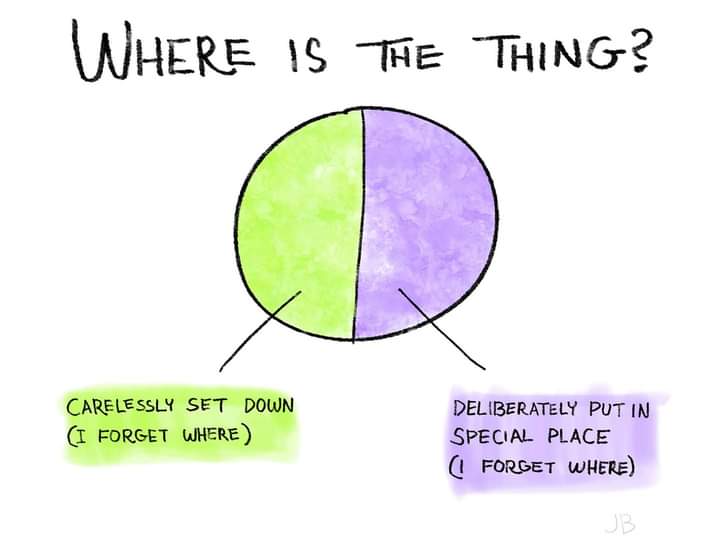
A favorite organizational chart or crafty Venn Diagram
Every now and then the whole confusion and got to get organized thing adds together with the memory thing to make life miserable for a few minutes or hours while I try to locate an important something for Cheryl. Today it was a couple of checks that her friends who are not internet savvy gave to her to donate to her sunflower fund raiser. She put them in a special place while I was not paying attention. Just when things are going smooth and the road looks straight a tire blows out and the vehicle veers off into a ditch.
It is much easier when I can see where she stashed (whatever) in the Special Place. The checks were discovered inside an old envelope from our nephew Stephen that was used to mail a thank you card to his grandmother now deceased. I suppose the envelope was kept because it had a current address for Stephen at the time. Why it was not recorded and then pitched is beyond this humble person’s understanding. Why it is in our house ten years later is less so.
Caregiver Anger — Damn this disease! In her confusion she found this envelope parked where Jill and Michael’s envelope had been parked for weeks. (The Special Place).
It is possible to laugh and cry at the same time.
It would be so much better if she was merely slow and stiff. I say this without meanness. If this was merely a physical disability. It might be easier for me personally to deal with but I am merely speculating. The mental difficulties come and go. They go less so of late. Mentally she is still young and agile. In the present she is older and fragile.
I worry about her falling and then she tells me she can not find something. I help her to find it and she is sorry to have brought an extra task to me so she puts herself in precarious positions to help look for it.
Diddle diddle dumpling, my son John : Went to bed with his britches on. : One shoe off, and one shoe on; Diddle diddle dumpling, my son John — It is interesting what jumps into your head at odd moments.
This morning after sleeping in for a bit Cheryl was still sleepy when I checked on her and asked about breakfast. She decided cereal was good and I dressed the bed. She used the bathroom and when she returned began searching through things setting on the dresser in front of the mirror on her side of it. I asked what she was looking for and at first she did not want to tell me . Eventually she told me she was missing an earring.
She had worn her little star sapphire earrings to watch our grandson’s ballgame last evening. One was still in her ear. one was at that moment unfindable.
I had to attend a meeting at school this morning, so I would be gone for a couple hours. I promised that I would help her find the earring when I returned. Although I had extracted a promise from her that she would not disassemble the house looking for earrings, I knew that she would be thinking and searching the whole time I was gone.
Later after I came home from my meeting I looked for and found it. She had taken off one and put it in the jewelry box. She had left the other in her earlobe when she went to bed last night. She was very tired last night when she went to bed. She had had a long day.
Anna and the girls had come to take her to her exercise class. They went out to lunch at one of Cheryl’s favorite lunch places. That allowed me to go to my caregiver’s support group meeting at lunchtime. In the late afternoon we watched Max play baseball. It was a long day for her but she enjoyed every minute and she told me so on the way home from the game. “Thank you for the nice day, Dear.” she told me as we drove home.
The little ditty about my son John jumped into my head when I found her earring and became a hero to her this afternoon.
Diddle diddle dumpling my wife Cheryl
Went to bed with her life in peril
One earring off and one earring still
Unfindable in the morning chill
I find that I love her more each day and the debilitating disease of Parkinson I hate even more.
The Parable of the Lost Coin; Luke: 15.8 – Or what woman having ten coins (when I was younger, this was talent) and losing one would not light a lamp and sweep the house, searching carefully until she finds it? And when she does find it, she calls together her friends and neighbors and says to them, ‘Rejoice with me because I have found the coin that I lost.’
This story came to me as do lots of stories from the bible and elsewhere after a cataclysmic episode in our life with Parkinson’s damnable disease.
This morning was a confused and befuddled one. This is not unusual in any way with this annoyingly debilitating disease. As a caregiver I just pay attention to be assured that nothing catastrophic happens and when it happens one just cleans up as best as you are able. This morning after she had a light breakfast of cereal, two muffins, orange juice, apple pie and tea she went into her office to check things. I heard her talking into her closet as I passed by with a load of laundry.
After loading the washer I asked who she was talking to. Often she would answer these two women or these two girls, this morning she responded with ‘myself’.
She told me that she could not find the stack of yet to be mailed birthday cards that we had put together the week before and propped next to her computer. She was frantic to find them. (Like the woman in Luke’s story.) I told her the cards where there somewhere probably just under something and not immediately visible. As I went out to gather the rest of the laundry I looked in all the usual places for the stack of cards. After I made my circuit and put the rest of the laundry near the washer I checked on her again.
She had found the cards. They were turned face down on her desk and underneath some collection of printed emails that where clipped together. She explained that and then spontaneously burst into tears.
The saddest, most maddening thing to a parkie with the beginnings of Parkinson’s disease dementia is the knowledge that her cognition is deteriorating. Sometimes she is acutely aware of missing pieces of her memory. Sometimes she is unaware. When awareness comes occasionally we hug and deteriorate into tears for a bit. We contemplate the next steps of our journey. We take time to feel a bit sad to realize the journey is becoming harder to do. The steps are harder to take.
It is hard to remain upbeat. It is okay to cry occasionally and let the emotion out.
I admire those who are able to remain upbeat. Parkinson’s disease sucks!
Cheryl got up very early this morning. I expected that but hoped for not.
Today we had an early eye exam. It is time for that once a year what is up with your eyeballs visit to the eye guy.
I angrily got up to get some breakfast for her but before that she was talking to someone. An apparition standing in front of her she described as a small girl.
After breakfast she walked into the bedroom several times. I asked her what was she looking for; could I help her to find something? She replied that she was looking for that woman who takes care of the little girl to find out what she – the little girl – might want for breakfast.
As the day moved on and her meds kicked in the apparition faded but Cheryl was angry that I did not believe her.
I believed her and I told her so. I merely could not see the girl.
An update; this evening Cheryl asked me if I saw that other woman tonight when we were sitting in the theater (living room). I answered no I did not but I was not paying attention to the other people. Cheryl said that she wanted to apologize for not talking to her about the little girl this morning.
There is some longevity to the dreamlike hallucinations.
When I was in California Cheryl had a severe bought of nausea that developed into dry heaves and spasms in her diaphragm. This caused my daughter to ring up the neurologist and as it turned out Cheryl’s doctor happened to be on the hook for answering the emergency phone. He instructed her to get Cheryl to the ER for help.
Our daughter called her brother who lives nearby for extra support just in case and took her to the ER near where we live.
A few hours later Cheryl came home after they had run several tests. She had no more bad experiences while I was away. I am very glad Anna was with her that night.
Perhaps if one would choose, a bit more experience would precede making a pie for company.
About Thursday of last week, something she saw on television or read in the paper caused her to decide that she would make a pie for dessert on Sunday.
In her mind’s eye, it was no big deal. In her mind’s eye there is no Parkinson’s disease. In her mind’s eye she has plenty of stamina. On the way home from dinner at Through the Garden Restaurant on Friday evening we stopped at the grocery and bought some apples. On Saturday she cut up and peeled three of the four apples and had to sit down. I peeled and cut up the last one and another for just-in-case.
She took her meds and laid down for a bit. When she felt a little better, I made the crust under her tutelage. We (I) rolled it out and started over about a dozen times. I quit to put on shoes and gather my stuff for a trip to the store for a premade crust. On the way through the kitchen I stopped to try just once more with a twist.
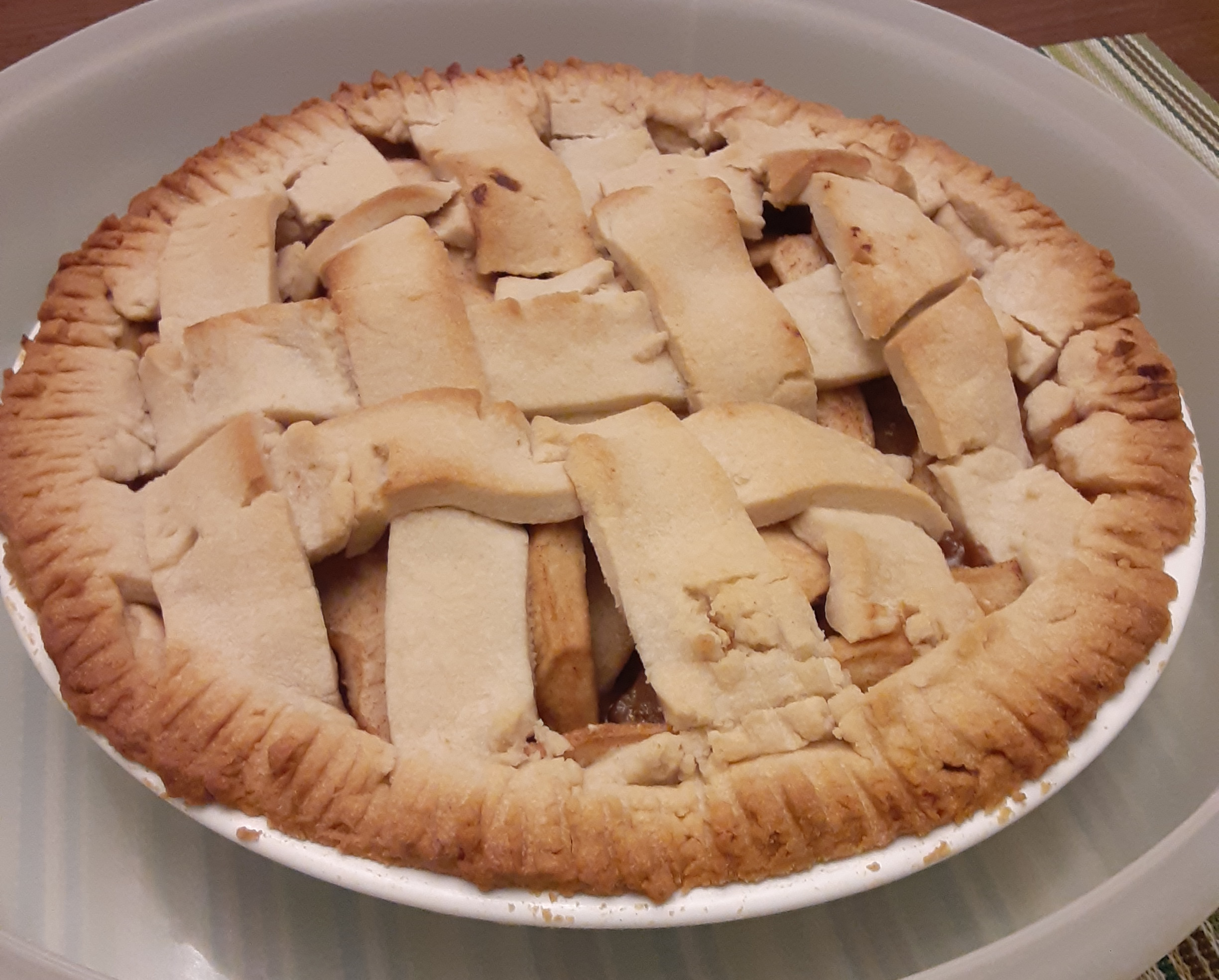
My twist worked and we (I) assembled the pie.
Today we will take it to my son’s house to see how it turned out.
My other son’s wife is an expert pie maker. I probably should have subcontracted the pie to her and they live pretty close by. Maybe next time I will do this or maybe next time I will practice making crust.
In the middle of the night, very early morning, she gets up and becomes argumentative about staying up. Its about 3AM and I admit to being less than social at 3AM. Today for the first time she told me what was happening to her. She has severe leg cramps and partial immobility.
She has found that she can combat that feeling by struggling to get up and move around a bit.
This pain is described as constant burning sensation with occasional burst of sharp pain. As it was in my case, this pain is commonly exacerbated by cold and by light touch. I could not stand the sheets to touch my skin and being in a cold room sent my pain through the roof. This type is usually bilateral but it may start on the side where other Parkinson’s symptoms begin. For me, it was the leg where my rest tremor began.
Second type of leg pain is caused by dystonia
When related to levodopa, it usually occurs as a wearing off but can also occur at peak dose. In most cases this leg pain is unilateral and has direct correlation to medication intake. When pain is due to dystonia, it is more common in early morning. This type of leg pain is usually accompanied by toes curling and foot abnormally posturing.
Third type of leg pain is musculoskeletal
Musculoskeletal pain occurs due to rigidity, abnormal posturing, and lack of mobility leading to pain in the legs. It may also affect the joint like the hip or knee. This pain is usually more pronounced on the more affected side. It can be localized or widespread and also can be sudden.
Fourth type of leg pain is radicular pain
In this case, the pain is caused by compression of nerves in lumbar area which results in weakness, numbness and tingling, and loss of reflexes from buttocks to foot in a distribution of a nerve. It can be acute or chronic, and can be worse with standing and sitting, or better with laying down. Of note: in my experience many patients including myself have these symptoms not because of physically herniated disc but rather by the stretching of a nerve in the canal as it exists due to severe musculoskeletal rigidity and abnormal posturing.
–Maria DeLeon
So there you are problem solved. 🙂 But – there is always a but – asked my wife of many years to read the referenced article and describe or discern as best she can the kind of pain she is feeling. Out comes a description of stabbing pain in her heals. In her words – like someone is stabbing pins into my foot.
So that sucks! Peripheral neuropathy can be related to Parkinson’s disease. Pardon my french but goddamn this disease. She often has numbness in her hands in the morning. It is hard for her some days to simply hold a spoon to put cereal in her mouth. I bought her four kangaroo cups (invented by a ten year old to help her grandpa) to help with her unsteadiness with the orange juice she has every morning. These work great and she likes them, so she uses them often.
Dealing with an ever changing range of symptoms, pains and degenerative cognition can wear one out.
Carpe Diem! I’m off to research different sorts of beds and mattresses, etc.
Almost fifteen years ago this summer is the time that I found out that I was a match to my youngest sister Laura. She had found out earlier in the year that she had Myelodysplastic syndrome. Her body was turning on her. She would die without treatment. Then our whole family was still alive.
Mom and Dad still lived in their home in Madisonville. My elder brother lived in Florida near Orlando with his wife. My younger sister Joyce lived with her spouse in Portland Oregon. Laura and her husband lived in south eastern Indiana and Cheryl and I lived in southwest Ohio in Cincinnati. Now only Joyce and I are still alive.
I think of these things when I donate blood four times each year. I ponder how long I can donate blood. The only answer I get when I search for that information is, as long as you are healthy, you can donate.
This started with Laura but I had donated blood before, just not on a regular basis. When I was in school at the University of Cincinnati in the last millennium an instructor whom many of us liked let slip some personal information about his family. His son had been in an accident and needed blood donations. Several of us went to Hoxworth to donate. I was too young so permission had to be obtained from my parent. Looking back this detail seems odd. I was eighteen at the time.
With Laura’s diagnosis and need for blood stem cells all of us siblings were tested to see if any of us were a match. Only I was a match. I found this out from the nurse who called me as was driving back towards Boston from Cape Cod. We had gone there for a little vacation and to visit with friends. This was convenient for Laura and me as neither of us had to travel far to do this but I had to get home first.
The summer of 2007 was a long one for Laura and me. I cannot speak for Laura because she did not make it out the other side of the treatment process. I am changed forever.
The process takes several days. For me it involved a very thorough physical and several meetings with the medical folks at the end of which I was deemed healthy enough physically and mentally to go through the process. During one meeting with a nurse who also had background as a sociologist, I was made aware of the fact that there was a chance that during the implantation process my stem cells could take over her bone marrow and give rise to my immune system within her body and reject her. Not simply that it might not take and we would have a do over. My immune system would reject her. Seems like a bad thing to happen, to be rejected by your own immune system.
Blood stem cells are removed from the donor in two ways either directly from your hip or by apheresis . In Laura’s case they used apheresis to remove blood stem cells from me and gave them to her after killing off her bone marrow’s ability to produce blood cells. Over a period of several days – my memory tells me four – I was given an injection of some growth hormone that told my body to make way too many blasts (precursors of various blood cells). These leak out into the peripheral circulatory system and can be retrieved by an apheresis machine. It was a miserable four days. Not so much at first but they can give you the injection anywhere and I opted for my arm. I am pretty sure that this started on a Monday so we were ready to do the apheresis on Friday. The had to get the blasts out of me before my body reabsorbed them.
The apheresis process takes a bit of time also. I do not remember talking about the actual process at the beginning. I suspect that if the donors are given all the gruesome details at the start, some will back out. The process was generally described as similar to donating blood except that the stem cells would be removed and the rest of my blood would be given back to me.
An innocuous drawing
In this sketch you can see the general set up. Blood is removed from one arm and the returned processed blood is put into the other arm. Pick your nose, pee and fart before you get started because there is no moving around once the machine is running.
I asked the nurse technician who was monitoring the machine approximately how long it might take and she responded with eight to nine hours for the first session. She said sometimes they do not get enough the first time so they have to do it again to get more stem cells. I intermediately got up to find the men’s room and empty everything out and began to worry about how long my bladder would hold out. In the end it was not a concern. I suspect my kidneys did not understand what was happening so they elected to take a break for a few hours. I helped by not drinking anything of course but there was a bag of saline as a part of the process and some blood thinners to keep my blood from gumming up the pumps. Nine hours is a long time to sit.
Making conversation I asked how many cells they were trying to harvest. Ten to eleven million came the reply. I remember thinking that seems like a lot but I did not have any idea what they might need to do this. I was curious how they would figure out how many they had and she told me they would count them. It is amusing when you think about it. how else would you figure it out. Isolate a certain quantity of serum and under a microscope count the stem cells. Well, huh. Even an engineer can do that.
With all the needles and tubes in the correct position we started. I think the first session was about seven hours or so. There was a clock, one of those battery jobs, hanging on the wall opposite where I was sitting. What a poor place for an ineffective time keeper to hang. After five hours I was certain that it had slowed down. After six hours I was certain it had started running backwards ever so slowly. At the seven hour mark the stem cell bag which I estimated could easily hold a liter had a tiny amount of yellowish life saving liquid in it. The nurse pronounced it good and Cheryl took me home.
Oddly I was incredibly tired. I had not felt this exhausted before. I had not moved all day. But my blood did. It had been in and out of my body about ten times during the day. It was wore out. As I rested in my chair hovering between resting and sleep we got a call from the hospital, I needed to come back again for a second session. How many cells I asked. About four million was the answer. A disappointingly low number, I was certain that they would need two more times. I may have said shit out loud.
On the second day the procedure the was much faster. I spent approximately four hours in the chair with the stopped clock view. Often the donor’s body wakes up and puts more cells out there where the apheresis machine can find them. But that is not really why I am telling this story. There were several times during the next couple of weeks when I was called to go directly to Hoxworth to donate other bloods products to Laura. Platelets mostly as I recall. On a couple occasions I gave Laura platelets. I may have given her red blood cells also but I am unsure of that. She was busy staying alive and I was trying to help. All of these experiences got me used to the activity of donating blood.
I started doing this at the main Hoxworth Blood center near UC Hospital in Clifton and then later discovered that I could do this at another collection center in Blue Ash, Ohio. Once when I was there donating, the nurse technician asked me if I had ever considered giving a double red. After a discussion of what was entailed and other questions, I tried it.
This is Laura’s legacy. Her brother became so comfortable with donating he continues to do it fifteen years later.
I often think about Laura when I am sitting in the chair listening to the apheresis machine do its thing. There is no stupid clock to stare at. I know now how long it takes. It takes thirty to forty minutes. Sometimes it takes longer because the technician is often monitoring other donors. Most often I read a book on my tablet reader. Occasionally I listen to the patter of conversation around me.
Hoxworth is actively soliciting folks who have had SARS CoV2 disease because their blood contains substances that can help those who are recovering from that disease. These folks sit across from where I am donating.
Over the weekend the reward for donating was a free T-shirt. Free t-shirts were the give away today, Easter Monday also. I selected a St. Patrick’s Day themed shirt. It is in the picture.
Laura’s recovery was long and arduous and fraught with disaster. She spent about six weeks in a coma as doctors tried to discover the source of her liver inflammation. Veno-Occlusive disease was the suspected culprit.
Hepatic Veno-Occlusive Disease (VOD) AKA: Sinusoidal Obstruction Syndrome is a well recognized complication and leading cause of mortality in hematopoietic stem cell transplant resulting from severe hepatocellular necrosis and hepatic vascular congestion. — This is from a medical teaching website. Laura and I both read about it in a big white binder that she had gotten at the beginning of her process. I remember her looking at me that first afternoon with her yellowish face telling me that there was about a 3% recovery rate. Pretty crappy odds she said. She was a CPA and the controller of a small successful beverage distributor. She knew about numbers analysis and crappy odds.
It was not that. Eventually the doctors discovered that Laura was having a bad reaction to the antibiotics given to her as a prophylactic to infection while my stem cells were taking over. She did recover but six weeks asleep devastated her body. During a visit at the holidays she told me that my stem cells had populated her bone marrow and was doing fine. A few weeks later she succumbed to pneumonia that could not be treated in the conventional way because of her problems with antibiotics.
Laura died with a part of me in her. Part of me died when she passed out of existence in early 2008. Watching someone whom you worked so hard to save take their last breath is a profoundly life altering experience. I hope to never participate in an experience like that again.















 Adjunct_Wizard