My search for grace and meaning after a former care partnering life with a wife who suffered from Parkinson's disease and dementia giving her a confused and disorienting world.
Several years ago we began going to a favorite local pizza store one night a week. We tried different days and over time we landed on Tuesday as the day we went out for pizza. It developed into a tradition as my youngest son would say. It became known as “Pizza Tuesday”. Sometimes in conversation a friend might say, “Can we get together tomorrow?” I might reply, “No. That’s Pizza Tuesday.” It became sacred. We did, however, invite others to our favorite pizza store to share. Occasionally one could see local celebrities such as one of the local colleges’ basketball coach there snarfing pizza like the rest of us fans.
When we sold our old house and moved to our condominium we invited our neighbor and friend Jane to our Tuesday dining adventure. It became a time to chat and catch up. Pizza Tuesday as a tradition became even more ingrained in our routine.
The pandemic pandemonium stopped much of that activity. At first we carried out (took away) our pizza from our favorite pizza store and moved our tradition home to our dinning room table. That worked well for a bit. Over a period of approximately fifteen months we experimented with pizza that was not only pepperoni. We added vegetables and fungus. We tried other sauces from the menu. We tried other pizza stores. We tried take away from other food emporiums. We expanded our flavors.
As the pandemonium eased Cheryl and I slowly began to visit restaurants with few or no utensils or menus. I learned how to use the square bar code thingy that restaurants pasted to their tables, walls and doors. A restaurant with paper menus became a favorite when previously it was not a favorite. Victoria, a young waitress at the favorite-not favorite, began to recognize us by sight. We came when she was working often. We began to look for her and tease her a bit about her constantly changing hairstyle. There was a reason to go there beyond pizza.
Socialization is a strong motivator. I worried a bit for Cheryl’s safety and health but I recognized that for her it was important to simply get out and see people other than me. Even in a pandemonium, one must live. Neighbor Jane who is immune-compromised remained isolated.
This past Tuesday evening we went back to Pizza Tuesday. The three of us went to yet a different pizza store. Perhaps, for us, THE PANDEMONIUM IS OVER! Prior to this event we made a list of various foods both home cooked and restaurant dishes that we would like to have. Jane aimed this discussion specifically at Cheryl. We will read the list and tick them off one by one. And I hope make a new list at the end of this list.
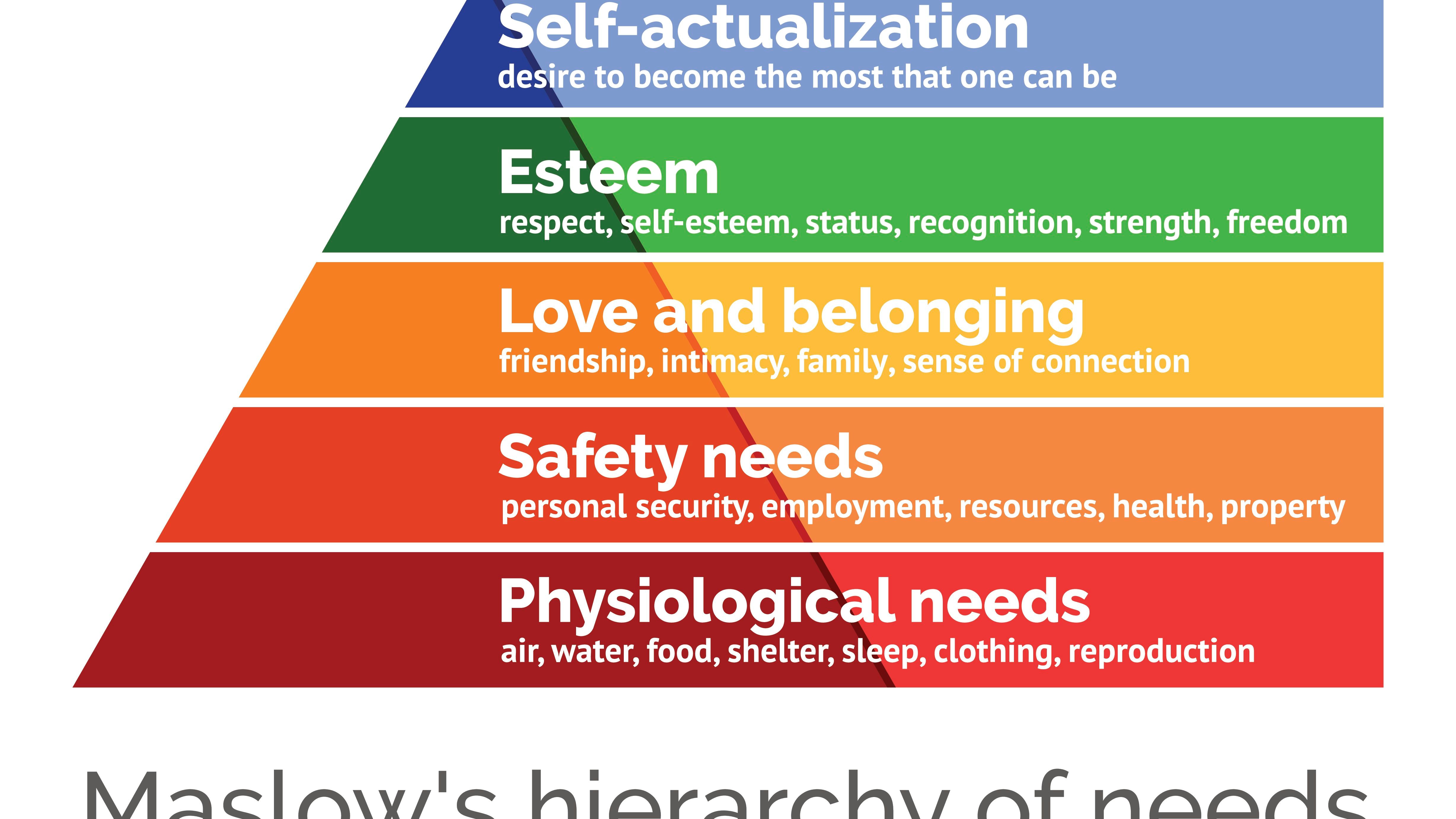
We are all three vaccinated. Not one of us has bought into the disinformation distribution on social media. Eating out and conversation provides all of Maslow’s hierarchy in one way or another. This chart is similar to one I saw many years ago.
An old psychology chart that I have not seen for awhile.
That is written on the front of my often bought bag of Eight O’clock coffee. I thought a good life philosophy.
Overnight was a hard one. Cheryl has been having a rough time sleeping at night. She has the normal seventeen trips to the bathroom overnight that occurs with any older person. Her Parkinsonism intensifies this experience.
The past few nights I have trained myself to get up with her. I have tried to get my system on her schedule. We started this because a few nights ago she awoke in a panic. She worries about incontinence. In her dreamy wake up at one o’clock in the morning, she was certain it had happened. She awakened me and I helped her to get cleaned up and new pajamas and other anti-leak equipment. (The pajamas she wore to bed were fine as were the other things but in the early morning dreamy state it is not important to argue.)
Since that experience I have awakened with her to guide her and help. I have to admit I am cranky pants in the early morning hours. It is sometimes difficult to get her interested in going back to bed. I have taken to hiding her medications occasionally because she has taken them in the middle of the night. I am uncertain that I will wake up with her and I worry that she will over medicate and inadvertently harm herself.
Last night and early morning was particularly bothersome. We got through it. I let her sleep a little later than normal before I gave her the mornings meds. She and I came to bed afterwards and slept a little longer.
Today she is very tired. She told me this earlier after her second dose of meds for the day. I told her I was not surprised at that as she had not slept well the night before. She replied that she did not remember. It seems unimportant to discuss overnight difficulties with someone who has no memory of events. I dressed the bed and helped her to lay down for a late morning nap.
Maintaining sweetness, a fruitful and well balanced life as a caregiver to a person with a chronic affliction can be hard. I have no mystical, magic or wise solutions to the stuff that pops up. Meditation does help to calm the caregiver.
[1] The first one-minute meditation involves counting your breath cycles. You count every exhalation from 1 to 10. Once you reach 10, you can go back down to 1 and continue the cycle as long as you’d like. In the audio recording, with my breath cycle, I only counted from 1 to 10 once in the 1-minute meditation.
[2] The second one-minute meditation is also a breath counting meditation. You count at the beginning of every breath cycle before each inhalation. We count cycles of 10 breaths. Once you complete 10 cycles, you go back to one and continue the cycle.
[3] In the third one-minute meditation, we take a breath before we begin to notice where we feel the breath most acutely. It may be at the tip of the nose, in our chests, in our bellies, or somewhere else. For the entire minute, you focus on the region of the body you feel most throughout each breath cycle.
[4] In the fourth one-minute meditation, we follow the entire breath cycle with our full awareness. We follow the breath from the first area we notice it (for me it is the tip of the nose) until it expands our chest and bellies, we pay attention to the way it feels when our lungs are full of air, and then we follow our full exhalation. We continue to be present with our breath and bring full awareness to the sensations of inhalation and exhalation for the entire minute.
[5] The longest guided meditation is a five-minute body scan. Body scans often range from 15 minutes to 45 minutes; however, similarly to the breathing meditations, I wanted to make this a shorter introduction to the experience to see what feels right for you. We scan from the feet to the top of the head, breathing as we bring awareness to each new area of the body.
This small list of meditations help with calm. They work for me sometimes to help me relax.
Diddle diddle dumpling, my son John : Went to bed with his britches on. : One shoe off, and one shoe on; Diddle diddle dumpling, my son John — It is interesting what jumps into your head at odd moments.
This morning after sleeping in for a bit Cheryl was still sleepy when I checked on her and asked about breakfast. She decided cereal was good and I dressed the bed. She used the bathroom and when she returned began searching through things setting on the dresser in front of the mirror on her side of it. I asked what she was looking for and at first she did not want to tell me . Eventually she told me she was missing an earring.
She had worn her little star sapphire earrings to watch our grandson’s ballgame last evening. One was still in her ear. one was at that moment unfindable.
I had to attend a meeting at school this morning, so I would be gone for a couple hours. I promised that I would help her find the earring when I returned. Although I had extracted a promise from her that she would not disassemble the house looking for earrings, I knew that she would be thinking and searching the whole time I was gone.
Later after I came home from my meeting I looked for and found it. She had taken off one and put it in the jewelry box. She had left the other in her earlobe when she went to bed last night. She was very tired last night when she went to bed. She had had a long day.
Anna and the girls had come to take her to her exercise class. They went out to lunch at one of Cheryl’s favorite lunch places. That allowed me to go to my caregiver’s support group meeting at lunchtime. In the late afternoon we watched Max play baseball. It was a long day for her but she enjoyed every minute and she told me so on the way home from the game. “Thank you for the nice day, Dear.” she told me as we drove home.
The little ditty about my son John jumped into my head when I found her earring and became a hero to her this afternoon.
Diddle diddle dumpling my wife Cheryl
Went to bed with her life in peril
One earring off and one earring still
Unfindable in the morning chill
I find that I love her more each day and the debilitating disease of Parkinson I hate even more.
The Parable of the Lost Coin; Luke: 15.8 – Or what woman having ten coins (when I was younger, this was talent) and losing one would not light a lamp and sweep the house, searching carefully until she finds it? And when she does find it, she calls together her friends and neighbors and says to them, ‘Rejoice with me because I have found the coin that I lost.’
This story came to me as do lots of stories from the bible and elsewhere after a cataclysmic episode in our life with Parkinson’s damnable disease.
This morning was a confused and befuddled one. This is not unusual in any way with this annoyingly debilitating disease. As a caregiver I just pay attention to be assured that nothing catastrophic happens and when it happens one just cleans up as best as you are able. This morning after she had a light breakfast of cereal, two muffins, orange juice, apple pie and tea she went into her office to check things. I heard her talking into her closet as I passed by with a load of laundry.
After loading the washer I asked who she was talking to. Often she would answer these two women or these two girls, this morning she responded with ‘myself’.
She told me that she could not find the stack of yet to be mailed birthday cards that we had put together the week before and propped next to her computer. She was frantic to find them. (Like the woman in Luke’s story.) I told her the cards where there somewhere probably just under something and not immediately visible. As I went out to gather the rest of the laundry I looked in all the usual places for the stack of cards. After I made my circuit and put the rest of the laundry near the washer I checked on her again.
She had found the cards. They were turned face down on her desk and underneath some collection of printed emails that where clipped together. She explained that and then spontaneously burst into tears.
The saddest, most maddening thing to a parkie with the beginnings of Parkinson’s disease dementia is the knowledge that her cognition is deteriorating. Sometimes she is acutely aware of missing pieces of her memory. Sometimes she is unaware. When awareness comes occasionally we hug and deteriorate into tears for a bit. We contemplate the next steps of our journey. We take time to feel a bit sad to realize the journey is becoming harder to do. The steps are harder to take.
It is hard to remain upbeat. It is okay to cry occasionally and let the emotion out.
I admire those who are able to remain upbeat. Parkinson’s disease sucks!
When I was in California Cheryl had a severe bought of nausea that developed into dry heaves and spasms in her diaphragm. This caused my daughter to ring up the neurologist and as it turned out Cheryl’s doctor happened to be on the hook for answering the emergency phone. He instructed her to get Cheryl to the ER for help.
Our daughter called her brother who lives nearby for extra support just in case and took her to the ER near where we live.
A few hours later Cheryl came home after they had run several tests. She had no more bad experiences while I was away. I am very glad Anna was with her that night.
Overnight conversations seem to repeat with Parkinson’s patients. At least it happens in our home.
Yesterday we had an appointment with a dermatology wizard to look at and remove a spot suspected as a basil cell carcinoma. As a result my wife was anxious before going to bed. (I think I am getting used to this anxiety about future events.)
2 AM
Get ups and trips to the bathroom happen at two hour intervals when she is anxious. On the first trip I did not hear any of the usual thumps and bumps of using the toilet, so I got up to see if I could help. She was standing in the middle of the floor looking toward the closet door on the far side of the bath. How are you doing? — I asked. I’m waiting for the elevator. — She responded. I explained that the door was a closet and the toilet was over here, gesturing at the toilet and opening the closet door.
That seemed to knock her off the fence of using the toilet versus waiting for the elevator to go up or down. Afterward she came back to bed.
4 AM
I am going to take a shower so that I am ready to go to the dentist. (I saw no reason to correct dentist v. dermatologist.) pointed out that it was four o’clock in the morning and there was plenty of time to take a shower later. Her appointment was not until quarter ’til ten. She had used the toilet earlier. I convinced her that it was okay to get a couple more hours sleep before taking a shower.
Before going into the bathroom she sat on the edge of the bed and told me that someone was in there so she would wait. I got up to look. As I open the bathroom door I announce – get moving, Cheryl needs to use the toilet. Then I tell her there is no one there.
She usually tells me there were kids in there. Sometimes she tells me that Virginia was in there. (Virginia is our granddaughter. Cheryl sees her as a five year old.)
6 AM (maybe 6:30)
She is up again with a repeat of four AM activities. It is later now so the taking a shower thing is probably a good idea. I got her morning meds that she will take at seven. She took them a few minutes early and prepared for taking a shower. I went back to bed for thirty minutes of shower noise to wait for the extremely loud alarm clock to spew its wrath on the morning rest period.
Good Morning ALL, said the alarm clock. Off we went to the dermatology wizard and the rest of the day.
Today is Cheryl’s birth date. She was born on this date many years ago. Many years before we discovered each other in life; God, fate or karma intertwined our existence together in life. It is meant to be.
Yesterday we celebrated. It was a wonderful party. She remarked as we drove home from the park, “That’s the best birthday I’ve ever had. Thank you for putting it all together.” I thank Anna, David and Scott (and Mavis, Eric and Melissa). I had very little to do with it.
Back in March or April when it was starting to warm up and we were both two weeks past our covid vaccinations. Cheryl was anxious to party with the kids and grand-kids. I hopped onto the Hamilton County parks site and reserved a shelter for her birthday celebration. Good time.
In the middle of the night, very early morning, she gets up and becomes argumentative about staying up. Its about 3AM and I admit to being less than social at 3AM. Today for the first time she told me what was happening to her. She has severe leg cramps and partial immobility.
She has found that she can combat that feeling by struggling to get up and move around a bit.
This pain is described as constant burning sensation with occasional burst of sharp pain. As it was in my case, this pain is commonly exacerbated by cold and by light touch. I could not stand the sheets to touch my skin and being in a cold room sent my pain through the roof. This type is usually bilateral but it may start on the side where other Parkinson’s symptoms begin. For me, it was the leg where my rest tremor began.
Second type of leg pain is caused by dystonia
When related to levodopa, it usually occurs as a wearing off but can also occur at peak dose. In most cases this leg pain is unilateral and has direct correlation to medication intake. When pain is due to dystonia, it is more common in early morning. This type of leg pain is usually accompanied by toes curling and foot abnormally posturing.
Third type of leg pain is musculoskeletal
Musculoskeletal pain occurs due to rigidity, abnormal posturing, and lack of mobility leading to pain in the legs. It may also affect the joint like the hip or knee. This pain is usually more pronounced on the more affected side. It can be localized or widespread and also can be sudden.
Fourth type of leg pain is radicular pain
In this case, the pain is caused by compression of nerves in lumbar area which results in weakness, numbness and tingling, and loss of reflexes from buttocks to foot in a distribution of a nerve. It can be acute or chronic, and can be worse with standing and sitting, or better with laying down. Of note: in my experience many patients including myself have these symptoms not because of physically herniated disc but rather by the stretching of a nerve in the canal as it exists due to severe musculoskeletal rigidity and abnormal posturing.
–Maria DeLeon
So there you are problem solved. 🙂 But – there is always a but – asked my wife of many years to read the referenced article and describe or discern as best she can the kind of pain she is feeling. Out comes a description of stabbing pain in her heals. In her words – like someone is stabbing pins into my foot.
So that sucks! Peripheral neuropathy can be related to Parkinson’s disease. Pardon my french but goddamn this disease. She often has numbness in her hands in the morning. It is hard for her some days to simply hold a spoon to put cereal in her mouth. I bought her four kangaroo cups (invented by a ten year old to help her grandpa) to help with her unsteadiness with the orange juice she has every morning. These work great and she likes them, so she uses them often.
Dealing with an ever changing range of symptoms, pains and degenerative cognition can wear one out.
Carpe Diem! I’m off to research different sorts of beds and mattresses, etc.
She put on her year old Nike walkers. It was one of those sunny spring days that says fresh and new is what we are up to today.
Where should we go? – c;
Let’s go up Troy. I hate to go through the dip.- p;
Okay. -c;
There is a quick look around and search for keys and other kit.
What’s the weather like? – c;
Warm. Probably no sweater. – p;
Are you sure? I thought it was supposed to rain. – c;
Nope. Sure. Look. – p;
He holds the door to the front porch open.
It does look nice out. – c;
Out the door and off on two miles or so.
Cortelyou (core-tell-you or cortil-you, your choice) avenue is named after John Cortelyou who either developed or owned that part of Pleasant Ridge. On plat maps the area is referred to as the John Cortelyou subdivision. John and his wife Martha are buried in the Pleasant Ridge Presbyterian Cemetery on Montgomery. The pavement is narrow and parking is only permitted on the west side of the street. The part of the street that they live on if allowed to connect to it would make an acute angle to Ridge road. Troy avenue which meets Cortelyou just before it drops down a short incline towards Losantiville road makes the base of a right triangle with Ridge and Cortelyou.
Troy avenue meets Ridge road precisely where Ridge curves to the right to head south again after coming up the hill from the little valley that holds Amber creek. The short street meets the thoroughfare with an acute angle to the left and a right angle to the on the other side. There are mostly single family houses on the south side of the street and mostly multifamily buildings on the north side. It is a pleasant street. Narrow along its length but bright and sunny with few large trees along its length to obscure the view towards Ridge road.
Ridge road is poorly named because it never travels along a ridge in the earth but rather perpendicular to several. It would be more aptly named Over the Ridges Road but, no doubt, this name was rejected when the names were being given out or the makers of maps became tired of precision and in their gay manner shortened the name to Ridge rather than ‘Over the Ridges’ or ‘On the Way to Ridge’ or even ‘Up to the Ridge and down Again’ road.
As they walked they spoke of their surroundings and of people they knew. He came with her as he usually did on this day to get to know her better. They were empty nesters now. All three of their children were grown and moved away. He did not often want to simply walk around the neighborhood but she was okay with that she pushed him to get out of the chair and move. It is a nice day. Let’s go.
They took the acute angle at the end of the street and walked north in front of the houses that were originally built, as the story goes, to show off the type of housing available to be built in nearby Norwood. No matter the back story these are beautiful old houses set far back from the west edge of the street. Some well kept. Some developing creeping overgrowth. An earlier majesty and grace left for some later owner to recover and let the homes bloom again.
At the top of the rise where the road dipped back down into the valley, they crossed into the neighborhood on the east side of Ridge. Through a small dip in the topography and up toward Grand Vista. Grand Vista climbs a hill to the left as they walked toward Montgomery road. This road is known as the Pike by the older generation.
At this point the conversation is interrupted to ask, up or not?
I think not -c.
Okay. – p.
Following Grand Vista to the cul de sac and back out will add over a mile to the walk. One can turn a mere walk into a trek in this fashion. They continue to Montgomery Pike.
Turning south on Montgomery they headed back into the business section of the old village of Pleasant Ridge just one of the ridges that over the ridges road went over in its meandering trail south toward the old village of Oakley. Near this turn anchoring one end of the business grouping is the Pleasant Ridge branch of the Hamilton County Public Library. They paused for a moment to allow a young mother to organize children, bicycles and a stroller as the family left the library with their booty.
It is a magnificent day for a walk around the neighborhood and they are enjoying themselves. The temperature is warm. The sky is the shade of pure blue that appears after a spring shower washes the air. The daffodils are near the end of their reign but stubbornly hanging onto their beauty as early tulips attempt to shoulder them out of view.
As they near Kincaid Rd. another key decision point he asks, Kincaid?
Yes, she replies.
They turn north on Kincaid on the west side of the street. During this entire walk p. has moved to her right or left to place himself between her and the street. In his own mind it is proper for the male to position himself between the female and the passing traffic. He is not certain where this ingrained behavior has come from. He merely knows that is what he needs to do. So, he has placed himself on her right side as they walk down the street.
…
As they walk he notices that occasionally she struggles to keep with him and this causes him to slow a little and look down at her feet. The walk is narrow and he thinks that perhaps he has hogged more of the width than he is entitled to. As he watches she is not lifting her left foot always. She is dragging it in a limping motion.
Being a man, he teases – are you having a stroke, dear?
She replies with – I don’t know. My leg does not seem to work right.
They slowed more and he held her hand as they walked. She seemed to be struggling to maintain any sort of normal gait. When they got to Harvest they turned and headed back home.
…
I always remember Cheryl’s initial struggles with Parkinson’s this way. She remembers a different story. About this time she was a big deep water aerobics fan and participated in a class at the YMCA about three times a week. Later on we joined the Jewish Community Center and she did deep water aerobics there.
If you ask her she will describe going in circles in her water aerobics class when she wanted to go straight down the pool. She probably did that but what I remember most is this little walk we took one day many years ago.