Exercise, Personality and Riding

I suspect that few reading this will care much but I will tell you about it anyway. In a short little piece this morning on CBS, Tony talked about exercise and matching exercise to your personality. The researchers thought is that if you match your exercise to your personality trait(s) you are more likely to continue it whatever it is. In the Telegraph article that Tony was citing, they used the Big 5 model, a psychological framework, to find participants’ dominant personality traits.

I have been interested in psychology and personality for a long time. That interest was rekindled when I went for my M Ed. A few years ago. Hanging with Debbie has rekindled my interest again.

The Big Five model further divides each of the 5 into two as follows:

1) Conscientiousness – industriousness (a self-disciplined and efficient attitude) and orderliness (tidiness and a routine-based lifestyle). I make the bed every morning.

2) Extroversion – enthusiasm (friendly, sociable outlook) and assertiveness (an ambitious and socially dominant attitude) I greet total strangers with a smile.

3) Agreeableness – compassion (caring for and about others) and politeness. I care about how my kids are doing and I like to open the car door for Debbie.

4) Openness to experience – intellect (competence and quickness to understand) and general openness (a creative, imaginative and reflective outlook) Debbie and I have been to many different restaurants and are exploring various soft serve ice cream stands. We call them field trips.

5) Neuroticism – withdrawal (feeling discouraged and self-conscious) and volatility of mood. Sometimes in the afternoon I take a nap. Naps are healthy.

Two qualities, enthusiasm and positive thinking, in other words, scoring low on the withdrawal aspect of neuroticism were the key factors for happiness. The traits most strongly linked to numerous measures of well being include; life satisfaction, self-acceptance, and a sense of mastery and direction in life.

What’s this have to do with exercise? The study sample size was small. Less than 200 participated. In addition, only 70% or so of the initial group completed the follow up survey at the end. So proof! Any meaningful data dissipated rapidly but Tony talked about it anyway. His graphic showed a bicycle rider. The picture reminded me that it is my favorite exercise. I wondered if it fit my personality traits.

I became interested in this so I found the Frontiers in Psychology website and started looking for the article itself. I couldn’t really find the article but it was a very small study. I found this reference to it in the Guardian. I misheard Tony. It was a University College of London study of 132 folks who were invited to join in a survey. The article is humorous.

I still like to ride on the bike trail by myself. Others like to ride in groups. I listen to music or a book or a podcast or the birds while I ride along. I prefer the aloneness of riding. When I was caring for Cheryl it took me away from the heartache of that activity. The summer after she died, it took my heart to a different place much like meditation. This summer it is hot but it has developed into a hobby and an interest that simply gets me outdoors.

I do not think I am neurotic. (I hope the Guardian link works.)

Carpe Diem.

Lately I’ve Been Thinking

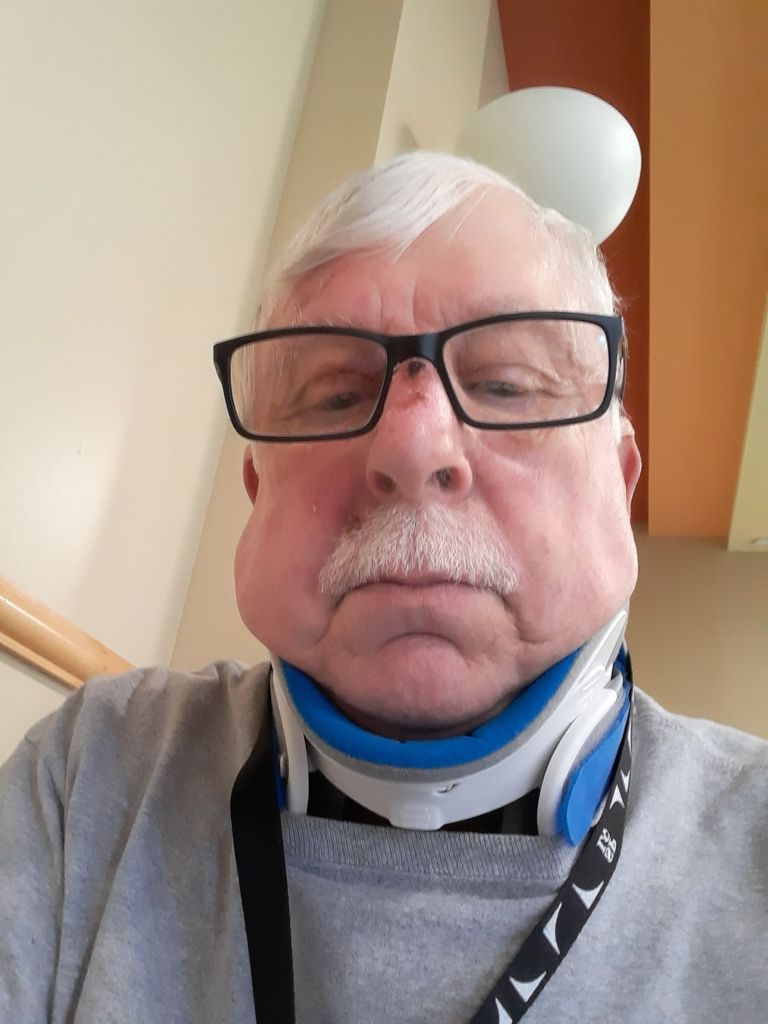
I did a stupid thing (my word) and injured my neck. After a couple MRIs and a couple of days in hospital and two neurosurgeons consulting with each other the eventual result is wear this necklace (dog collar) for eight weeks and all will be well.

I have found that I am getting used to it. I can remove it to shave and as long as I keep that up, it is not terribly uncomfortable. But that is not what I intended to write about here.

Few people are satisfied with “I fell” as an explanation for my wearing this device. Most will not hesitate to get more details. Those are all people who know me and know Cheryl’s situation. I must have a group of good friends who are concerned with our well being. I am grateful for that concern. It is also something for which I have not learned to be thankful and say thanks often for the kindness and help. I have an explanation of course, my head is generally somewhere else these days but that does not excuse me from being thankful for the extra hands and help.

So, thanks to everyone in my life who has helped me the past few days. You know who you are. Thanks to others who did not need a full explanation of how I fell on my face. It is an embarrassment to me no matter how many times others tell me that things happen. It morphed into some of us old guys telling stories about how we screwed up and luckily did not kill ourselves in the process. – You think that was dumb, wait until you hear this one I did. – A good discussion was had by all.

Today Cheryl was very active and animated. A friend from church and my cousin-in-law came to visit her and then while we were chatting the music guy showed up to get the residents to sing along and drum with the music. It lifted my spirits for a bit.

Carpe Diem.

Stream of Conscious – Touch

Two days ago when I sat with Cheryl in the common area of where she is staying, I noted in my journal that she seems to need touch. I think I do too. On these occasions when she does not seem to be in the present, somewhere in her head she needs to feel, manipulate and touch.

It seems to me that these days Cheryl has to have more touch. That is just my thought in my observations when I see her. I am just sitting with her and seeing how she’s doing. But that is what I see and think. I think also that I need the same kind of touch. I sit there and turn the chair so that I can we can be side by side and I can hold her hand. Doing that action is important to me. I observed that about myself today. Today for awhile, about an hour or so, we sat holding both hands. She was holding my left hand with her left hand and I was holding her her right hand with my right hand and we sat that way for a long time.

I am writing this using an app that I downloaded that transcribes spoken words into printed words. I will see how that goes. It looks like I can write in a crude fashion. I can just send this text to myself via email and then paste it into a document and then spend some time trying to figure out exactly what I am trying to say.

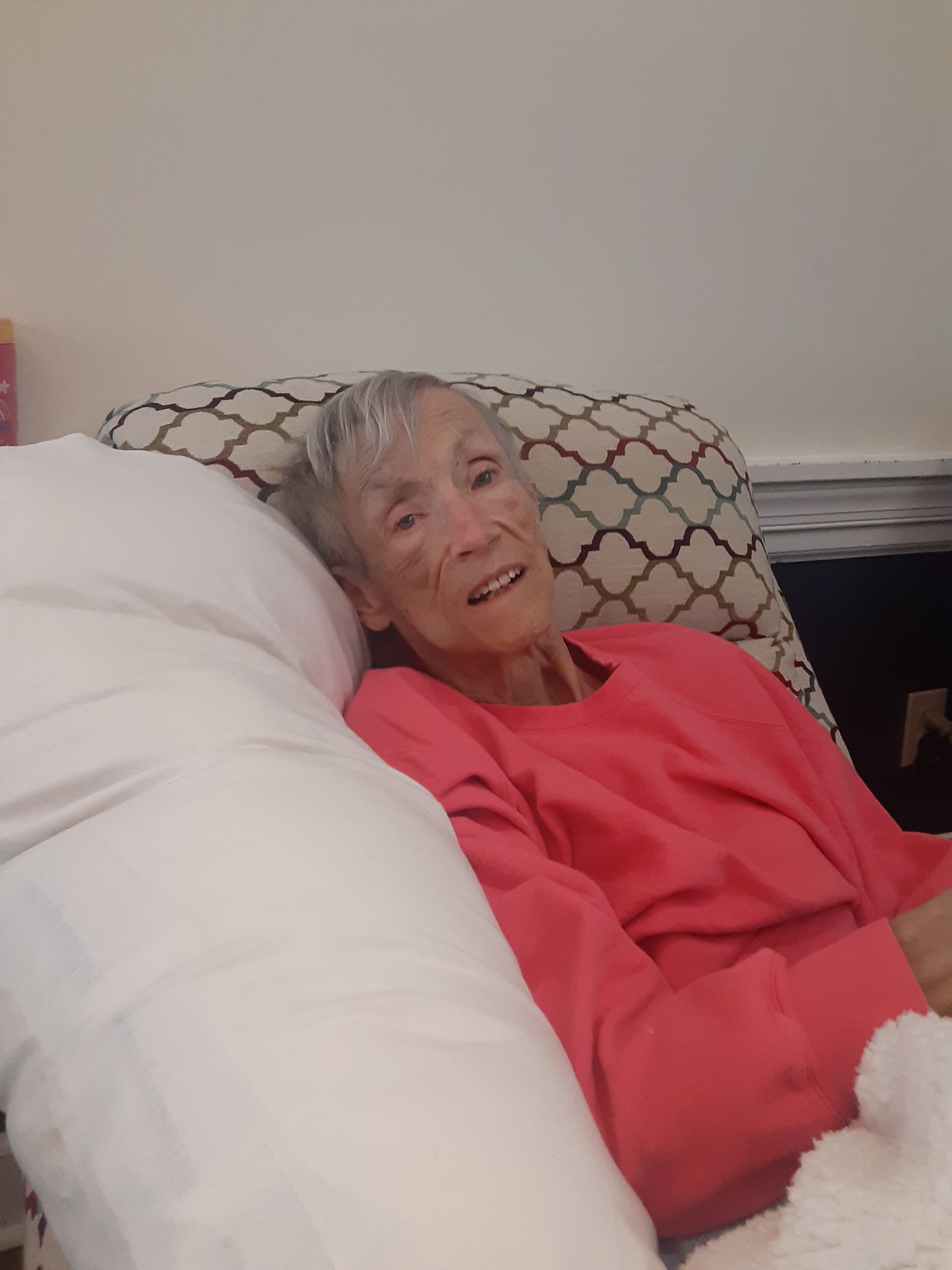
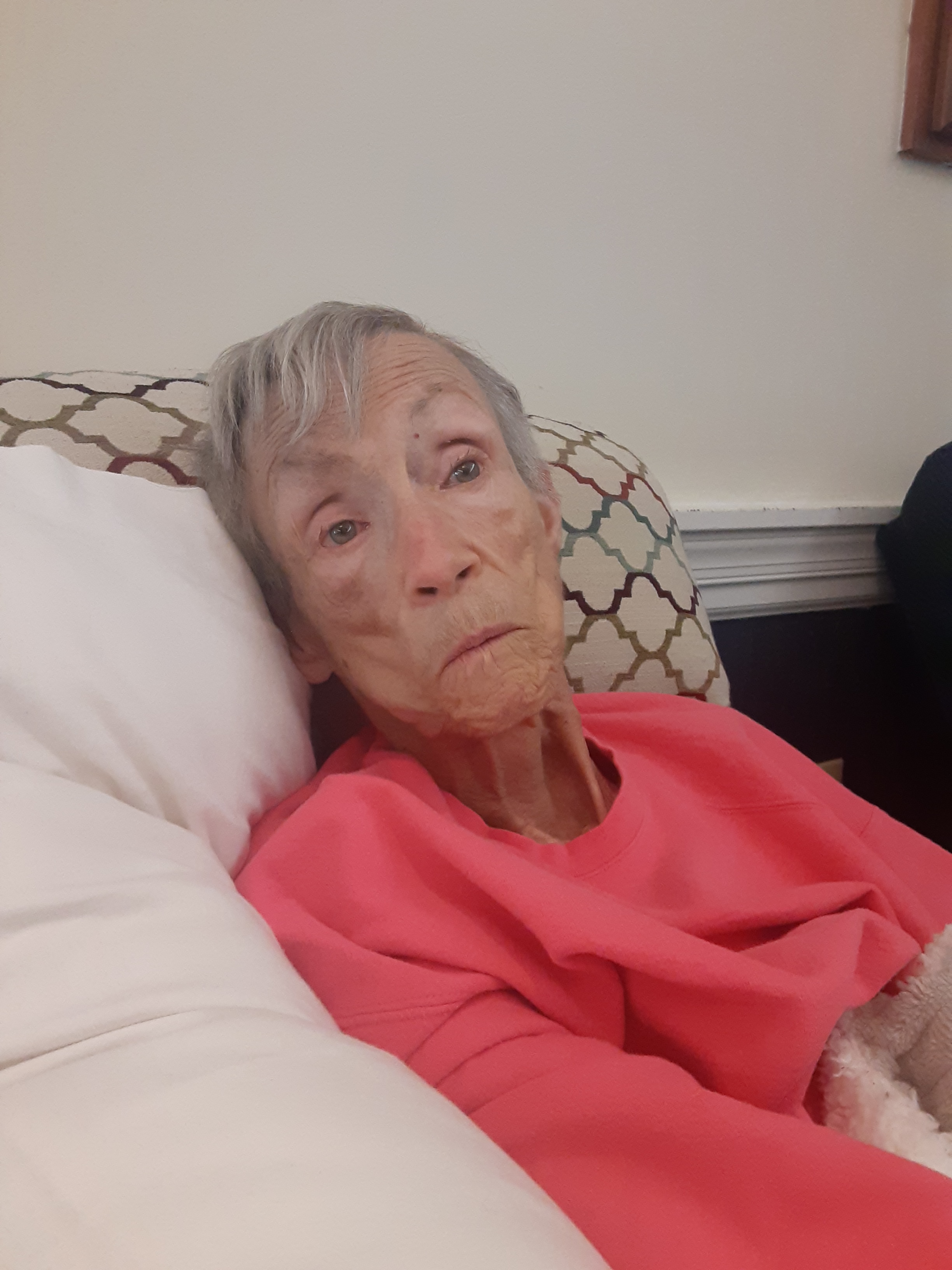
It is hard to describe. What I see and and I mean as I think about what I am internalizing when I’m touching her or feeling as I am feeling her knee. Cheryl has gotten very skeletal over the past few weeks.

Even as she looked around at things in the room and told me some story that I could barely hear because her voice is so soft. There is a lot of ambient noise; television in the main room, television in one or two side rooms, Bluetooth music and the occasional phone call, she would simply just sit holding my hands. She was okay to sit that way. Every now and then I had to move my hand and scratch my nose or whatever and every now and then she would let go and you know touch something else or scratch her nose or whatever. It is fascinating to me as this goes on how much it is important for the both of us to touch each other.

The whole thing about touch is sort of interesting to me. I think we have always had that throughout our married life but as I as we get further in this Parkinson’s journey, the sense of touch is is important to me and I think I really do think it’s important to Cheryl. We are communicating our presence to each other through touch.

She does not resist it. She does resist things that that bother or sometimes hurt her. Her sense of pain can be strong. I am sure she feels pain because every now and then she says stop doing that, it hurts me or something like that, or maybe she’s having a cramp in her leg or whatever the deal is, but simple touch is very different. She will also grimace if something causes pain.

I have been exploring the nuances of touch in my head and I don’t really know how to describe differences of instance. It is interesting to me that it is important to her and me at the same time.

Now if she is sleeping or she’s very tired or trying to doze or she does not feel quite right or she is hungry or she needs to go to the toilet or needs to move, then touching gets in the way. When she was still home here with me, it seemed like we would fight (not the right word) when I was helping her with one of these activities. She would be dissatisfied with any any help that I would give her.

I sometimes just reached over to touch her leg to see whether or not there is anything left there. And I realize that I am holding on to her thigh bone, for example without hardly any any any meat. She used to be a much bigger woman. She used to be a lot fluffier. Just a year ago, I would have had a very hard time picking her up and holding her up and helping her into and out of bed. These days, in some book somewhere, I read somebody describe somebody as a bag of bones, that is a pretty good description of Cheryl. She still has a lot of muscle strength when she decides to squeeze and grab something, but she really doesn’t have a lot of mass. There is little subcutaneous fat left on her body and that too makes me want to touch her just simply so that I know in my own mind that she’s still there and she’s still alive. Without touching her she still in my heart. I think about her all the time but somehow there is a physicality that happens when when I actually touch her.

She is very skinny. Touching helps me to understand.

Carpe Diem.

Sleeping

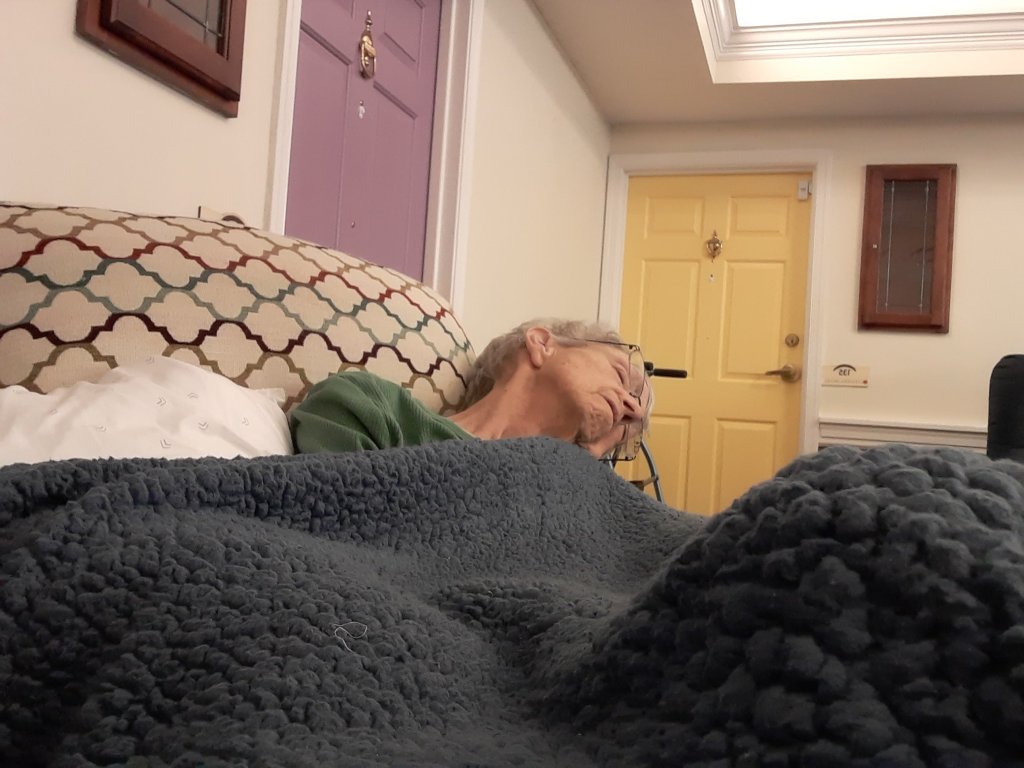
This morning when I came to visit she was sleeping. I kissed her on the forehead my usual ploy when she was still home with me. It did not work this morning. I left her to sleep. I went home and invented an early lunch.

It was a Thai dish from Hello Fresh. It was quick and easy to make. Pretty good to eat and I have leftovers since I renewed the smallest amount which is two meals for two people.

I am back at Bridgeway Pointe it is almost 2 PM and she is still sleeping or she awakened and was not interested in eating lunch so she is sleeping again. As I was walking out the nurse told me that she had not awakened and had not taken her meds at all so far that day. She is off her schedule and very tired.

Yesterday afternoon she had lots of visitors. That kind of activity would often make her remain awake late into the night. Sometimes she did not sleep well at home. She would be very tired the next day.

Zonked out

This is that day. The night shift nurse was able to get her to take her 6 PM dose. I went to visit at 6:30 PM. She was still very tired but she had eaten about 25% of dinner by the nurse’s estimation. She is drinking very little liquid.

Carpe Diem.

Diachrony

Change happening over a period in time. This is the word of the day from Anu Garg who has been publishing “A Word A Day” since 1990-something. He started in college.

I wrote the following story almost two years ago. I found it back looking for something else. It tickled me then when I wrote it then but reading this and thinking about Cheryl’s current state has dramatic contrast. It makes me wonder how much longer? Diachrony makes no reference to how long the period.


Black Underwear

In my new life as caregiver, I have developed several routines. Friday is laundry day. In the “delicate” load was a pair of black panties and a black brazier. And then my mind wandered off into the weeds.

When we were much younger and it was early in our marriage, I let slip to her that black underwear was for me a big turn-on. Through out our younger lives she kept this in her heart. She would let it be known through certain hints, glimpses in the mirror or direct conversation that this was a good night for what she referred to as intimate time.

On various date nights or other occasions the clue phrase was “I am wearing black tonight”. Somehow the wine in the restaurant tasted better. The conversation was closer. I quit seeing the surrounding tables. I quit hearing the surrounding conversation. I guess pheromones intermingled with testosterone does that.

Sometimes I would initiate the contact. Is this a black night? No, she responded, I thought red would be more appropriate. Well it was! It is hard to go slow and stay with your partner when she is wearing black underwear. Much more so when she is wearing red. Holy cow, I miss those days.

I guess she does too. A couple days ago, I do not recall where we were off to, but I was pecking away at this computer and she, after finishing her shower, stood in the doorway of my home office wearing only the two items that were now in the load of laundry I am folding to put away. “I’m wearing these today”, she announced. My brain went spiraling off into the weeds. Holy cow I miss those days. Sorry. I am repeating myself.

Even now I am distracted by those thoughts. Our intimacies in many ways are much closer now even though less sexual in nature. Love is a lot of things. Only a small part is sexual.

It is hard to express how much closer this journey has made us. It is hard to express how this illness has opened my eyes to things in her that I did not notice before. I am more aware that my words can hinder her. I am more aware that my words can hurt her.

This is an eye-opening experience for me as well as her. I have taken on many of the domestic day-to-day tasks – laundry, cooking and others. We have hired out the cleaning to my niece who has her own cleaning service going. We moved into a condo situation so that lawn care and building maintenance is contracted. I am amused by the fact that I have become somewhat protective of my own methods and how easily I become annoyed when she or anyone else critiques my method.

She takes care of me as much as I take care of her. I miss the younger us. I miss the crazy running around chasing kids sporting events. I miss the, “I’m wearing black tonight.” And the opportunity to make more kids. But I really love her in this moment. I just hope I am able keep caring for her and I as fear for the worst outcome, and cannot fathom why my feeble brain goes there, I realize how deeply I love her.

The black underwear still looks good.


That was written in January of 2021. These days she can barely stand much less lean seductively in the doorway in her underwear.

Our love is still strong.

Carpe Diem

How do you know?

How do you know when it is time for an extra care facility? Maybe it is time when she brushes her teeth with Noxema and is not repulsed by the taste?

Maybe it is time when a magazine arrives in the mail and she immediately takes it apart to sort and re-sort the pages into a file.

Maybe it is time if she suddenly at 12 AM becomes interested in calling her long dead grandmother to find out where she lived when she was a little girl and is inconsolable until she can find the phone number.

Maybe it is time if you recognize in yourself that much of your patience with God’s plan is no longer available.

Maybe it is time when she is no longer eating enough to sustain life and you begin to think that perhaps others may be more knowledgeable than you at finding a solution to nutrition.

Maybe it is time if you simply want to help her more than you are capable of doing.

Maybe it is all or none of these ideas. Maybe there are other thoughts that have crept into your mind as you realize how deep your love is and how shallow your skill set is.

Living apart will probably be as hard as living together for the first time when we joined ourselves in matrimony fifty-three years ago.

It makes me sad and anxious.

Carpe Diem

They Are Not You

“… Don’t forget she’s in one piece and they aren’t you.” My daughter said to me in a text message after we had collected Cheryl from the place she stayed for a week while I went to visit my sister in Portland Oregon. (Great trip. Beautiful weather. Decent gin. Excellent wine. We never felt the need or desire to turn on the TV.)

A big part of this was a trial for me (and Cheryl). How would I feel about getting Cheryl into a 24/7 care situation? The place where she stayed in respite is a new memory care place. It is locally owned but not directly associated with any medical institution and not part of a bigger chain or group. How would Cheryl do there? It is a secure facility. Electronic locks on everything including the elevator. They do not let the visitors have a pass to the front exit door. You can be escorted by the nurse or knock loudly and the lobby receptionist will let you out. It is a memory care place. People can wander off at home but not there. That is not Cheryl’s problem.

Cheryl’s problems are numerous: dementia, memory loss, occasional confusion about space and time, Parkinson mobility issues, eating issues, hydration issues, yadda, yadda, yadda. Our life has been taken over by the evil Parkinson.

My thoughts are numerous. How would I feel about settling her in a place away from me? Would she get the same kind of undivided attention that I give her? Would she become angry with aides like she does with me occasionally? Meds and their schedule of delivery is paramount to a parkie. Would I want to micromanage the healthcare aides? Would the aides be pushy and encourage her to eat and drink like I do? Would I feel the need to be there every minute of every day? I have my eye on Bridgeway Pointe which is a place where my mother and her mother stayed toward the end of their lives. Is that the right place for her? Can they provide services for her? How to afford it?

Meditating and thinking about it is tiring.

Carpe Diem.

Monday August 28, 2023

August 30, 2023 – a blue moon

Cheryl has two therapy sessions today. One is occupational one is physical. As we pulled into the south portico I realized that it was jammed up with four other vehicles and all are equipped with mobility equipment ramps. I stopped short and helped Cheryl up the curb to her walker that I placed on the walk.

My third thought after damn it is crowded,  why are all these people here now and in my way was I guess we do not have it that bad after all. As I helped Cheryl walk past one van the ramp came out of the side door and settled onto the walk next to us. I thought how convenient. A crippled woman was sitting in a battery powered mobility chair. She said, “Hi!” as we walked by. I thought that looks way more difficult to deal with. I wonder what his morning is like as I looked at the guy helping her.

Tomorrow is our 53rd wedding anniversary and the day after that the anniversary of when we met. It is also a blue August moon as it was in 1966. It makes me wonder how often blue moons occur in August. We met on a special day. This year the same celestial event happens. We have had and continue to have a special life. (Follow-up — only once between 1966 and this year. According to the internet of all knowledge.)

So far we do not need a battery powered chair for Cheryl to get around. I do have a transfer chair for when she is not moving well. I bought it as a convenience to me.

Carpe Diem

It is Quite a Task

It is a task to watch her struggle to walk. She will not ask for assistance or help. One has to brave the storm and help anyway. To me as her principal helper, it is frustrating.

We went to the physical therapist and the occupational therapist today. I suppose I was hoping for some magical solution to Cheryl’s interest and attitude towards exercise. I suppose I was hoping for a story end like the tale of Lazarus. (“Rise up and walk!”)

He suggested to her that she practice by taking big steps and for exercise stomp down on the floor to emphasize a marching motion. He suggested that she practice getting out of and into a chair– nose over toes. Bend forward to stand up. Bend forward and stick your butt out to sit. When you are up – grab your walker. Practice this often and muscle memory will kick in. When we were home she complained of pain in her back. Her core is weak.

He politely suggested that I should coach her to put her feet in the right place and lean forward to stand up. Her has no idea how much friction that coaching causes. (You are always telling me what to do!) I do tell her to lean forward and stand up. I usually put my hand on her back to help her and steady her as she rises. She leans on me pretty hard. She might say stop pushing but if I remove my hand I find that she was leaning hard backward on me and she can easily stumble back and lose her balance. I ignore her complaint mostly and apologize later when I am sure she is stable.

I learned an important nuance today from Justin the physical therapy guy. He had never met Cheryl before so part of the visit was him looking through her records and asking various questions about this and that. He asked about falls. Everyone new asks about falls. I replied that Cheryl falls a couple times a week. She usually falls backwards and it seems to me that it is getting worse. She tends to lean backwards when getting up from a chair. If she passes by a stable solid piece of furniture that she has grabbed for extra support she hold onto that as long as possible even to the point of leaning backwards to maintain contact. Justin told me that is pretty typical for folks with balance issues. (Huh. I was under the misguided illusion that parkies tend to hunch forward. Cheryl never hunches forward.)

I know that there is no magical solution. But I can hope.

Just like I can hope her voice will get stronger with speech therapy.

Just like I can hope for the occupational therapist to be useful to her.

The palliative care clinic is focused on improving her sleep. Part of that is controlling her constipation. If she sleeps well she does better during the day. She can remember who I am for example. She will remember to eat. Perhaps she will quit losing weight.

There is no cure for this debilitating and degenerative disease.

Carpe Diem.

Palliative Care

Today we saw the doctor whose clinic is concerned with palliative care. After a long discussion about drugs, symptoms and what the palliative care clinic does the conversation turned to what we hoped to achieve from it. My hope is for better existence for Cheryl. She has trouble vocalizing her hope.

From the National Institute on Aging — (NIOA) — the next couple paragraphs are useful general information. The doctor’s question hit me spiritually, what are we expecting? It is a good one — What are we expecting? A cure? Return of mental acuity? A better attitude about living with one’s plight? More mobility? A stronger core muscle strength? — A flood of thoughts entered my mind.


What is palliative care?

Palliative care is specialized medical care for people living with a serious illness, such as cancer or heart failure. Patients in palliative care may receive medical care for their symptoms, or palliative care, along with treatment intended to cure their serious illness. Palliative care is meant to enhance a person’s current care by focusing on quality of life for them and their family.

Who can benefit from palliative care?

Palliative care is a resource for anyone living with a serious illness, such as heart failurechronic obstructive pulmonary diseasecancerdementiaParkinson’s disease, and many others. Palliative care can be helpful at any stage of illness and is best provided soon after a person is diagnosed.

In addition to improving quality of life and helping with symptoms, palliative care can help patients understand their choices for medical treatment. The organized services available through palliative care may be helpful to any older person having a lot of general discomfort and disability very late in life.

Who makes up the palliative care team?

A palliative care team is made up of multiple different professionals that work with the patient, family, and the patient’s other doctors to provide medical, social, emotional, and practical support. The team is comprised of palliative care specialist doctors and nurses, and includes others such as social workers, nutritionists, and chaplains. A person’s team may vary based on their needs and level of care. To begin palliative care, a person’s health care provider may refer him or her to a palliative care specialist. If he or she doesn’t suggest it, the person can ask a health care provider for a referral.


Why (a conversation with myself, often) is palliative care necessary and useful? What benefit will come from this method of viewing Cheryl’s worsening Parkinson and her associated dementia issues? These are my thoughts.

Since the beginning of this road all I have wanted is for Cheryl to be safe, comfortable, mobile, and as independent as she is capable. Seven years ago, just before we purchased this condo that we live in now we lived in a neat old five bedroom, two story house with a basement. It was a hundred plus year old house with much space and character. Cheryl’s main complaint was her knees. At first I moved her office area downstairs to the front bedroom. We called it the guest bedroom and sometimes “your Mom’s bedroom.” I rearranged the use of the other extra bedrooms upstairs. I remodeled one and took over Cheryl’s old office upstairs as my own. The upstairs bathroom was accessed through the office. The home office was moved to the guest bedroom downstairs as was the rest of her equipment – sewing machine, computer things, printer, etc. but Cheryl had adopted the upstairs bathroom as her own and regardless of where she was maintaining a presence during the day she went upstairs if she required the facilities. (The hallway to our big bedroom in our condo she now refers to as upstairs or downstairs as her Parkinson and memory issues worsen.) She complained about her knees everyday until we moved to our flat single floor living arrangement.

During the seven year process of moving, adapting, adjusting I put her needs first not thinking about or recognizing what those adjustments would do to my emotional and physical health. Not once did I think about how my life would change when Cheryl gave up driving voluntarily when she could not remember where she was or where she was going. Nor did I realize that she was starting into her creeping memory issues. A couple months later when she became terribly upset and anxious one evening because she could not find $1.89 mistake in the check register that she was still computing by paper and pencil, I did not realize that she was struggling with cognitive issues in addition to memory issues. Her math and logical sequencing was gone or mostly so. She did not admit it to herself or to me and I did not recognize it. (notice – cognition in recognize) It was perhaps two years later that she was unable to follow recipe instructions or sewing pattern instructions. (I found myself reading how to reverse an item so that the seam allowance was hidden.) In retrospect she was probably terrified that she could no longer do those things. She was in fear of losing her mind and it caused anxiety.

My hope or expectation is that she will achieve some level of relief from her anxiety. My hope is that she will sleep more comfortably. My hope is that she will accept her disabilities that inhibit what she wants to do and she will ask for and accept help freely offered by her spouse (me).

My hope is that I will be more comfortable with letting her do for herself as much as she can while she can do it. Whatever it may be. My hope is that I will find the strength and the financial means to provide for her future care. My hope is that I will plan activities and be cognizant of the fact that plans will change without warning and I will not rage out loud when it does not go my way.

My hope is to be able to let go once in awhile for my own mental well being. I hope that this group of clinicians can help with living and life. But mostly I hope to get a good night’s sleep most nights.

Carpe Diem.