My search for grace and meaning after a former care partnering life with a wife who suffered from Parkinson's disease and dementia giving her a confused and disorienting world.
One can always learn new things if you open your heart to the experience.
Recently we met with a dementia specialist. It was not intended on my part to be one on one but as it turned out it was. She had several key points to deescalate frustration and anger. Like many things that happen these days with Cheryl and me, I often forget which people and services I have investigated before. Theresa Youngstrom is a nurse and a dementia specialist. In a previous post I quoted these points from her website.
When engineers look for a solution to some dilemma, they often spend a lot of time observing the problem.
Many thoughts can arise. Many questions seek answering. But ultimately the dilemma is slowly broken down to component problems and individual solutions to small problems are sought out. An engineering education teaches this process. An engineering education does not teach solutions for Parkinson’s disease and related issues. Those are discovered along the way.
“There’s someone hanging upside down in the trees in back”, she told me. There is a scrub tree growing in the weedy lot behind our condo. It has a crotch near the ground and branches into to smaller trunks as it grows toward the light. The bark is a light color almost khaki in color. To Cheryl it looks like a kid standing on their head. Perception is off a bit and her creative brain describes a different interpretation.
In that moment she pushed me into interpreting things and objects differently. Are painters able to do this spontaneously? Are story tellers able to imagine a different reality? Are engineers stuck with what they see and touch with little imaginative creation? It intrigues me, the imagination and story telling part. I have often thought that if I could get into her head I could help but maybe I would merely be steering her toward my reality and away from hers.
There are many changes that I notice in her behavior. She can easily ramp up an anxiety about indigestion. It is not apparent to me what specific foods cause distress. Milk products and foods high in milk and sugar seem to give her a hard time. Tomato sauces and beef with a high fat content also distress her stomach. The engineer says figure that out and do not eat those. (Easy Peasey) The average time to relief is an hour to an hour and a half.
I have not discovered any silver lining in these stomach episodes. It is challenging to distract her from focusing on how her stomach feels although occasionally I can get her to sip lemon ginger tea which settles my stomach and does not add caffeine. After a severe episode she is typically awake much of the night. This happened last night.
After it became obvious to me that there was no way for her to calm down and sleep some more, we got up. I got her a bowl of cereal and some orange juice. She sat and worked the puzzles for a bit. I sat with her and worked on the crossword. I ate a banana and drank some lemon ginger tea. I asked her if she wanted to watch TV for a bit to see if she would get tired. She agreed and I played a couple of episodes of Steven Colbert. I can no longer sit up and watch his show so I record it for later. We watched a couple shows. Fortunately he was funny and Cheryl laughed here and there.
Today she is not in tip top shape of course and she fell over backwards in the kitchen. She is understandably fuzzy headed even though she slept until about 9 am. Maybe one day she will keep her hands empty when getting up from or down into a chair. But my wishes and encouragement which she interprets as anger go mostly unheeded.
On the drive to exercise class she asked if I slept well. I asked her if she remembers being up for a large part of the very early morning hours. She said no. The fact that she does not have a memory of being awake is not uncommon. I asked her if she specifically remembered watching Steven Colbert’s late show. She remembers that slightly. She apologized. She apologized for something that she has no control over and that frustrates me to no end.
There is no reason for her to apologize. It is not her causing undue commotion. Parkinson did it.
Watch out for kids hanging in the trees. Carpe Diem.
Last night was one of those sleepless nights for Cheryl. I think I am learning when she will have a sleepless night or sleep fitfully overnight or sleep for a bit and then be awake for a couple hours. And the next day she has no memory being awake or thinks she slept soundly.
She went to bed a little early at nine but she had complained of being tired at eight while we were playing Uno. I got her bedtime meds and we played another round of cards. (I am losing this marathon game.) She insisted she was tired, so, I helped her find pajamas and opened the bed. I kissed her goodnight and read my book for a bit. Nine o’clock is too early for me to go to bed.
I went to bed at about eleven and slept for about an hour. At twenty minutes or so after midnight, she was up. I thought initially for a trip to the bathroom but she was up with conversational gibberish about work and school and children. I left her to put on clothes and I put on a sweat suit to go read some more and wait to see if she needed my help. (Her motion is good and she seems steady with no hint of Parkinson in the middle of the night.)
When she came out of the bedroom dressed for work, I got her some cereal and orange juice. She also ate a piece of coffee cake. She wanted to look for the morning paper and pointed out to her that the paper would not appear for several hours. She seemed to accept that and sat back down to re-read the Sunday paper. After breakfast we played a couple more rounds of Uno. In conversation before and during our card playing I was able to convince her that we had no appointments today. After a while she decided that she was very tired again and we went back to bed at about 2:30 am.
In previous episodes like this I admit to being Mr. Cranky-pants. Rosie showed me a different way to respond to her at night. We both fell asleep quickly and the LOUD AND ANNOYING alarm clock woke me at seven for her morning meds.
I would like to report that she is okay today and I am rested but I am not. I am a little tired but coffee helps. She is still a little confused but not any more so than normal lately.
She has a rash that appeared a couple days ago. This afternoon I made an appointment with our primary care physician to look at it. Hopefully it is nothing other than hives. I wish I knew what new thing is irritating her skin. She does not complain about it. (Update: Shingles. She has shingles. In some people it does not hurt. Damn. Another reason to not get old.)
In writing this little piece I googled “a different way” in the hunt of an image to use as a header picture. This hip-hop song popped up DJ Snake. I am not a consistent listener of hip-hop music but much of it is very good and has a happy beat. This video is very creative.
A Different Way – DJ Snake, Lauv
Could you believe I could be different? I’ll be the difference, I’ll lift you high And I understand your hesitation Our reputation, it’s no surprise So let me redefine you And you can see the tide move Just like tears in the eyes do And when you’re feeling alone Oh, baby, I’ll be right here Between the sea and silence So breathe easy my dear You can find sunshine in the rain
I will come running when you call my name
Even a broken heart can beat again
Forget about the one who caused you pain
I swear I’ll love you in a different way
I know that love is so unforgiving
You’ve been a victim too many times
And I’ll be the thread, hold you together
I’ll be forever, will you be mine?
So let me redefine you
And you can see the tide move
Just like tears in the eyes do
And when you’re feeling alone
Oh, baby, I’ll be right here
Between the sea and silence
So breathe easy my dear
You can find sunshine in the rain
I will come running when you call my name
Even a broken heart can beat again
Forget about the one who caused you pain
I swear I’ll love you in a different way
Hey, hey, hey
I swear I’ll love you in a different way
Hey, hey, hey
I swear I’ll love you in a different way
Source: LyricFind
Songwriters: Edward Christopher Sheeran / Ilsey A Juber / Jonny Mcdaid / Lindy Robbins / Steve Mac / William Grigahcine
Cheryl went to high school with Rosie. Rosie went on to become a Sister of St. Francis. Cheryl went to the prom with me and four years later we married.
Yesterday after many scheduling issues we hooked up for lunch. Cheryl was moving very slow that afternoon. Rosie moved very slow with her and very gently held her arm into the restaurant and over to the table. In conversation, Rosie, the quiet calm and gentle person that she is with her own health issues, gently took Cheryl down a memory lane of remembrances from their high school years to their current time.
I slowed a bit and observed. Slow and gentle were Rosie’s movements, her companionship, her conversation. I learned something.
When we got home Cheryl rested for a bit.
I realized that Cheryl needs to go at her own pace. I always knew that she did but I did not always observe that pace or make myself slow to her pace. Cheryl’s pace is principally Parkinson slow with occasion spurts of Parkinson fidget and sprinkled with Parkinson frantic and a little normal motion and conversation.
She did not seem really very tired or ready to go to bed at what I think of as her normal ordinary bed time of 9:30 – 10 PM. I tried to exercise what I had observed earlier in the day and suggested we play a card game or work a puzzle for a while. She said let’s play Uno. We played with half the deck. She shuffled the cards and asked, Does everyone get seven? I said yes and she did not deal any extra players. Uno for those who do not know has a simple theme. Follow the color or follow the number. She could do that for about an hour or so. She began to notice on her own when she could not tell the difference between red and green. She declared herself tired about 11:30 PM and we got ready for bed. She slept soundly for several hours — all at her own pace.
Rosie taught me something. Let Cheryl set the pace. And if she is not around, think about letting God set the pace. Life is peaceful at Godspeed. Life at warp-speed requires quick reactions and having your shields up at all times.
As we get older and this goofy damnable disease takes more from her I find that is more important to find those gems of experience and good times.
I did not realize how important that is to me and to Cheryl. Today was a pretty good day. I expected it to not be so. Cheryl slept little overnight.
Ordinarily when that happens she is tired and lethargic the next day or maybe that is just me. Today she got up and had some breakfast. She took a shower with no help from me. We went to exercise class.
I made dinner that evening. I made a Betty Crocker noodle thing that I had not done before. We had our neighbor Jane over to eat with us. Both Cheryl and Jane pronounced the recipe good, so, I will make it again.
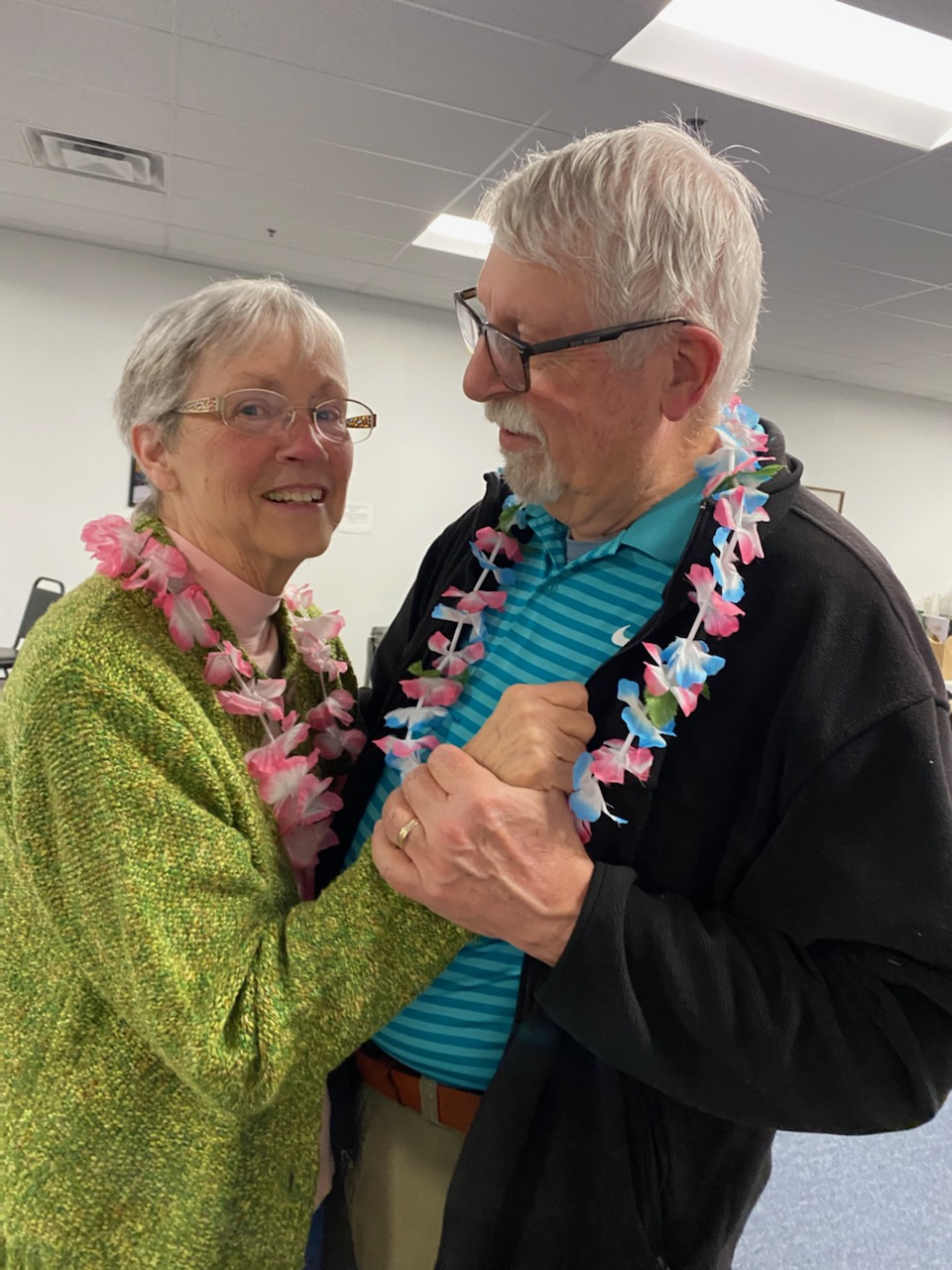
At exercise class we were reminded that this evening the Parkinson Community Fitness is having a Beach Party theme party that evening. So after dinner and Jane returning to her condo, I reminded Cheryl of that and asked if she wanted to go. She said yes if it was not too late. It was not so we went.
At first she seemed iffy as the seven o’clock meds shook her well being for a bit but she came out of it okay and had a good time. As you can she by the picture, she had her smile on. We both had a good time and we even got to dance for a bit. (It was more like a sway. :-)) — Thanks to another Jane at PCF we have these great pictures on our Frameo electronic picture frame.
Cheryl and Paul, 2022
In both of these pictures, she has her smile on. Carpe Diem.
In our support group meeting we start with a topic or group of topics that are put together by a committee that meets the Saturday before out scheduled time. A partial list of these is below.
Our meetings are never very formal. Some of us, the core group, will kick off the discussion by talking about the topic(s) on our list. I count on John who is one of the core group and a retired teacher to keep us on track but it is okay if the conversation wanders off into the weeds because sometime people need to just talk without worry and fear to a group that understands and empathizes.
How do I (care partner) know when to help and when to let him or her do things alone?
What thoughts or actions help you cope? Why do those work for you?
What are a care partner’s typical feelings during the day?
How to manage stress; as a caregiver, as a PD patient
Tom and his wife Joyce attended the first meeting that Cheryl set up a few years ago. Tom was in the early diagnosis stage of Parkinson. They came to no other support group meetings but remained on the email list. The initial meds dose surely worked to initially relieve most if not all of his symptoms. It did for Cheryl too about fifteen years ago. But lately his unsteadiness became worse and he had had a fall with more than incidental injury. Mostly though physical therapy Tom and Joyce came to the previous meeting and came to the meeting on Monday evening.
Tom spoke to the second list topic about coping. He remarked that his doctor said in conversation that instead of focusing on what you have lost, focus on what you have gained. Tom said he was still working on that but I thought the idea is an excellent way to grow and change and stand up to the challenge of Parkinson and his damnable disease.
So often we focus only on losses. It is the basis of all grief and sadness. It promotes anxiety and worry. It takes a lot of time. It is a stresser. It is the source of most news stories on television. We are attracted by tragedy and loss.
As a thought experiment I felt the need to look inside my own thoughts and make a list of gains and losses, not necessarily from the beginning of this life with Parkinson but as they come to me as I write this. I am not dealing with symptoms physically as Cheryl is but it affects my life with an intimacy I did not intend to sign up for when we married many years ago.
Below is my list so far:
Gains:
a greater knowledge of how much is lost to a person that has dementia.
circular repetitive conversation
consideration to how things are said (tone and volume)
new friends,
simply meeting with new people that are not friends,
different view of walking paths,
empathy and concern for others,
end of life planning,
new found cooking strengths,
exhaustion,
unwanted attention,
unwanted advice and opinion and solutions
meditative thoughtful discernment,
new socialization,
family closeness,
family envy,
party envy,
care for spouse, growth in knowledge
patience and resilience, less “flying off the handle” in various situations
how to deal with fainting spells
how to deal with falling
how and when and who to ask for help
inner calmness
close attention to safety concerns.
close focus on safety,
slow walking, not strolling, slow walking
knowledge of skilled medical care;
prayers and kind thoughts from total strangers
Losses:
mobility and spontaneity;
spousal conversation that is not tainted with cognition failure
implied requests or “helpful” comments (instead of, “it looks cold outside” say, “please put on a jacket”)
consideration to how things are said
confidence in the future;
ease of travel;
disinterest in end of life;
spontaneity of exercise;
patience
inner calmness
I may add to these lists as life goes on. Somethings appear on both lists because they are both. Somethings on the gains side are not always good things. Somethings on the losses side are good things. Perception is everything and nothing.
Three O’clock in the Morning is a novel by Gainrico Carofiglio. A story of a teenager who makes a trip to France with his estranged mathematician father to be cured of his epilepsy and ends up learning about his father in an intimate way during two days without sleep.
“Who were epileptics?” I asked, realizing that this was the first time I’d managed to say the word.
‘Just to give a few examples: Aristotle, Pascal, Edgar Allan Poe, Dostoevsky, Handel, Julius Caesar, Flaubert, Maupassant, Berlioz, Newton, Moliére, Tolstoy, Leonardo da Vinci, Beethoven, Michelangelo, Socrates, Van Gogh.”
I processed this information.
It’s strange how the same thing, exactly the same thing, can make us feel so different depending on how we see it, the mental context in which we put it.
Ever since I’d been diagnosed with it, epilepsy had been, as far as I was concerned, a stigma, a sign of inferiority, a disgraceful blemish that had to be hidden. After Gastaut’s words, after hearing that list of geniuses who had all apparently had a problem similar to mine, my inner world now turned a hundred and eighty degrees, as if moving from darkness to light. I had felt like a reject, and, all at once, for the very same material reason, I felt almost one of the chosen, a member of a special category of superior beings.
“Please sign your drawing,” Gastaut said, in an almost formal tone. I signed it, and it seemed natural to me, as if I were signing a contract with my new life, which was starting at that moment.
He stood up, shook hands with us, repeated that he would see us again in three years and walked us to the door.
— from the novel.
I found myself reading it at three o’clock Monday morning. At 2:30 am Cheryl was awake and longer able to sleep.
Bummer.
She ate a doughnut and some cereal. She drank some orange juice. I read my book for a bit. How appropriate, I thought. We did the Wordle. It was four in the morning. We went back to bed at four.
I was awakened by the EXTREMELY LOUD AND ANNOYING alarm clock at seven. I fetched her pills. She took them and we returned to bed.
At 7:30 am she arose to get dressed for school. I got up and finished the story. Not a crime novel which is my usual genre. I did not remember that I had finished the Wordle.
She wants to do it herself. We had a tough for me conversation this morning about issues we trip over as travel the annoying twisty road of Parkinson. It started out as, you know I can still do stuff.
This was a response to me speculating about learning to make my own piecrust instead of buying a commercial piecrust. I will take the path of least resistance every time I can. There are enough things to staff, organize and worry about. If someone has already made the piecrust, I am good with that.
I buy salad in a bag too. Dump and go. Chop a tomato and it is salad. Dressing is in the fridge.
She remarked that she could make a pie and that she knew how to make piecrust. Naturally I forgot about what I have been attempting to practice on a daily basis. I started to enumerate the negatives. I caught myself before I got too far into the ditch along side this partially paved macadam thoroughfare.
It is Lenten season. Instead of chasing some carryout fish fry from our parish we had the makings of tuna casserole. An old time favorite from the Dinner for Two Cookbook by Betty Crocker (You can still find one if you poke around.) Remember Betty Crocker? She is my go to for a lot of things. That seemed like an easy thing and she likes it. I said why don’t you make the tuna casserole and we can have the leftover pie for dessert.
She agreed.
We attended a discussion in the afternoon about newer drugs used to treat Parkinson’s disease and when they are used and how they worked. When we returned I attended to the laundry and then busied myself with work for my job at our local community college where I teach part time.
She announced she was going to start on the tuna casserole. It was three pm. I spent the next hour listening and worrying and occasionally sneaking a peek into the kitchen twenty feet away. After a few misfires on her part she got started with minor aid from me. She put all the ingredients into a Corning ware bowl and mixed it. She used to know how to start the oven but that knowledge and skill has been lost to Parkinson. I told her which buttons to push and it clicked on.
I went back to work on my project but gave it up for a bit when the oven played its happy tune to announce it was up to temperature and waiting. I went in for the oven placement of the casserole. She put it in but I worried while watching. (Maybe I am a worry wart.)
Scary activity for someone not steady on her feet.
I suppose there is a good mechanical engineering reason for oven doors to open as they do. I have not seen one built so that door opens any other way but down. A standard range winds up with the door about a foot off the floor so that the person reaches down into the oven from three feet away. It looks to me like a disaster waiting to occur. I hovered nearby as she put the casserole into the oven and then put on oven mits to get something from the fridge.
We ate about an hour ahead of when we usually eat but time and calendar and sunrise and sunset seem to have less meaning for her. It is time for us to start eating dinner at four pm like the rest of the old folks.
Some days things just seem to go better with pie. If you want to lift your spirits a bit, make a pie. Whatever kind of pie you want, just make one. You can buy a pie of course, and that will settle the need for a sugary delight, but if you want to ignore the world around you for a while, make your own pie. It might turn out ugly but it is yours and it will taste scrumptious.
I have been down on myself for a few days. I think I worry for the folks in Ukraine. I do not know anyone in Ukraine but it is kind of stinky that a short guy with big army and navy can just drive over the fence and poop on the short guy without a big army and a navy with only one boat. That situation just sucks.
This is an ongoing conversation in our house. Cheryl struggles enough with day to day things. She fears for those mothers and children showing up at the Polish border behind the reporters that flew there in order to record the history of the short guy beating up the other short guy. From the news reports it looks as though the partisans are taking root in Ukraine and in Russia they are taking a nap. The world markets are yinging and yanging around and today I paid $4.999 a gallon for 12 or so gallons of gas to fill up my car. It was the first time I have spent more than $50 to fill up a car. That situation just sucks.
Time to make pie and eat it.
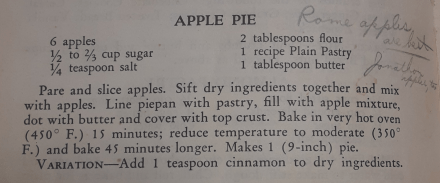
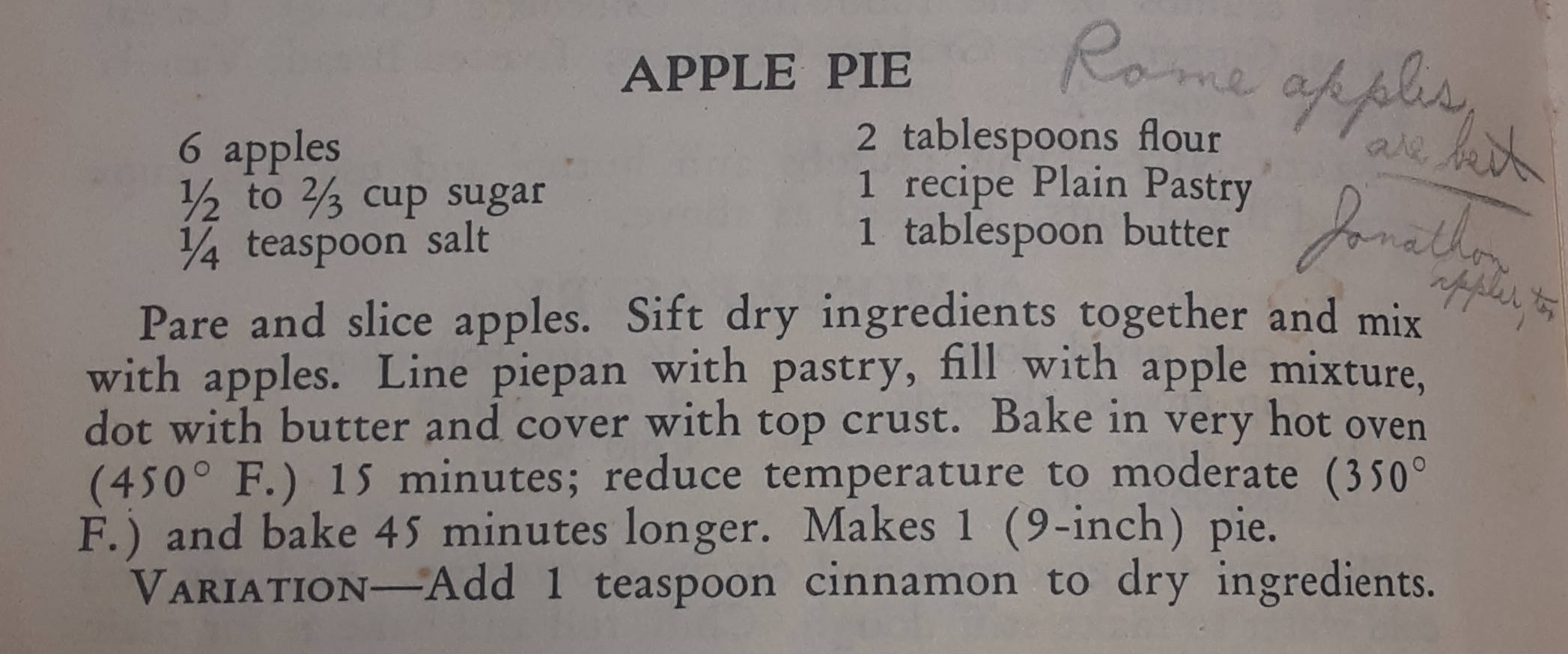
an old favorite recipe modified
This particular recipe guidance is a favorite one. As you can see specific types of apples and the resulting pie has been noted by Cheryl. When she drug me down the cooking road a couple years ago I picked up what we call the “Big Green Cookbook”, so called because it is about two inches thick and has a green cover, to learn how to do pies. This book reads much like my grandmother’s cookbook that is a collection of church ladies’ recipes entitled “Culinary Cullings” from a farming community in Rich Hill, Missouri.
“6 apples” but no reference to general size. “1/2 to 2/3 cup”is the same as writing some but not too much. It makes me smile to read these measurements. (1 recipe plain pastry — but no hint about where to find that.) I have modified and added to the instructions myself. Since it is unspecified I use dark brown sugar with my teaspoon of cinnamon. I also add a couple tablespoons of tapioca. I got this last one from my mother who learned how to make pie from my grandmother. I think I got my bravery to adjust ingredients and try new spices from Mom. She was pretty damn good cook and liked to have a gin and tonic while doing it. Perhaps I will try a gin and tonic with my next pie.
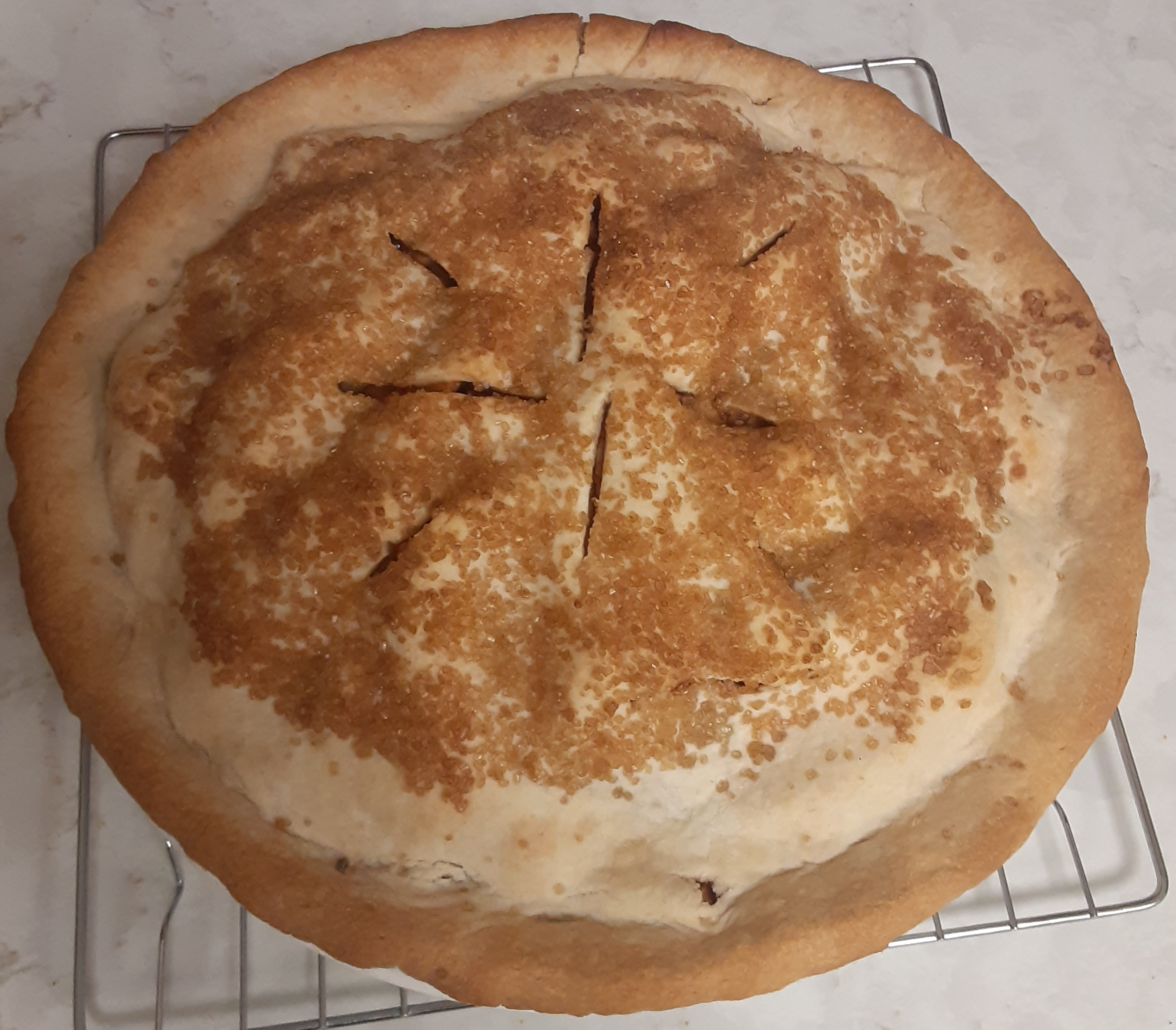
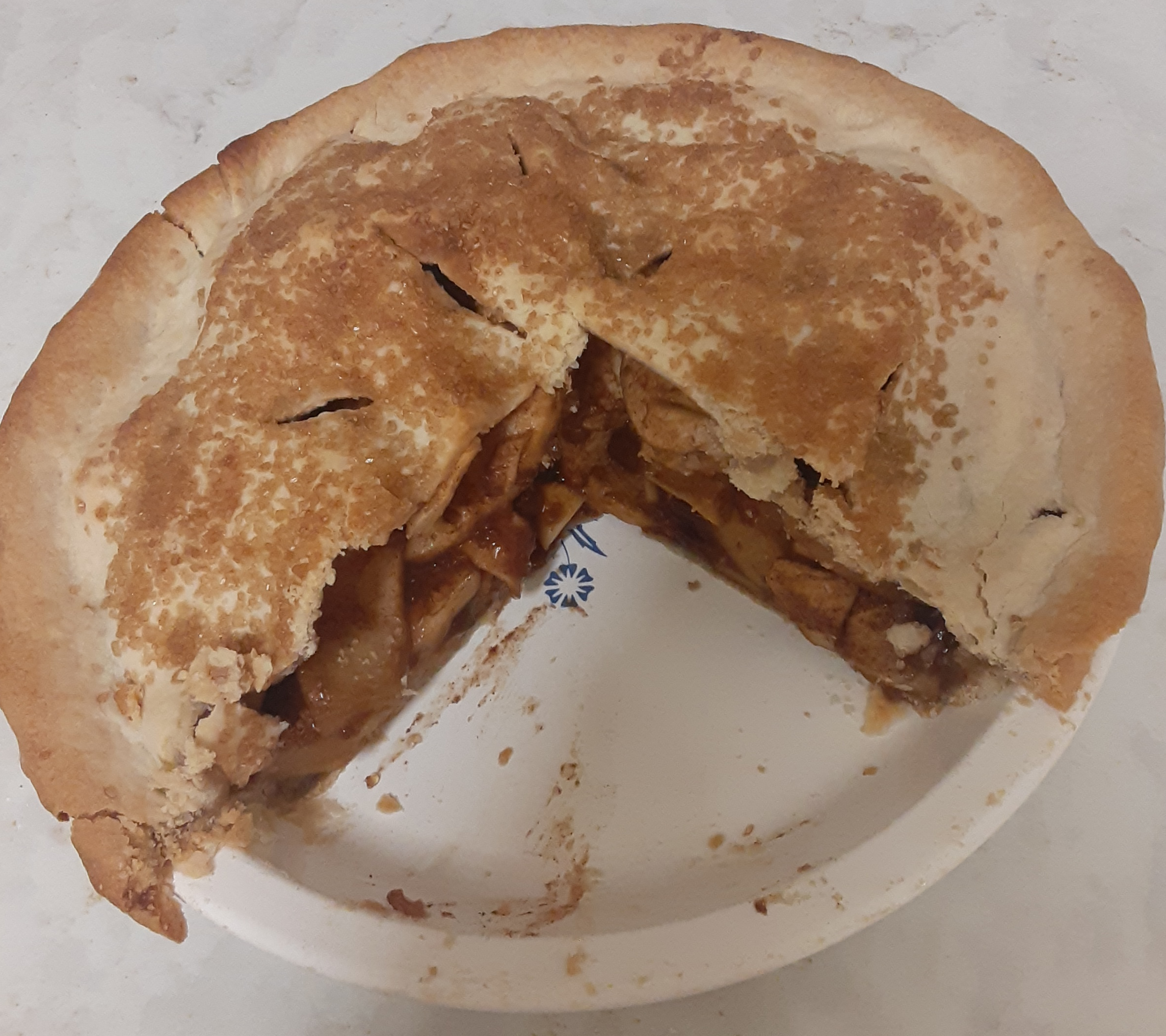
So today is PIE day. A little early actually because the math enabled folks celebrate 3/14 as pi day. But I digress.
Yummy
For a short time this afternoon I have bumped Cheryl off of her worries and anxiety about world idiots.
After the pie got to the condition shown above I went of to find the big round Tupperware pie saver we have owned since about 1975. Gone. I was worried that Cheryl had put it in a special place so that it would not get messed with by the little girls that live in her head. I put out a text query to the kids and found out I had left it at our son’s house. I probably took a pie there.
Recently I read a book entitled – Dementia Reimagined by Tia Powell MD. It was a disappointment to me personally because I believe that I judged this book by its title. I was hoping for some sort of expert thoughts on how I can deal better with my personable anxiety, emotion and smoldering anger with Cheryl’s disease of Parkinson and her accompanying dementia. I was hoping for; when this comes up, do this. Life is not that easy but my engineer training wants to make it so.
Dr. Powell’s book is a good argument for changing the way government programs, insurance companies and the like perceive and fund help for those with dementia. I know that the funding albeit private or public is screwed up. A few months ago I met with a lawyer to discuss end of life issues especially since I felt certain that Cheryl’s chronic illness would eventually bear a heavy toll on our family finances. He asked why I still lived in Ohio.
All states are different.
No Help There
That does not really help me. These tips on dementia (copied from a website somewhere) do seem to be useful:
Always approach from the front. – or do that as much as you can. When I first read this it was not meaningful to me but I have noticed that Cheryl startles easily. Her startle reflex shows itself at seemingly random moments. If we are traveling somewhere in our car, she will react to other drivers with jerky motions or a surprised little noise from her lips. I used to point that out to her and she reacted with both embarrassment and a little anger. I have learned to ignore these little things but it is hard for me to do.
She no longer drives a car having given up her license several years ago.
I have noticed that she will jump if approach her while working on something in her office which causes her to face away from the doorway so that she does not see me coming. I am not moving quietly when this has occurred but I may be mistaken about that idea. I may be more stealthy than I think myself to be. We are both older. Our hearing may not be as acute as in our youth.
Watch your body language and tone in addition to the words you use. – frustration or surprise at the immediate situation may easily be interpreted as anger. This is the hardest concept for me personally to deal with. I am concerned for Cheryl’s safety and I also hate to clean up messes. I apologize a lot and she apologizes a lot for making a mess even though I tell her that no apology is necessary.
I recognize that I am perceived as angry by her when one of these situations occurred. The aweshit reflex is strong in students and practitioners of engineering. So far I have been able to tone it down to oh-poop but it is a work in process with some small progress. I keep telling myself it is anger with this disease and what it has taken from her. I cannot tell you if there is truth to that statement but I keep repeating it to myself quietly at night when a combination of sun-downers and dreamy illusions and hallucinations creep into her perception of the world.
Sometimes I merely lose it, however. I can be mister cranky pants in the middle of the night.
Smile and wait until they acknowledge your presence before touching them. – Hugs are always welcome but Parkinson’s patients may be unsteady, so be prepared to steady her and accept some weight change. Hugs are always smoother from the front than from the rear. (see startles above)
Regardless of acknowledgment touching, hand holding, hugging are preferable to distance. The combination of Parkinson’s and dementia are frustrating, depressing and scary. Cheryl has expressed this to me often in moments of perfect lucidity. Those moments are still there. Savor them like fine wine or life as it used to be.
Validate their point when they are upset even if they are wrong. – and be aware that it is not important to correct anyone’s perception of things. Never start a response with; you are wrong, dear. … and continuing with the rest of it.
Let’s face the fact that “you are wrong” is a manifestly stupid way to start with no dementia present. Relax and take a deep breath and decide between two things, is it important to correct her perception or do you merely have a need to be right. Try, yes, that could be true… and go from there if concepts are way off and you want to help her find the way back. Or just ignore it, after all, her memory is not very good any more. She will not remember that you are right but she will remember that you angrily corrected her.
Say you are sorry at the first sign of their frustration to keep situations at a minimum. – I say I am sorry a lot because I am sorry that I tread on her heart. This disease is frustrating for us both.
Cheryl sees a nurse practitioner a couple times a year. Maureen is pretty practical when it comes to nuanced care partnering. These are her words;
I get lots of questions on how to deal with dementia. I could give you a list of resources to look up on the internet, workshops to attend, books to buy. All of that takes time which most of us have too little of. A great caregiver website, caregiving.com, offers these 5 tips for dealing with dementia.
PRACTICE PATIENCE – This can be incredibly difficult to do. Try to remember when you were dealing with your children when they were young, especially the toddlers. You probably had more patience then, than now. Remember those days of taking a deep breath before saying something. With practice, it will get easier.
PROMOTE PHYSICAL HEALTH – This is for both the care giver and the care receiver. The care receiver can benefit from practicing chair yoga, dancing, gentle stretching. Since the pandemic there are abundant resources on You Tube which can be helpful for both the care giver and the care receiver. A walk outside in the fresh air can help clear the mind for the care giver and give a person a brief respite.
USE PHYSICAL TOUCH – Touch is a powerful form of communication and connection. It can also be a valuable expression of reassurance particularly to someone living with dementia. All of us need a hug now and again. My own mother would remind me I forgot to kiss her good night!
FIND RESPITE – If you’re focusing most – if not all – of your time, energy, and resources on caring for a loved one with dementia, you may find you cannot sustain doing so over the long-term. With proper self-care, you can relax and recharge, manage caregiver stress, and become a better and more effective caregiver. Consider sitting on the porch and reading a book, a brisk walk, a cup of Starbucks, an ice cream cone, a massage, a warm bath with soothing scents. These things need to be done regularly in order to maintain your own health.
REDUCE WORKING HOURS – If you are still working full time, care giving becomes a second full time job. Consider scheduling a meeting with your human resources manager to propose temporarily working from home, flex-time opportunities, job sharing, and/or even paid leave due to your caregiving demands. You may be pleasantly surprised by the accommodations your employer is willing to make.
Maureen is a wonderful practical person. (I also wish she was not in our life because then there would be no disease of Parkinson or dementia.)


















 Adjunct_Wizard