Generally I like mystery stories of some sort. I am a big fan of and have read all of John Sanford’s (Cloud’s) Lucas Davenport and Virgil (that fucking) Flowers series. They are entertaining but not mysteries. The last couple with Letty are mechanical in structure. John may be losing me as a fan. As I look at the library website and read other things, I make note of, or if I have my communication device (phone) with me and can look for whatever book was mentioned, I put the volume on hold at the library if they own it or are buying it.
That last sentence looks cumbersome and may need restructuring. Sometimes the book takes weeks to appear at my local library branch. occasionally several will arrive simultaneously. This simultaneous arrival of several books happened on Friday, I responded on Saturday and another appeared. Alas, I have six books to read or at least peruse before I return them. These six are in addition to the several e-books that I have borrowed and downloaded to my Kindle. I do not read everything that I borrow or download. I give the author a chance, perhaps, ten or twenty pages, before I decide too bad a bummer.
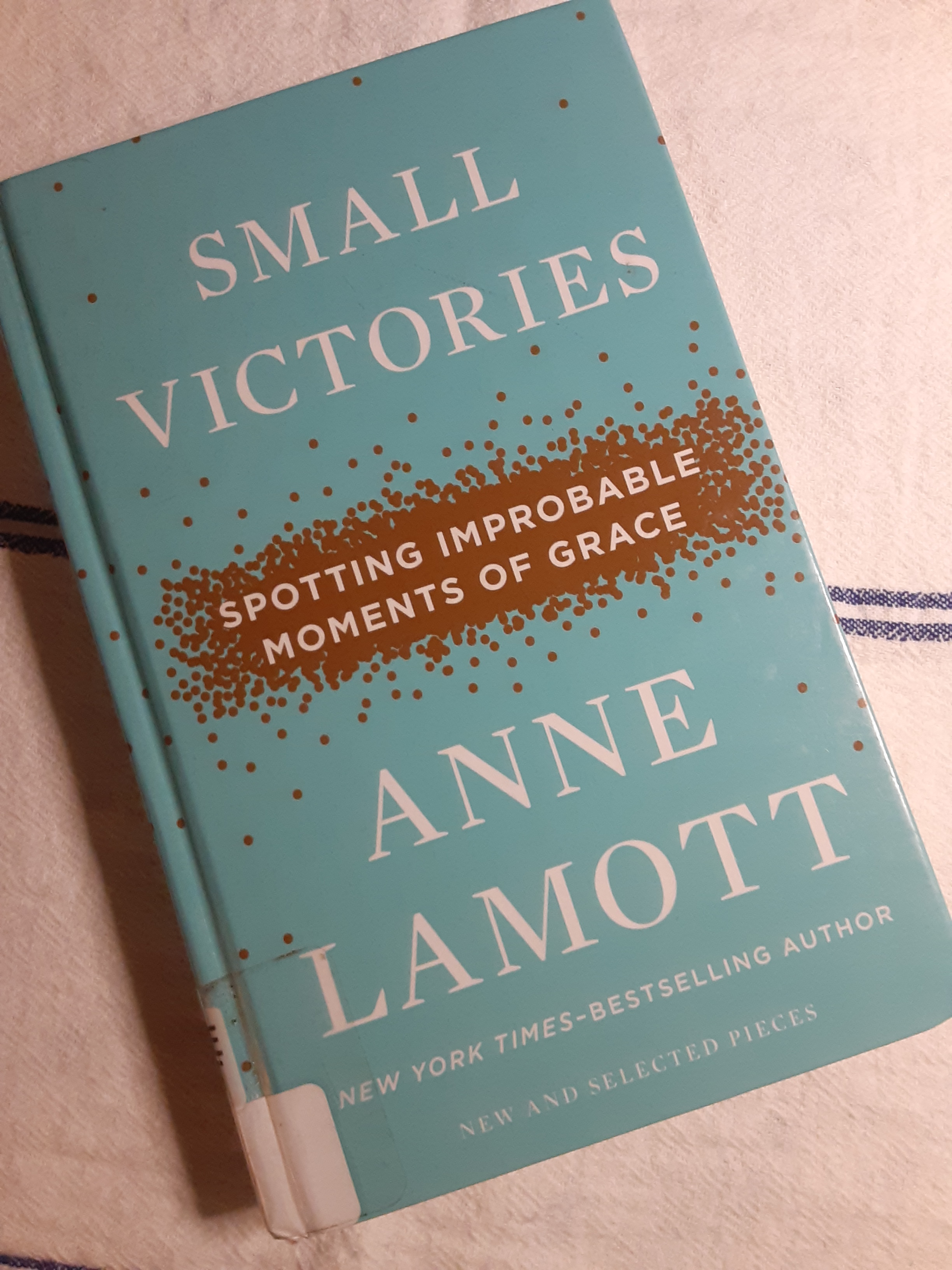
I have a lot of nothing to do lately. It consumes my whole day, however, it is interesting and amusing to me that I can spend all of this time with nothing to do doing nothing and not lose interest. How I tripped over Anne Lamott is a true mystery and I love mysteries. Did I say that? Already? Was Cheryl talking to me? Her book, “Small Victories [Spotting improbable moments of grace]” is not one I would have selected while shopping at the library, nevertheless, it showed up on the holds shelf for me. I did not steal someone else’s hold (I checked) but I wonder what was going through my head when I put it on hold. I put the hold on the LARGE PRINT addition which is often available when all other versions are out which means I felt an urgency to finding a copy. This is truly mysterious.
Her book is a collection of essays about life, faith and graciousness in adversity. We all have adversity fall on us at some time on life’s journey. Cheryl’s death hit me pretty hard even though she died mentally a couple of years prior to her actual death. Anne’s book was on top when I set these six down near where I often sit in the evening to read or find some old movie (or new one) on Prime, Peacock or one of the other streaming services for which I have subscriptions. (Movies get a mere five minutes to gain my interest. I forgot how good JAWS is and the bad science of compressed air bottles.)
Anne entitled this story, simply, “Ashes” and since Cheryl was cremated the story title attracted my interest as the one to read first. I started her anthology in the middle.
Ash Wednesday came early this year. It was supposed to be about preparation, about consecration, about moving toward Easter; toward resurrection and renewal. It offers us a chance to break through the distractions that keep us from living the basic Easter message of love, of living in wonder rather than doubt. For some people, it is about fasting, to symbolize both solidarity with the hungry and the hunger for God. (I, on the other hand, am not heavily into fasting: the thought of missing even a single meal sends me running in search of Ben & Jerry’s Mint Oreo.)
There are many ways to honor the day, but as far as I know, there is nothing in Scripture or tradition setting it aside as the day on which to attack one’s child and then to flagellate oneself while the child climbs a tree and shouts down that he can’t decide: whether to hang himself or jump, even after it is pointed out nicely that he is only five feet from the ground.
But I guess every family celebrates in its own way.
Let me start over. You see, I tried at breakfast to get Sam interested in Ash Wednesday. I made him cocoa and gave a rousing talk on what it all means. We daub our foreheads with ashes, I explained, because they remind us of how much we miss and celebrate those who have already died. The ashes remind us of the finality of death. As the theologian said, death is God’s no to all human presumption. We are sometimes like the characters in Waiting for Godot, where the only visible redemption is the eventual appearance in Act Two of four or five new leaves on the pitiful tree. On such a stage, how can we cooperate with grace?
How can we open ourselves up to it? How can we make room for anything new? How can we till the field? And so people also mark themselves with ashes to show that they trust in the alchemy God can work with those ashes — jogging us awake, moving us toward greater attention and openness and love.
Sam listened very politely to my little talk. Then, when he thought I wasn’t looking, he turned on the TV. I made him turn it off. I explained that in honor of Ash Wednesday we were not watching cartoons that morning. I told him he could draw if he wanted, or play with Legos. I got myself a cup of coffee and started looking at a book of photographs. One in particular caught my eye immediately. It was of a large Mennonite family, shot in black-and-white: a husband and wife and their fifteen children gathered around a highly polished oval table, their faces clearly, eerily reflected in the burnished wood. They looked surreal and serious; you saw in those long, grave faces echoes of the Last Supper. I wanted to show the photograph to Sam. But abruptly, hideously, Alvin and the Chipmunks were singing “Achy Breaky Heart” in their nasal demon-field way — on the TV that Sam had turned on again.
And I just lost my mind. I thought I might begin smashing things. Including Sam. I shouted at the top of my lungs, and I used the word “fucking,” as in “goddamn fucking TV that we’re getting rid of,” and I grabbed him by his pipe-cleaner arm and jerked him in the direction of his room, where he spent the next ten minutes crying bitter tears.
It’s so awful, attacking your child. It is the worst thing I know, to shout loudly at this fifty-pound being with his huge trusting brown eyes. It’s like bitch-slapping E.T.
I did what all good parents do: calmed down enough to go apologize and beg for his forgiveness, while simultaneously expressing a deep concern about his disappointing character. He said I was the meanest person on earth next to Darth Vader. We talked, and then he went back to his drawing. I chastised myself silently while washing breakfast dishes, but then it was time for school and I couldn’t find him anywhere. I looked everywhere in the house, in closets, under beds, and finally I heard him shouting from the branches of our tree.
I coaxed him down, dropped him off at school, and felt terrible all day. Everywhere I went I’d see businessmen and businesswomen marching purposefully by with holy ashes on their foreheads. I couldn’t go to church until that night to get my own little ash tilak, the reminder that I was forgiven. I thought about taking Sam out of school so that I could apologize some more. But I knew just enough to keep my mitts off him. Now, at seven years old, he is separating from me like mad and has made it clear that I need to give him a little bit more room. I’m not even allowed to tell him I love him these days. He is quite firm on this. “You tell me you love me all the time,” he explained ‘recently, “and I don’t want you to anymore.”
“At all?” I said.
“I just want you to tell me that you like me.”
I said I would really try. That night, when I was tucking him in, I said, “Good night, honey. I really like you a lot.”
There was silence in the dark. Then he said, “I like you, too, Mom.”
So I didn’t take him out of school. I went for several walks, and I thought about ashes. I was sad that I am an awful person, that am the world’s meanest mother. I got sadder. And I got to thinking about the ashes of the dead.
Twice I have held the ashes of people I adored — my dad’s, my friend Pammy’s, Nearly twenty years ago I poured my father’s into the water near Angel Island, late at night, but I was twenty-five years old and
very drunk at the time and so my grief was anesthetized. When I opened the box of his ashes, I thought they would be nice and soft and, well, ashy, like the ones with which we anoint our foreheads on Ash Wednesday. But human ashes are the grittiest of elements, like not very good landscaping pebbles. As if they’re made of bones or something.
I tossed:a handful of Pammy’s into the water way out past the Golden Gate Bridge during the day, with her husband and family, when I had been sober several years. And this time I was able to see, because it was daytime and I was sober, the deeply contradictory nature of ashes — that they are both so heavy and so light. They’re impossible to let go of entirely. They stick to things, to your fingers, your sweater. I
licked my friend’s ashes off my hand, to taste them, to taste her, to taste what was left after all that was clean and alive had been consumed, burned away. They tasted metallic, and they blew every which way. We tried to strew them off the side of the boat romantically, with seals barking from the rocks onshore, under a true-blue sky, but they would not cooperate. They rarely will. It’s frustrating if you are hoping to have a happy ending, or at least a little closure, a movie moment when you toss them into the air and they flutter and disperse. They don’t. They cling, they haunt. They get in your hair, in your eyes, in your clothes.
By the time I reached into the box of Pammy’s ashes, I had had Sam, so I was able to tolerate a bit more mystery and lack of order. That’s one of the gifts kids give you, because after you have a child, things come out much less orderly and rational than they did before. It’s so utterly bizarre, to stare into the face of one of these perfect beings and understand that you (or someone a lot like you) grew them after a sweaty little bout of sex. And then, weighing in at the approximate poundage of a medium honeydew melon, they proceed to wedge open your heart. (Also, they help you see that you are as mad as a hatter, capable of violence just because Alvin and the Chipmunks are singing when you are trying to have a nice spiritual moment thinking about ashes.) By the time I held Pammy’s ashes in my hand, I almost liked that they grounded me in all the sadness and mysteriousness; I could find comfort in that. There’s a kind of sweetness and attention that you can finally pay to the tiniest grains of life after you’ve run your hands through the ashes of; someone you loved. Pammy’s ashes clung to us. And so I licked them off my fingers. She was ‘the most robust and luscious person I have ever known.
Sam went home after school with a friend, so I saw him for only a few minutes later, before he went off to dinner with his Big Brother Brian, as he does every Wednesday. I went to my church. The best part of the service was that we sang old hymns a cappella. There were only seven besides me, mostly women, some black, some white, mostly well over fifty, scarves in their hair, lipstick, faces like pansies and cats. One of the older women was in a bad mood. I
found this very scary, as if I were a flight attendant with one distressed passenger who wouldn’t let me help. I tried to noodge her into a better mood with flattery and a barrage of questions about her job, garden, and dog, but she was having none of it.
This was discouraging at first, until I remembered another woman at our church, very old, from the South, black, who dressed in ersatz Coco Chanel outfits, polyester sweater sets, Dacron pillbox hats. They must have come from Mervyn’s and Montgomery Ward, because she didn’t have any money. She was always cheerful — until she turned eighty and started going blind. She had a great deal of religious faith, and everyone assumed that she would adjust and find meaning in her loss — meaning and then acceptance and then joy — and we all wanted this because, let’s face it, it’s so inspiring and such a relief when people find a way to bear the unbearable, when you can organize things so that a small miracle appears to have taken place and that love has once again turned out to be bigger than fear and death and blindness. But this woman would have none of it. She went into a deep depression and eventually left the church. The elders took communion to her in the afternoon on the first Sunday of the month — homemade bread and grape juice for the sacrament, and some bread to toast later but she wouldn’t be part of our community anymore. It must have been too annoying to have everyone trying to manipulate her into being a better sport than she was capable of being. I always thought that was heroic of her: it speaks of such integrity to refuse to pretend that you’re doing well just to help other people deal with the fact that sometimes we face an impossible loss.
Still, on Ash Wednesday I sang, of faith and love, of repentance. We ripped cloth rags in half to symbolize our repentance, our willingness to tear up the old pattern and await the new; we dipped our own fingers in ash and daubed it on our foreheads. I. prayed for the stamina to bear mystery and stillness. I prayed for Sam to be able to trust me and for me to be able to trust me again, too.
When I got home, Sam was already asleep. Brian had put him to bed. I wanted to wake him up and tell him that it was okay that he wouldn’t be who I tried to get him to be, that it was okay that he didn’t cooperate with me all the time — that ashes don’t, old people don’t, so why should little boys? But I let him alone. He was in my bed when I woke up the next morning, over to the left, flat and still as a shaft of light. I watched him sleep. His mouth was open. Just the last few weeks, he had grown two huge front teeth, big and white as Chiclets. He was snoring loudly for such a small boy.
I thought again about that photo of the Mennonites. In the faces of those fifteen children, reflected on their dining room table, you could see the fragile ferocity of their bond: it looked like a big wind could come and blow away this field of people on the shiny polished table. And the light shining around them where they stood was so evanescent you felt that if the reflections were to go, the children would be gone, too.
More than anything else on earth, I do not want Sam ever to blow away, but you know what? He will. His ashes will stick to the fingers of someone who loves him. Maybe his ashes will blow that person into a place where things do not come out right, where things cannot be boxed up or spackled back together, but where somehow that person can see, with whatever joy can be mustered, the four or five new leaves on the formerly barren tree.
“Mom?” he called out suddenly in ‘his sleep.
“Yes,” I whispered, “here I am,” and he slung his arm toward the sound of my voice, out across my shoulders.
Tomorrow I hope the weather will let me ride my bike for a little exercise, but if not, I can read the rest of Anne’s stories.










 Adjunct_Wizard