My search for grace and meaning after a former care partnering life with a wife who suffered from Parkinson's disease and dementia giving her a confused and disorienting world.
Stephan T. Patsis is a favorite cartoonist. His signature work, “Pearls Before Swine” is the cartoon in the comic section of the local newspaper that I read first when my wife hands me the funnies and says, “There are some funny funnies today.”
You have to choose to be happy. The goat who is somewhat intellectual and thought provoking tells rat. An absolutely true statement from a smart goat. One does choose to be happy and no one else can make that choice for you.
And whether or not it is clear to you, no doubt the universe is unfolding as it should. Therefore be at peace with God, whatever you conceive Him to be. And whatever your labors and aspirations, in the noisy confusion of life, keep peace in your soul. With all its sham, drudgery and broken dreams, it is still a beautiful world. Be cheerful. Strive to be happy. – Desiderata by Max Hermann
The title of this blog post is the name of the poem posted in a discussion group. Zella wrote earlier this week… “I thought my husbands poem might be suitable for Parkinson’s Awareness Day!” To which LAJ responded… “I thought it was going to be about a caregiver who thought their husband didn’t like them anymore, […]
As Sue thought, I thought this was going to be about the care giver. It is not. It broke my heart. I have watched Cheryl struggle with opening many things. And I heard Parkyboy talking in the background.
When engineers look for a solution to some dilemma, they often spend a lot of time observing the problem.
Many thoughts can arise. Many questions seek answering. But ultimately the dilemma is slowly broken down to component problems and individual solutions to small problems are sought out. An engineering education teaches this process. An engineering education does not teach solutions for Parkinson’s disease and related issues. Those are discovered along the way.
“There’s someone hanging upside down in the trees in back”, she told me. There is a scrub tree growing in the weedy lot behind our condo. It has a crotch near the ground and branches into to smaller trunks as it grows toward the light. The bark is a light color almost khaki in color. To Cheryl it looks like a kid standing on their head. Perception is off a bit and her creative brain describes a different interpretation.
In that moment she pushed me into interpreting things and objects differently. Are painters able to do this spontaneously? Are story tellers able to imagine a different reality? Are engineers stuck with what they see and touch with little imaginative creation? It intrigues me, the imagination and story telling part. I have often thought that if I could get into her head I could help but maybe I would merely be steering her toward my reality and away from hers.
There are many changes that I notice in her behavior. She can easily ramp up an anxiety about indigestion. It is not apparent to me what specific foods cause distress. Milk products and foods high in milk and sugar seem to give her a hard time. Tomato sauces and beef with a high fat content also distress her stomach. The engineer says figure that out and do not eat those. (Easy Peasey) The average time to relief is an hour to an hour and a half.
I have not discovered any silver lining in these stomach episodes. It is challenging to distract her from focusing on how her stomach feels although occasionally I can get her to sip lemon ginger tea which settles my stomach and does not add caffeine. After a severe episode she is typically awake much of the night. This happened last night.
After it became obvious to me that there was no way for her to calm down and sleep some more, we got up. I got her a bowl of cereal and some orange juice. She sat and worked the puzzles for a bit. I sat with her and worked on the crossword. I ate a banana and drank some lemon ginger tea. I asked her if she wanted to watch TV for a bit to see if she would get tired. She agreed and I played a couple of episodes of Steven Colbert. I can no longer sit up and watch his show so I record it for later. We watched a couple shows. Fortunately he was funny and Cheryl laughed here and there.
Today she is not in tip top shape of course and she fell over backwards in the kitchen. She is understandably fuzzy headed even though she slept until about 9 am. Maybe one day she will keep her hands empty when getting up from or down into a chair. But my wishes and encouragement which she interprets as anger go mostly unheeded.
On the drive to exercise class she asked if I slept well. I asked her if she remembers being up for a large part of the very early morning hours. She said no. The fact that she does not have a memory of being awake is not uncommon. I asked her if she specifically remembered watching Steven Colbert’s late show. She remembers that slightly. She apologized. She apologized for something that she has no control over and that frustrates me to no end.
There is no reason for her to apologize. It is not her causing undue commotion. Parkinson did it.
Watch out for kids hanging in the trees. Carpe Diem.
Punding certainly can be challenging to recover from during lucid episodes.
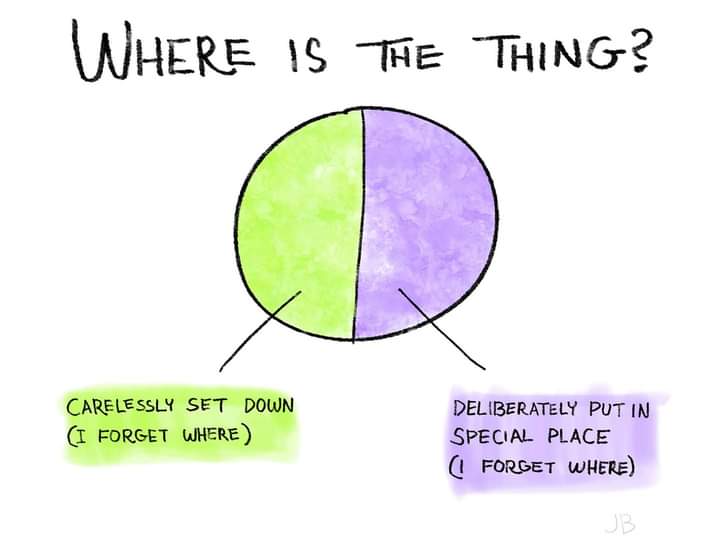
In our latest distressful activity, she has lost part of the equipment she uses for a pedicure. I have no doubt that she had it in her hand when she decided to do something after its last use. And it became “organized” somewhere. I may be wrong but we will see. She says that people move her stuff around and sometimes hide it.
Gone now to that special place so that it would not become lost.
Perhaps a trip to the local Walgreens will help. Maybe I will buy two kits.
Recently I read a book entitled – Dementia Reimagined by Tia Powell MD. It was a disappointment to me personally because I believe that I judged this book by its title. I was hoping for some sort of expert thoughts on how I can deal better with my personable anxiety, emotion and smoldering anger with Cheryl’s disease of Parkinson and her accompanying dementia. I was hoping for; when this comes up, do this. Life is not that easy but my engineer training wants to make it so.
Dr. Powell’s book is a good argument for changing the way government programs, insurance companies and the like perceive and fund help for those with dementia. I know that the funding albeit private or public is screwed up. A few months ago I met with a lawyer to discuss end of life issues especially since I felt certain that Cheryl’s chronic illness would eventually bear a heavy toll on our family finances. He asked why I still lived in Ohio.
All states are different.
No Help There
That does not really help me. These tips on dementia (copied from a website somewhere) do seem to be useful:
Always approach from the front. – or do that as much as you can. When I first read this it was not meaningful to me but I have noticed that Cheryl startles easily. Her startle reflex shows itself at seemingly random moments. If we are traveling somewhere in our car, she will react to other drivers with jerky motions or a surprised little noise from her lips. I used to point that out to her and she reacted with both embarrassment and a little anger. I have learned to ignore these little things but it is hard for me to do.
She no longer drives a car having given up her license several years ago.
I have noticed that she will jump if approach her while working on something in her office which causes her to face away from the doorway so that she does not see me coming. I am not moving quietly when this has occurred but I may be mistaken about that idea. I may be more stealthy than I think myself to be. We are both older. Our hearing may not be as acute as in our youth.
Watch your body language and tone in addition to the words you use. – frustration or surprise at the immediate situation may easily be interpreted as anger. This is the hardest concept for me personally to deal with. I am concerned for Cheryl’s safety and I also hate to clean up messes. I apologize a lot and she apologizes a lot for making a mess even though I tell her that no apology is necessary.
I recognize that I am perceived as angry by her when one of these situations occurred. The aweshit reflex is strong in students and practitioners of engineering. So far I have been able to tone it down to oh-poop but it is a work in process with some small progress. I keep telling myself it is anger with this disease and what it has taken from her. I cannot tell you if there is truth to that statement but I keep repeating it to myself quietly at night when a combination of sun-downers and dreamy illusions and hallucinations creep into her perception of the world.
Sometimes I merely lose it, however. I can be mister cranky pants in the middle of the night.
Smile and wait until they acknowledge your presence before touching them. – Hugs are always welcome but Parkinson’s patients may be unsteady, so be prepared to steady her and accept some weight change. Hugs are always smoother from the front than from the rear. (see startles above)
Regardless of acknowledgment touching, hand holding, hugging are preferable to distance. The combination of Parkinson’s and dementia are frustrating, depressing and scary. Cheryl has expressed this to me often in moments of perfect lucidity. Those moments are still there. Savor them like fine wine or life as it used to be.
Validate their point when they are upset even if they are wrong. – and be aware that it is not important to correct anyone’s perception of things. Never start a response with; you are wrong, dear. … and continuing with the rest of it.
Let’s face the fact that “you are wrong” is a manifestly stupid way to start with no dementia present. Relax and take a deep breath and decide between two things, is it important to correct her perception or do you merely have a need to be right. Try, yes, that could be true… and go from there if concepts are way off and you want to help her find the way back. Or just ignore it, after all, her memory is not very good any more. She will not remember that you are right but she will remember that you angrily corrected her.
Say you are sorry at the first sign of their frustration to keep situations at a minimum. – I say I am sorry a lot because I am sorry that I tread on her heart. This disease is frustrating for us both.
Cheryl sees a nurse practitioner a couple times a year. Maureen is pretty practical when it comes to nuanced care partnering. These are her words;
I get lots of questions on how to deal with dementia. I could give you a list of resources to look up on the internet, workshops to attend, books to buy. All of that takes time which most of us have too little of. A great caregiver website, caregiving.com, offers these 5 tips for dealing with dementia.
PRACTICE PATIENCE – This can be incredibly difficult to do. Try to remember when you were dealing with your children when they were young, especially the toddlers. You probably had more patience then, than now. Remember those days of taking a deep breath before saying something. With practice, it will get easier.
PROMOTE PHYSICAL HEALTH – This is for both the care giver and the care receiver. The care receiver can benefit from practicing chair yoga, dancing, gentle stretching. Since the pandemic there are abundant resources on You Tube which can be helpful for both the care giver and the care receiver. A walk outside in the fresh air can help clear the mind for the care giver and give a person a brief respite.
USE PHYSICAL TOUCH – Touch is a powerful form of communication and connection. It can also be a valuable expression of reassurance particularly to someone living with dementia. All of us need a hug now and again. My own mother would remind me I forgot to kiss her good night!
FIND RESPITE – If you’re focusing most – if not all – of your time, energy, and resources on caring for a loved one with dementia, you may find you cannot sustain doing so over the long-term. With proper self-care, you can relax and recharge, manage caregiver stress, and become a better and more effective caregiver. Consider sitting on the porch and reading a book, a brisk walk, a cup of Starbucks, an ice cream cone, a massage, a warm bath with soothing scents. These things need to be done regularly in order to maintain your own health.
REDUCE WORKING HOURS – If you are still working full time, care giving becomes a second full time job. Consider scheduling a meeting with your human resources manager to propose temporarily working from home, flex-time opportunities, job sharing, and/or even paid leave due to your caregiving demands. You may be pleasantly surprised by the accommodations your employer is willing to make.
Maureen is a wonderful practical person. (I also wish she was not in our life because then there would be no disease of Parkinson or dementia.)
She writes uplifting and spiritual thoughts in a weekly email newsletter she calls “Sunday Paper”. Today she writes about changes in life. She struck a chord in me but probably not in the way that she intended.
This Parkinson thing is a dramatic change in our life. Maria uses as her focus a friend that is moving far away and talks of pivoting toward the future. What struck me is Cheryl is moving away inside. Not purposely of course but this morning the conversation centered on location and space. She believes inside her head that we are far away from home. She asked are we going home today?
Home is a concept different to everyone. I told Cheryl as I always do when she asks this, we are home. We live here. Sometimes I go into more detail and tell her when we moved. She has a puzzled look on her face when I tell her those things. Sometimes I regret moving out of our big old house in Pleasant Ridge when we have these conversations but I have no basis for regret. She is confused now and most likely would be if we were still living in the big old house.
To me home is not so much a place as a situation. If one “googles” home the famous web search returns thousands of pictures of various houses in various places but a building is not home. Those houses may or may not be home to others.
Cheryl is where I am home. Our life was unimaginable to me when we got married 51 years ago.
On this snowy slowly warming February Sunday I am reminiscing about life and home and the twisty turny path we all follow though life. And that is my concept of home.
She sometimes thinks that we are not home. I am as long as I am with her somewhere.
A boy, a fox, a mole and a horse – great book for meditation
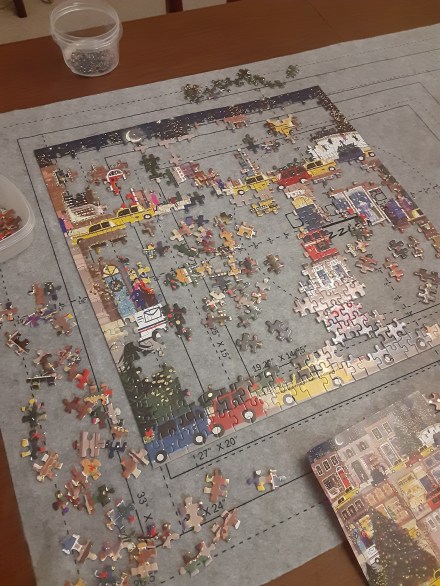
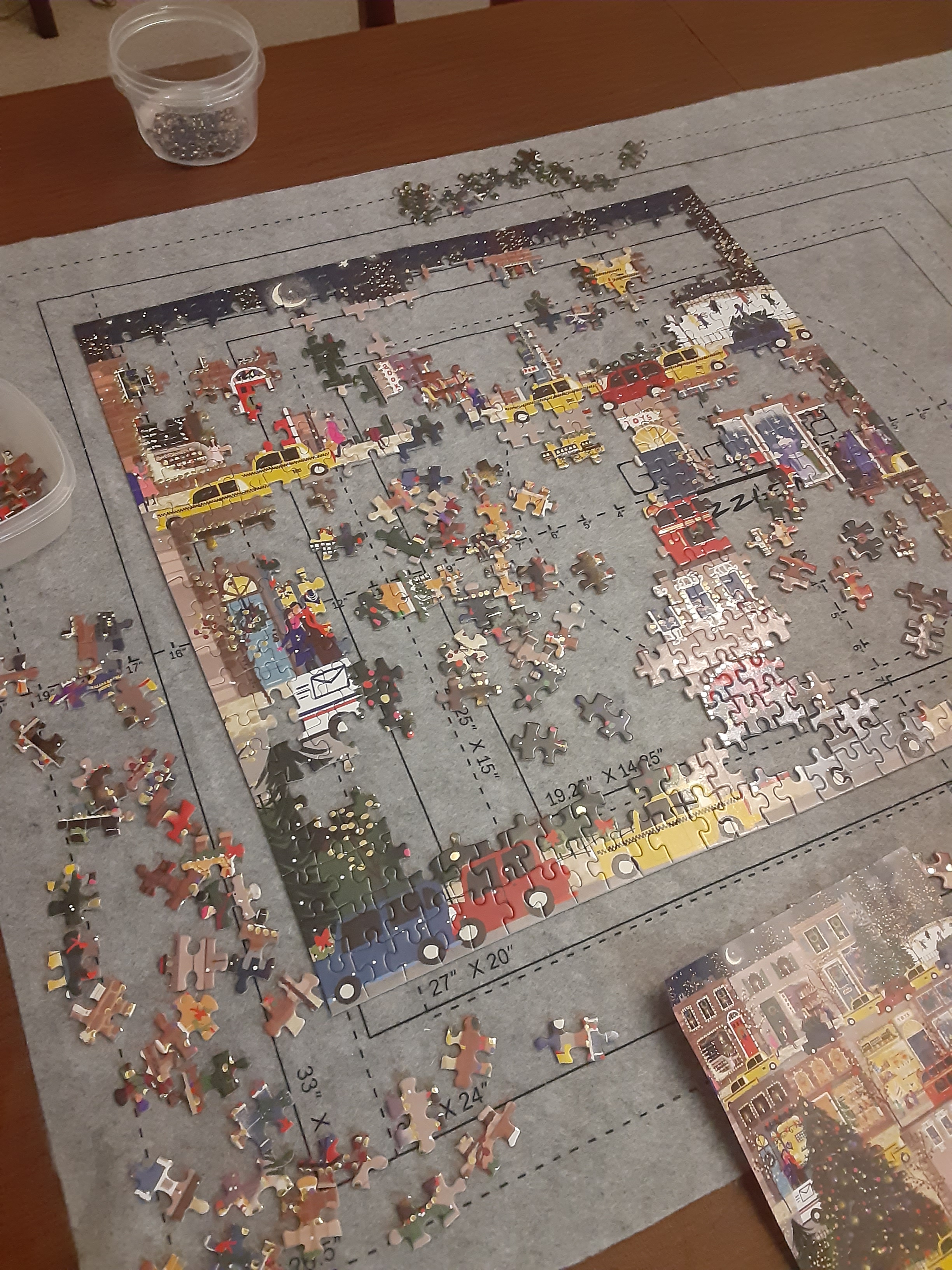
Many months ago Cheryl started on this puzzle. I wrote about it before. I could figure out exactly how long ago but the specific span of time is actually unimportant to the story. Last week when Cindy came to sit with Cheryl for a bit so that I could go do whatever I wanted to do by myself, I said to her that she could help Cheryl with this puzzle that she has been ignoring for months. I said that thinking that it would go over like the proverbial lead balloon – what is a lead balloon? – but Cindy is an enthusiastic puzzle doer and she sucked Cheryl along with her. I left to do a couple errands and take a walk.
Two hours or so later when I returned Cindy and Cheryl had not moved from the spots alongside the dining table where I unrolled the puzzle and reinflated the tube that the felt surface was wrapped around with the trapped puzzle pieces. Cindy had Cheryl hard at work sorting pieces of like color and they had assembled several chunks of pieces to figure out where they fit in the picture that came with the puzzle. They did not finish it that day. It is a half thousand pieces of a complex image of small town Christmas.
The picture when completed
Lots of colors are involved. We bought this puzzle several years ago. I think we may have had it for a couple years by the time the pandemic broke into pandemonium everywhere. It came from a Barnes & Noble book store that we happened to be shopping in for one of the grandkids. Cheryl passed by the puzzles parked in the aisle and was inspired to retell the story about someone at Bridgeway Pointe assisted living facility who worked puzzles all the time and lived down the hallway from her mother. I remarked that she should pick one out to do for herself and she selected this Christmas scene.
Leaving it on the dining table is somewhat of an inconvenience at dinner time as I had gotten into setting the dining room area for two. We had used mostly the kitchen table when we first moved into the new condo and reserved the dining table for company. As I took on most of the cooking duties I decided to use the dining area more instead of preserving it for non-existent company. Had we stayed in our old house I suspect that I would have gotten to this point there also. For now, we are back in the kitchen for dinner.
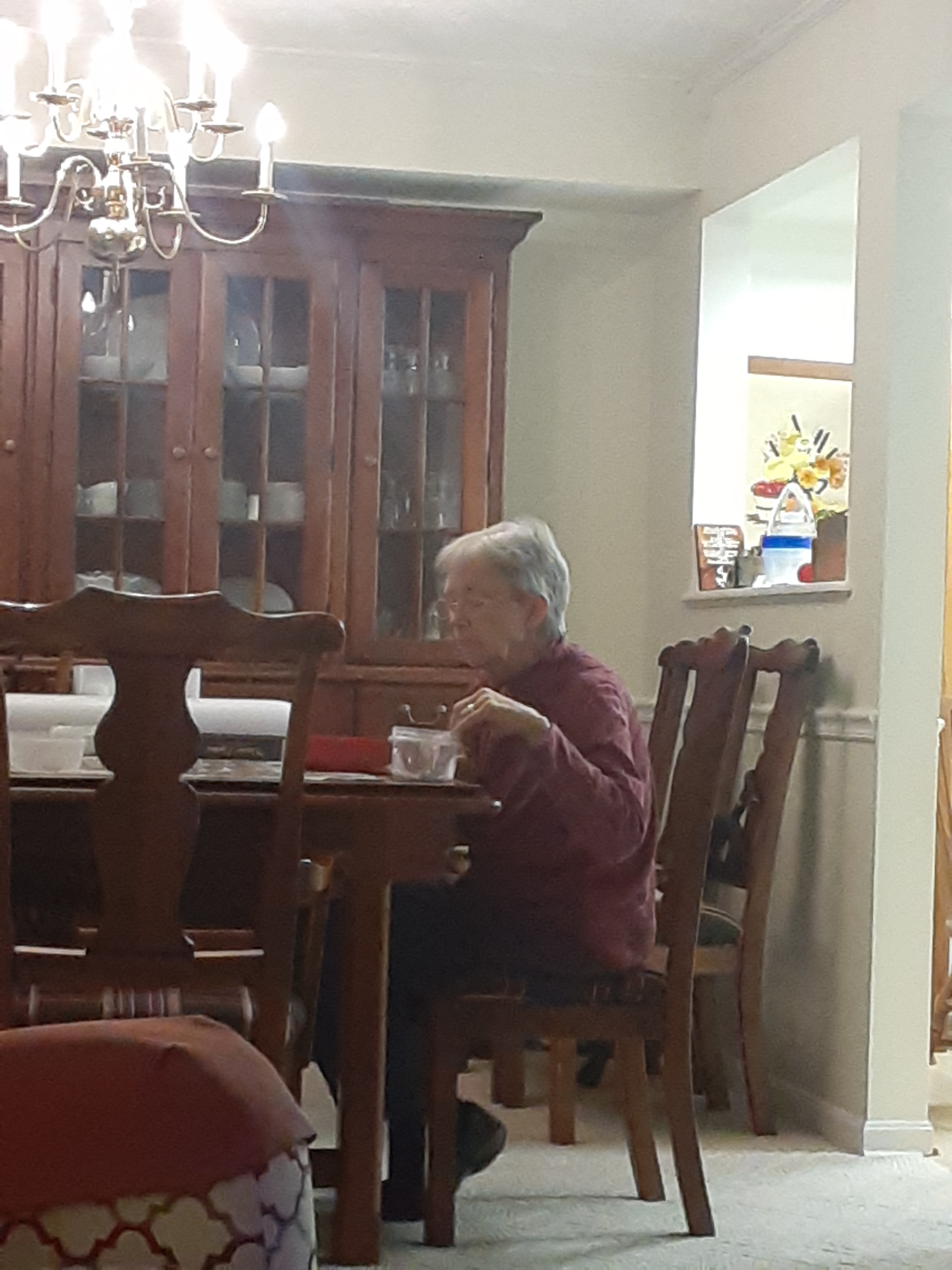
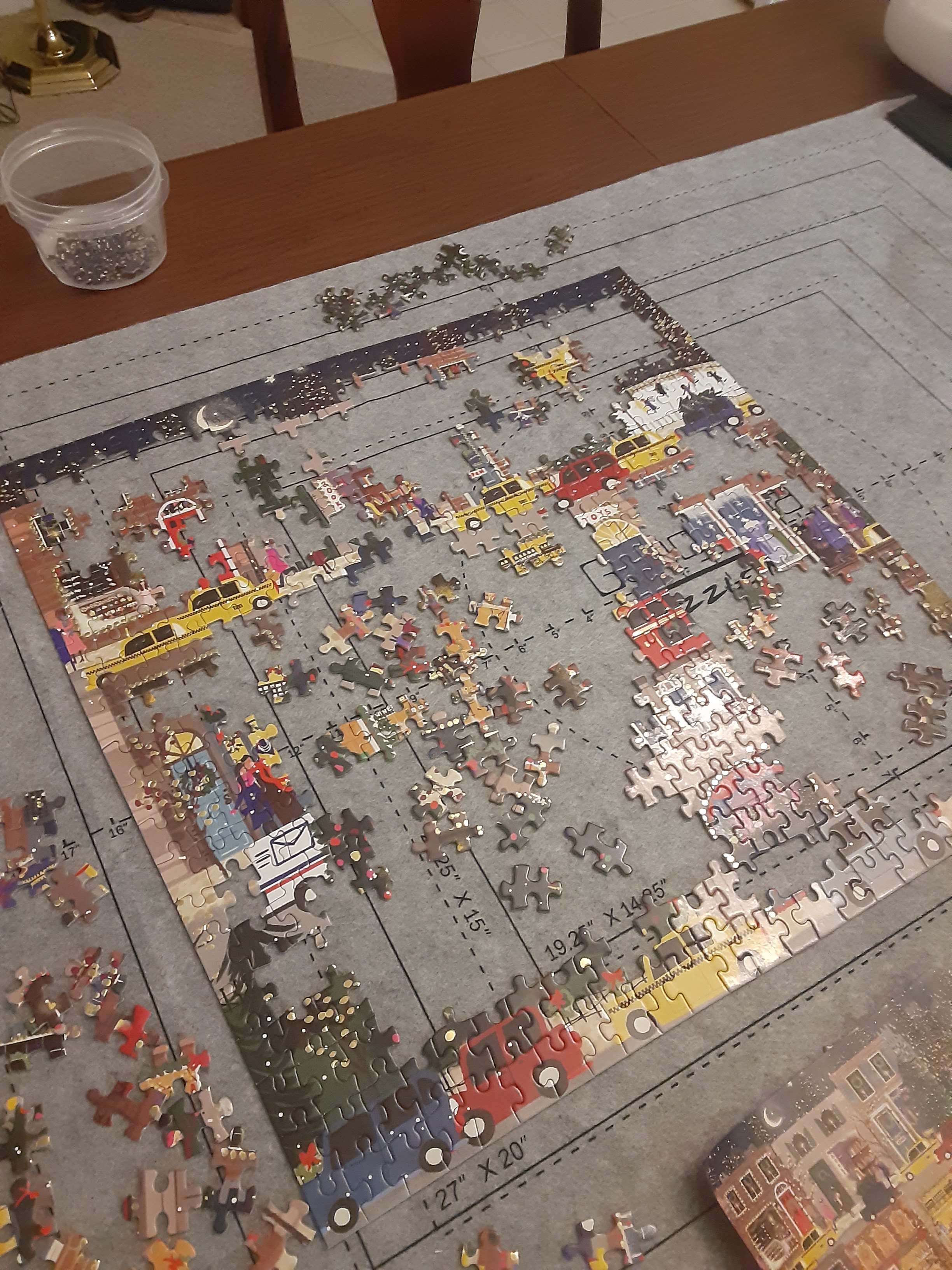
For several days after Cindy’s inspiration we walked around the puzzle on the table awaiting Cindy’s return. I did not mention it. Cheryl once suggested that she could put it in her office and I persuaded her that it was not in the way of anything. She was worried that her little people that she sees occasionally would disturb it but they have not. Last evening she started to work on it. It was a spontaneous move on her part. She worked on it for a bit. I texted this picture to Cindy. She responded with, “Great! Don’t let her finish it without me.” There is not much danger of that, Cindy.
I checked on her during the evening. She worked on it for about an hour. She found two pieces that seemed to fit together but they did not. I was able to help her find a couple pieces and fit them somewhere in the picture.
Her memory seems to be going faster. She looks at a piece and as she looks at the picture the shape is lost in her visual memory. It is a long process.
Living with a parkie makes me alert to new information when it comes up. That being said I do not always recognize my new task. This is about becoming a master cookie maker on the fly.
Executive function
Dementia occurs in about 40% of Parkinson’s sufferers. Some behaviors are side effects of medications. Some come with build up of unpronounceable proteins in the brain. No matter the source, the behavior can be disheartening and annoying from a care partner perspective. Cheryl’s reaction often is anger to some perceived slight or merely, the question, why do it that way? (It is an engineer’s question.)
It starts with me. Words and question structure is important. Engineers always want to ask why something is done some way or simply is some way. Why often sounds like a challenge, even to other engineers, if it is not asked properly.
How to do
Our latest challenge to our marital bliss is Christmas cookies. Baking is a hobby and a passion. I like to think I have perfected my meager talent at making breads of various types and shapes. I am proud of that but lately I have pushing into cakes and pies. The pandemic pandemonium gets to us all in various ways.
My perception of making cookies is one of a trivial exercise in baking. That seems to be an incorrect perspective. Cheryl’s helping me. Two cooks in the kitchen is a recipe for a challenge to peaceful coexistence. Two bakers near an oven enables battle lines to be established and defended with vigor. Starting a question with why is akin to removing one’s glove and casting it upon the dueling ground. (smiley face)
Cheryl has made perhaps a giga-dozen (I just made up that word) of cookies. I have made none. What can I say to redeem myself? Engineers ask why a lot.
Where to start
To a skilled cookie baker the recipe is merely a guide, a refresher, a list that says these get lemon zest. Interestingly, that is much like how I view a new bread recipe. I am on familiar territory.
But not so fast apprentice! Nearby there is a master cookie baker. Do not question the master’s skill at her craft with disdainful utterances such as, why and how come? All will be revealed. But also keep an eye on the recipe and make suggestions such as, yes, we have put that in the mix. Shall I add the butter?
Sometimes with creeping dementia ingredients are forgotten. Sometimes without that factor ingredients are forgotten. Try to be kind and remember that no one got up in the morning thinking, how can I mess with his mind today? Most importantly, do not raise your voice two octaves, that is a dead giveaway to your ignorance.
How does one check for doneness? It is common sense! Look at them. (the “fool” is left unsaid.) They will look right. What is right? (and on and on and on…)
Cut out the Crap in the Conversation
To a person standing nearby this conversation can sound rude. It sounds like one person is giving another orders and it can be that way. If, however, it is done with kindness in the communicator’s heart and with understanding that a Parkinson’s patient also may be dealing with confusion issues, it is neither rude nor demeaning in any way. Often a person experiencing Parkinson’s cannot or does not get the implication or inference. Be clear. Have kindness in your voice when speaking.
The onus is on the care partner to be patient, kind and clear. Be aware, care partner, that this is hard to do because you remember how your partner/spouse/parent/friend was before. (Good natured teasing may be misinterpreted. Be certain that your partner is not confused.) You too can be unaware of how they are now. The Parkinson’s patient may become sad or angry. Be persistent if you as care partner are very concerned about safety. Add some love to the conversation if you think you are not getting through the confusion. Strive to not become frustrated and raise your voice (two octaves).
We did wind up with our first battle batch of cookies. Although they are a motley crew, they taste fine.
Here is the setup. Cheryl has a wheelchair tag. In fact we have two. When Cheryl was still driving we applied to the state to get one for each car.
A few weeks ago we got in the mail on two different days a form for the state to renew our wheelchair tags if we wished to do that. The forms require a script from Cheryl’s doctor. When they came a couple weeks ago I put them in a special position on a ledge wall between the kitchen and the rest of our living area in the hope that I would remember to take them with me to our doctor appointment in December. Cheryl agreed that was a good spot to leave them.
Today, she re-discovered them and was telling me what they were. I let worry and anxiety about losing them before the doctor appointment come over me. I took them from her and explained why they were on the ledge. Thinking back on it, I was not that forthcoming with why I was putting them back on the ledge. She became very angry. I apologized for being a stinker. It is a delicate balance on some days and I admit I am not always up for it.
Of late, Cheryl keeps her emotions just below the surface. It seems to be a symptom of her disease. She is constantly thinking about what was. Hearing a particular hymn in church will cause her to weep. When she sees pictures of the grand kids on our electronic picture viewer, they become real to her and she will talk to them. If I take a deep breath or just simply sigh, she will ask me what’s wrong? If I do something and she feels slighted in some way real anger appears. All of these reactions are the same as any feeling person except maybe talking to the hallucinations. Parkinson’s is not real to her. The unsteadiness and jerky motion is not visible her until it is.
It is hard for me to not be a helicopter care partner and hover close by. It is hard for me to not be protective of things that I am certain will be lost in her PD and Lewy body confusion. She displays punding style behavior which in her case seems to be arranging and rearranging her papers in her office. These papers are often random collections of emails and news letters assembled with no apparent theme. (I worry that real papers will disappear in the organized randomness of her office.) I try to watch what goes into her office and short circuit anything of importance before it gets there.
Sometimes, like this morning, I do that without the gentleness that I should have used. When that happens I tread on her heart.
Edie’s prayer
I should have read this when I got up this morning.
Recently (yesterday) I convinced Cheryl to go to a chair yoga class. I thought it would be good for her. In my sometimes helicopter care partner mode it seemed to me that I might be able to find something for her to go to most everyday at PCF. She often wants to get different things that she uses in class so that she can do the exercises at home. But lately she does nothing at home that looks like exercise. There is nothing unique in that, many people to not.
Today when I talked to her about going to class she said, I don’t want to do that. I have a hard time knowing my right from my left. I have problems with a similar thing I said. I always have to say the alphabet jingle in my head. Elemenopee… I thought about what I said suddenly. Why was it necessary to make it about me?
She went on to say that all that reaching and stretching was hard. Somewhere in her conversation I realized she thought I was taking her to chair yoga. I spent another ten minutes or so convincing her that this class was one that she had been taking all along. It was not a new class. I realized that I was rushing her into trying new things to exercise her body (tired with PD).
Apathy and lack of interest to try new things or finish things once started is common in PD sufferers. I found myself reading about Apathy in Parkinson’s patients while she was exercising at PCF this afternoon. The internet of all knowledge directed me to Michael J. Fox; the APDA site; the Parkinson Foundation and others. All say approximately the same thing.
Apathy describes a lack of interest, enthusiasm or motivation. It interferes with the effective management of Parkinson’s disease (PD) symptoms, since apathetic people are less inclined to do things like exercise and follow their medication schedules. …
Apathy can be frustrating for people with PD, caregivers and loved ones. Understanding apathy as a symptom of PD and finding ways to cope with it are key to ensuring a good quality of life and for maintaining good relationships with caregivers, family and friends.
Therapies
Currently, there are no proven effective treatments for apathy — no pills or special therapies — but structured activities and opportunities for socialization are a useful approach. A regular routine, continuing to socialize and exercise even if you don’t’ feel like it…
from the Parkinson Foundation website
As I was reading along various sites, Cheryl was exercising three feet away. Same things are easier to get her to do. By that I mean things that she is familiar with, things she has done before. And as I watch her do the exercises she changes. Her motion becomes more fluid and steady. She does not quit. She pushes herself. And tears come me. What’s up with the emotional response in me? What a pain PD can be to people close by. Once she gets started all can be well. As class moves on she is an enthusiastic participant. I am merely an observer and not someone to argue with. (smiley face with tears)
More … My own thoughts … Usually when I write one of these messages to myself I struggle with what point I am trying to make. Not so here. It is easy to drift into making something about yourself. I believe that it is a natural act. To understand some thing, some idea, some opinion, some action of others we relate it to some local knowledge we already have. Educators call it scaffolding.
What happens when one has no similar knowledge? It can be made up out of whole cloth. It is natural. We, at least many of us, want to empathize with the other person’s unsatisfactory experience.
A life lesson, I suppose. Maybe an AHA moment appeared for me. Try to stop making it all about myself and still empathize with Cheryl. Or, at least, do not vocalize it to her.

















 Adjunct_Wizard