Not Too Negative About It

As we move down the road of Cheryl in a special place that can take care of her all day long every day, it gets easier for me to leave her. I am assured that she is getting the best care for her at this time.

The past few weeks when she was still home and it was all me, I started feeling anxious and upset with her lack of motivation to help with her own well being. I knew that her disease was getting in the way more. I was frustrated with her lack of cooperation with me with caring for her.

I was perhaps stepping on the last little bit of control that she had over events in our life. My whole waking day was consumed with her. I did not mind that but looking back, from her perspective, I was overwhelming, helicoptery and just plan annoying. There is a difference between accepting help from someone and having unwanted help thrust upon you. I was drifting into the thrusting arena.

This current situation is different. I can step back and let the aides do it – whatever it may be.

I am a husband again. Making sure has has all she needs to do for herself – whatever it may be.

Carpe (deep sigh) Diem.

Little Incremental Changes

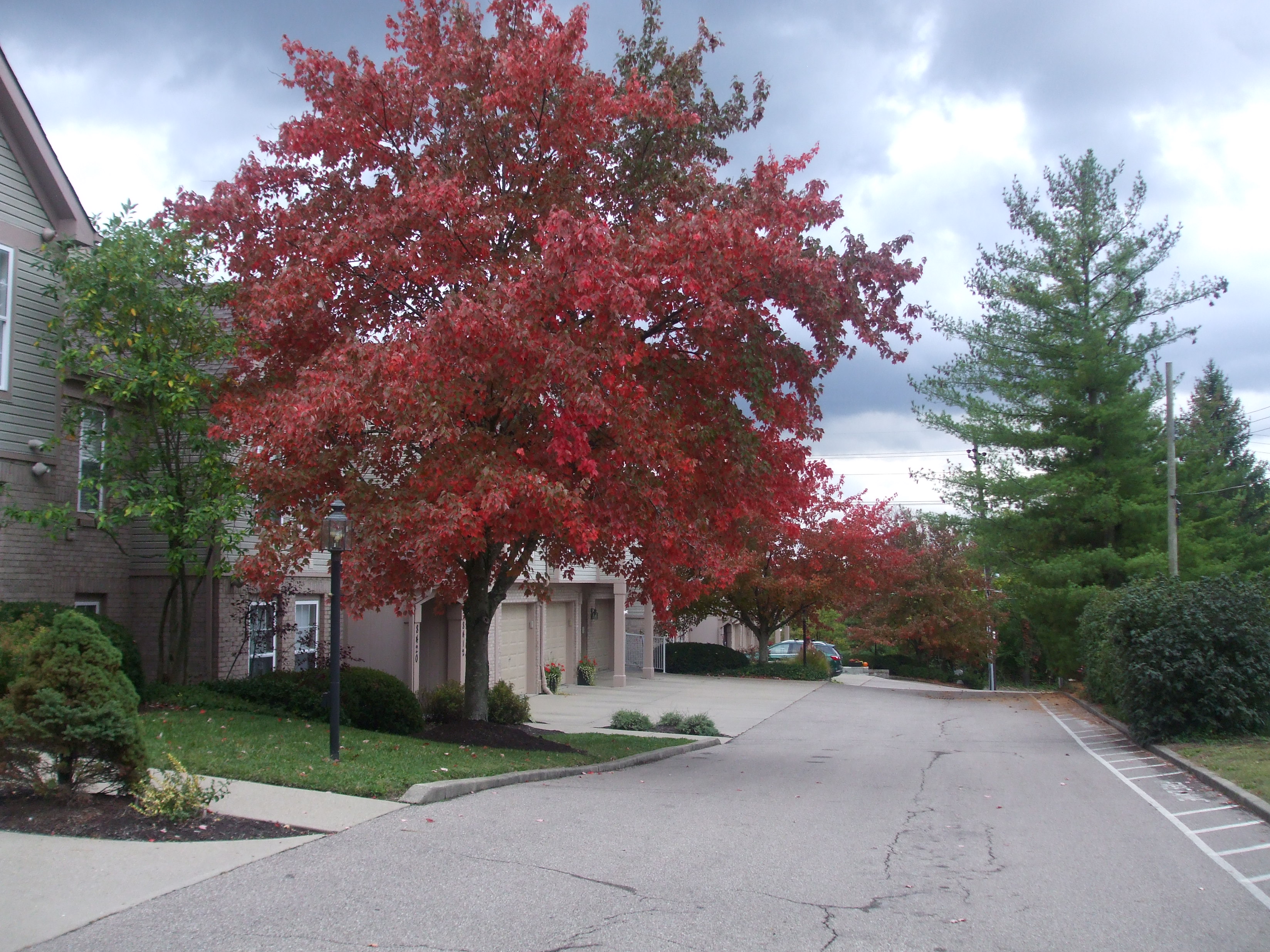
This morning I am thinking about the little incremental changes this disease of Parkinson caused in Cheryl. The trees in these pictures are maples and they are turning with the season. It is not apparent in the big picture as they show below but zoom in and each individual leaf has a tinge of red around the edge of the leaf. The green still remains in the core of the leaf. Little incremental changes as the leaf begins to shutdown for the season.

Tonight and on days since I started this essay, I am thinking about the little incremental changes this disease of Parkinson that has invaded the person I most want to be with, the person where I am home, has caused in me. Our green area is smaller. And yet at the same time it is still green.

It is my goal to talk to her on a level that is her. Sometimes her behavioral response to some situation can appear childish to me. It has only recently come to me that I must ignore that perception and talk to her as I once did. Almost every morning when I wake her she will ask, “Can we still get to church?” or “What time is church?” I used to respond with, “There is no church today.” Sometime in the past I decided that response was unhelpful. These days when she asks me about church I take that to mean, “What is on the agenda for today?” She has little memory of what we may have discussed doing on the previous evening when we went to bed.

Aphasia appears often. When she is telling a story it is very important to her to get the names dates and places correct, even if she is way off the mark. Her mother is no longer on this Earth nor is her sister Janice. Cheryl tells stories about them or visiting with them in the present tense. Once in awhile I might tell her that her mom is in heaven. She will respond, “Are you sure?” That question reminds me that it is unimportant to correct her perceptions. I have a difficult time resisting the natural male response of – bullshit that is not the way it is.

It appears to me – just observation – that although she can read, the words are mostly meaningless. It the morning over breakfast we look at the newspapers. For me that is the Wall Street Journal. For her that is the Cincinnati Enquirer. I have two observations; She does not recognize that they are two different papers. She is unable to comment on articles that she may be looking at in the paper. (I have asked.) The particular article might be about some city council fiasco. She will tell a story about Sr. Janet and what the newspaper tells Cheryl about her job with the parish office.

I know there is some green still left in the middle.

I am thinking about how it has changed my focus. I used to worry about how late she slept in the morning. The why of that worry always comes back to how much sleep I will get that night. Those two ideas are connected only in my mind. They are not connected in practice.

It changes my perspective. There is a bigger picture. Just like these trees on our property, when one zooms in one sees the differences in the leaves but when one zooms out one sees beauty.

It changes my interest. What can I do to enable her to reminisce even if her memory is weak? Perhaps I can aid her reminiscence. Comment about her stories to get her to tell me more.

It changes my observation of the universe. There is beauty everywhere you look. Cheryl is always telling me about the moon when we are driving somewhere. I look too. She can see the moon in the clouds. So can I if I look carefully and listen to where she says she sees it. A shape in the clouds looks to her like the moon. I long to see through her eyes.

Maybe I could read to her rather than watching her struggle to understand printed words.

Carpe Diem.

Longing for a Life

Some days when I look at family pictures I find myself longing for a different life. I long for a life without Parkinson. Often it is a deep deep longing on those days when Cheryl is struggling and I understand she is struggling and I have no ability to help without making her feel helpless. Her dementia pattern seems to inhibit her from asking for any assistance or realizing that she needs assistance whether it is me holding her up so that she can steady herself or simply handing her a tissue to blow her nose or blot her mouth when the drool comes.

Care partners run out of gas too. On most days her memory seems to work for about 10 minutes. ( That may be a sarcastic quip.) On others the loss of the discussion is much shorter than that. On those days I become frustrated which manifests as a louder whiny voice and sounds like anger. It sounds like anger even to me. Cheryl responds with anger and I suddenly remember where her mind is. It is very easy to forget she is still Cheryl. Repetition helps her know what to do or where to go or what she thinks she needs to do. Nevertheless it can be frustrating.

I started writing this short essay a couple days ago when I was feeling down? lost? tired of it all? – defeated? – maybe all of these. Sometimes I just wonder what if?

I doubt that anyone dealing with a partner in life that has a chronic disease wishes for their current existence. Endurance and strength to get through it all is all I ever hope for.

Looking back on the past few years, the covid shutdown, the covid start-back-up, the lifestyle/work style changes to society, the meanness of social media politics, I realize that Cheryl and I do not have it so bad. I wish her dementia to be gone but it is not – except for the few moments early after she awakens. She will look at me with tired eyes and smile. It lifts my heart and soul when that happens.

I still wonder “what if?” I just do not let it control me.

Breathe in, breathe out, move on. — Jimmy Buffet

GULF SHORES, AL – JULY 11: Musician Jimmy Buffett performs onstage at Jimmy Buffett & Friends: Live from the Gulf Coast, a concert presented by CMT at on the beach on July 11, 2010 in Gulf Shores, Alabama. (Photo by Rick Diamond/Getty Images for CMT)

Picture stolen from NPR.

Carpe Diem.

I Expect Too Much

I do.

I expect Cheryl to do things that she is incapable of and respond with anger when she cannot. My anger is better described as frustration. As I leave her thinking she is headed in the right direction, when I check on her later, I find that she has wandered off in some new direction. Instead of washing her face, she is cleaning the sink.

I expect others or hope that others will see our dilemma and voluntarily help in some way. Those people who do are very few in number. They are a joy to be around.

I do not expect anything from strangers but they open doors or hold the door or jump up to open the door. It is a small thing but useful.

Friends and family are all helpful in their own way. They all have lives. They all have other interests. It is self centered of me to expect them to think about us.

As we travel this road of Parkinson and related dementia changing expectations is necessary. If you do not make adjustments all that can be found is perpetual disappointment.

Perpetual disappointment leads to cynicism. Conversation becomes sarcastic. The sarcasm is wasted on dementia patients. They will only detect the underlying anger.

Cheryl uses her left side successfully only when she concentrates. Perhaps specific marching encouragement will help – left foot, right foot, left foot, and on.

If I change my expectation for her walking, perhaps I can help her improve.

If I change my expectations of family and friends perhaps I can find more happiness and less disappointment.

Perhaps I need to change my expectations.

Carpe Diem.

Palliative Care

Today we saw the doctor whose clinic is concerned with palliative care. After a long discussion about drugs, symptoms and what the palliative care clinic does the conversation turned to what we hoped to achieve from it. My hope is for better existence for Cheryl. She has trouble vocalizing her hope.

From the National Institute on Aging — (NIOA) — the next couple paragraphs are useful general information. The doctor’s question hit me spiritually, what are we expecting? It is a good one — What are we expecting? A cure? Return of mental acuity? A better attitude about living with one’s plight? More mobility? A stronger core muscle strength? — A flood of thoughts entered my mind.


What is palliative care?

Palliative care is specialized medical care for people living with a serious illness, such as cancer or heart failure. Patients in palliative care may receive medical care for their symptoms, or palliative care, along with treatment intended to cure their serious illness. Palliative care is meant to enhance a person’s current care by focusing on quality of life for them and their family.

Who can benefit from palliative care?

Palliative care is a resource for anyone living with a serious illness, such as heart failurechronic obstructive pulmonary diseasecancerdementiaParkinson’s disease, and many others. Palliative care can be helpful at any stage of illness and is best provided soon after a person is diagnosed.

In addition to improving quality of life and helping with symptoms, palliative care can help patients understand their choices for medical treatment. The organized services available through palliative care may be helpful to any older person having a lot of general discomfort and disability very late in life.

Who makes up the palliative care team?

A palliative care team is made up of multiple different professionals that work with the patient, family, and the patient’s other doctors to provide medical, social, emotional, and practical support. The team is comprised of palliative care specialist doctors and nurses, and includes others such as social workers, nutritionists, and chaplains. A person’s team may vary based on their needs and level of care. To begin palliative care, a person’s health care provider may refer him or her to a palliative care specialist. If he or she doesn’t suggest it, the person can ask a health care provider for a referral.


Why (a conversation with myself, often) is palliative care necessary and useful? What benefit will come from this method of viewing Cheryl’s worsening Parkinson and her associated dementia issues? These are my thoughts.

Since the beginning of this road all I have wanted is for Cheryl to be safe, comfortable, mobile, and as independent as she is capable. Seven years ago, just before we purchased this condo that we live in now we lived in a neat old five bedroom, two story house with a basement. It was a hundred plus year old house with much space and character. Cheryl’s main complaint was her knees. At first I moved her office area downstairs to the front bedroom. We called it the guest bedroom and sometimes “your Mom’s bedroom.” I rearranged the use of the other extra bedrooms upstairs. I remodeled one and took over Cheryl’s old office upstairs as my own. The upstairs bathroom was accessed through the office. The home office was moved to the guest bedroom downstairs as was the rest of her equipment – sewing machine, computer things, printer, etc. but Cheryl had adopted the upstairs bathroom as her own and regardless of where she was maintaining a presence during the day she went upstairs if she required the facilities. (The hallway to our big bedroom in our condo she now refers to as upstairs or downstairs as her Parkinson and memory issues worsen.) She complained about her knees everyday until we moved to our flat single floor living arrangement.

During the seven year process of moving, adapting, adjusting I put her needs first not thinking about or recognizing what those adjustments would do to my emotional and physical health. Not once did I think about how my life would change when Cheryl gave up driving voluntarily when she could not remember where she was or where she was going. Nor did I realize that she was starting into her creeping memory issues. A couple months later when she became terribly upset and anxious one evening because she could not find $1.89 mistake in the check register that she was still computing by paper and pencil, I did not realize that she was struggling with cognitive issues in addition to memory issues. Her math and logical sequencing was gone or mostly so. She did not admit it to herself or to me and I did not recognize it. (notice – cognition in recognize) It was perhaps two years later that she was unable to follow recipe instructions or sewing pattern instructions. (I found myself reading how to reverse an item so that the seam allowance was hidden.) In retrospect she was probably terrified that she could no longer do those things. She was in fear of losing her mind and it caused anxiety.

My hope or expectation is that she will achieve some level of relief from her anxiety. My hope is that she will sleep more comfortably. My hope is that she will accept her disabilities that inhibit what she wants to do and she will ask for and accept help freely offered by her spouse (me).

My hope is that I will be more comfortable with letting her do for herself as much as she can while she can do it. Whatever it may be. My hope is that I will find the strength and the financial means to provide for her future care. My hope is that I will plan activities and be cognizant of the fact that plans will change without warning and I will not rage out loud when it does not go my way.

My hope is to be able to let go once in awhile for my own mental well being. I hope that this group of clinicians can help with living and life. But mostly I hope to get a good night’s sleep most nights.

Carpe Diem.

It is Important to Listen

Research study questions are I opening (I know you think eye opening) but I meant I as in me. Before the pandemic pandemonium Cheryl agreed to participate in a longitudinal study on Parkinson’s disease.

There is an initial evaluation of mobility and mental agility. There is a blood test, urine test and stool sample test.

Much of the mental agility data collection effort is question and answer style. Several different instruments are used, one of which is the Beck Depression Inventory. As Cynthia (study tester) asked Cheryl the questions and marked her answers, Cheryl began to cry. Cynthia decided to skip the test. She did the same thing with the MOCA test. Cheryl could not draw a clock last time she took it.

As Cheryl was using the restroom I remarked to Cynthia that this might be the last time that Cheryl would be able to come and participate in Dr. Espay’s study. It was not that I thought she did not want to, rather, her mind is gone to the point that she may be of no help to them. Perhaps I should not impose on Cheryl’s desire to help others. A year from now she probably will not remember this visit.

The Beck instrument starts with questions such as:

1.
0 I do not feel sad.
1 I feel sad
2 I am sad all the time and I can’t snap out of it.
3 I am so sad and unhappy that I can’t stand it.
2.
0 I am not particularly discouraged about the future.
1 I feel discouraged about the future.
2 I feel I have nothing to look forward to.
3 I feel the future is hopeless and that things cannot improve.

… etc.

Cheryl teared up on question 2. In each question the participant selects the answer that they feel at the time. At the end a score is computed that evaluates the participant’s depression. Cheryl’s emotional level was strong on the second question and Cynthia stopped the instrument.

I had not realized how this disease was weighing on her emotions. As the disease progresses Cheryl needs more help physically. She relies more on me and others around her. She is very resistant to accept help from others constantly. She gave up driving long ago. A big part of her independence left her when she gave up driving.

It has proven to be a very emotional disease. Cheryl becomes angry with me when I help her “too much”. We have been together too long for me to ignore her needs. I help her anyway. She gets angry with me. I get angry with the disease and what it has stolen from us.

And then my heart melts.

Carpe Diem.

Home Now

We are home now and I have been thinking about it all. it was a great trip. Are there things I could have planned better? You betcha but we adapted and got through it all.

A few things that I would do differently…

And before I left I updated the Linux Gnome interface and for the first time in a year or so turned that computer completely off. Gnome is broken. That computer operates like an old DEC PDP 11. I have a project to keep me busy for awhile.

Carpe Diem.

81 Miles to Home

In my former life as a teacher of control topics I had the students set up an electronic timer to reach its goal at 10 seconds and 30 seconds to teach the point when you are waiting 10 seconds to is a long time and 30 seconds is “forever “.

From my view in the back seat the miles to go display is not fast enough. What is it about progress displays that make us wish them to go faster? The electronic timer had no display. It also taught patience.

61 miles now. Urgency is calling me. We are close to home and I can feel stability and familiarity drawing me in. It was a great beach trip.

Black hat
Us beaching
Early morning beach
Setup
Patience almost done

Carpe patience Diem.

Bittersweet

THOUGHT FOR TODAY: The bitterest tears shed over graves are for words left unsaid and deeds left undone. -Harriet Beecher Stowe

This TFT came via Anu Arg’s newsletter to me this morning and when I read it two thoughts occurred to me. The first observation is yes but more importantly talk to the people you care most about and listen to them. The second observation is that I have been getting Anu’s newsletter since he started it in college about 1994-ish. Long ago and several email servers back. He and I share a love of words and their meaning both old and new. Today’s word is chirk. An old one that means cheerfulness. (Such a contrast to the TFT)

The Last Day

Today is our last day at the beach in Florida. Is it bittersweet? Tomorrow morning we will return home to our regular daily life (sweet). Am I reluctant to leave this Florida beach (bitter)? No I am not. It was/is however a nice change of pace.

Florida is hot. The humid air sticks to you like Luke Skywalker does to Mark Hamel. Fine white sand is everywhere. Tile floors although easy to maintain feel like a NHL practice rink just before the Zamboni comes out to a parkie unsteady on her feet. Those are a couple of the nuances that did not dissuade us from taking the opportunity to come here with Anna’s family. The experience was sweet. Going home will be sweet as well. No bitterness here.

Cheryl made it through all of the little inconveniences that come with being away from home and slightly off schedule for several days. Her schedule is very different from the rest of us and especially me. I suppose that I should be more cognizant of that but I am not. I am always hopeful that her disease interlaced with dementia will cure itself and we can move on with our life, run around and travel, drink fine wine, keep a schedule, make love again, just simply be. And that makes me forget where she is and where we are. Alas.

Red flag day

There is only sweetness coming when we get home. This vacation adventure with our daughter’s family has been hard on Cheryl but she does not seem to know it. She only knows that I am angry when she is doing something different than I am trying to get her to do. The page I have here about Dementia alludes to a lot of those little daily frustrations that I have observed. I should read it more often. Daily, perhaps?

… talk to the people you care most about and listen to them. Even when they are suffering with dementia and memory loss, she is still in there. Thanks, Anu. I often forget about that. The bitter can overwhelm the sweetness.

Carpe Diem.

Clear and Calm

Clear and Calm

The water is calm. The air is clear. It is a new day. Pizza Tuesday is here.

Every morning I spend a few minutes finding my center. Many call it prayer and I suppose it may be that for some but for me I think of it as centering.

Each day brings new experiences unlike the previous or the next. Starting in the center allows for movement in either or neither direction. One can go with the flow as the kids say.

This trip to the beach with family is centering me more than I originally thought that it could. Before we left I worried over small details and ultimately let go of some. Of course now that we are here I see a few details that should have occurred to me but did not.

Had I centered on Cheryl and her needs, I might have thought about some handy things that I have used to help her. I should have brought with us a couple more handicapped useful devices. I bought her transfer chair not realizing that her U-Step walker is just as important to her mobility. She needs her manicure kit to keep track of her finger and toenails daily. A handicapped toilet seat would have been a wonderful thing. (At home we have had seat height toilets installed. The toilet seat height is within an inch of the height of the transfer chair seat which is becoming more of the care partnering experience. )

But centering on her disease shifts the mood of the vacation holiday. It is a delicate balance between understanding and helping.

Centering myself at the beginning of each day provides a perspective and I deal things as they come up, not as how I want them to be or wished them to be.

Carpe Diem.