My search for grace and meaning after a former care partnering life with a wife who suffered from Parkinson's disease and dementia giving her a confused and disorienting world.
Recently a classmate and friend of Cheryl passed away. Sister Mary Claire Hausfeld was not in Cheryl’s ICA class. Cheryl went to grade school with her and Mary Claire went to OLA high school. She found her vocation after high school. But that is not what I want to tell you about.
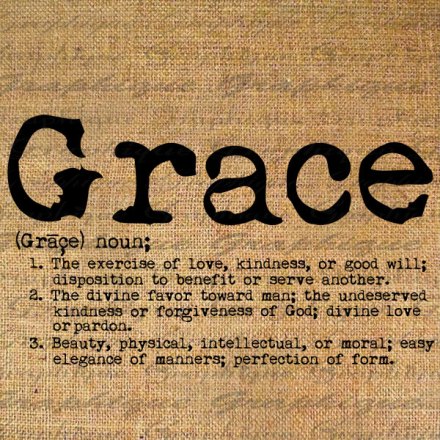
In a wonderful and well written obituary about Mary Claire and her life of service S. Delouise Menges writes about grace in Mary Claire’s life and how to recognize grace in our lives.
This poem by Marilyn Chandler McEntyre that Mary Claire used in prayer is a beautiful and touching meditation.
How to recognize grace
It takes you by surprise
It comes in odd packages
It sometimes looks like loss
Or mistakes
It acts like rain
Or like a seed
It’s both reliable and unpredictable
It’s not what you were aiming at
Or what you thought you deserved
It supplies what you need
Not necessarily what you want
It reminds you, you’re not in control
And that not being in control is a form of freedom
I have read this over several times and the line that strikes me most is “And that not being in control is a form of freedom”.
This life of Parkinson gives that statement new perspective. Little of our life is able to be controlled and I for one would like life to at least be predictable. It is not predictable either and that can be a form of freedom if you let it.
Frank, I know you are not with us any more and have not been for awhile but I suspect that like Google and Facebook you can watch us, so here is what I want to say to you.
Thank you ever so much for marrying Linda all those years ago when we were young. These days she is an immense help to me and a good friend. As you are aware, her simple act of kindness to Cheryl and me comes in the form of being with Cheryl while I go do something else. Lately that has been riding my bike around Lunken Airport.
When she first started doing this for us I had signed myself up for a care giving class which put great emphasis on making sure that you take care of yourself as a care partner. I asked if Linda could be with Cheryl during those class times and she agreed. I took the “take care of yourself” message to heart and make an extra effort to find help so that I can be on my own for a couple hours.
Since I am seeing Linda more these days, prior to this as you know we met for pizza Tuesday maybe four or five times a year, I think often about our conversations and ponderings in Aunt Dorothy’s kitchen. Do you remember some the questions we posed? How does one determine if sour cream is bad?, for example. I had not thought about it at the time but it was the same sort of thing that would puzzle my dad and I am guessing his brother, your dad. Sometimes small people would run through and we would wonder who they belonged to. Those are good memories. That entire older generation of our family is gone now. Aunt Bert passed away last year. But you know that. Have you talked to her yet? Does dementia go away when you get to heaven?
So, here is a couple questions for you. How are you doing in heaven these days? Is heaven a no smoking area? Is there a smoking section? Or did you give that up?
Did you know grapes are better when they are frozen? I learned that from Sarah’s Luke.
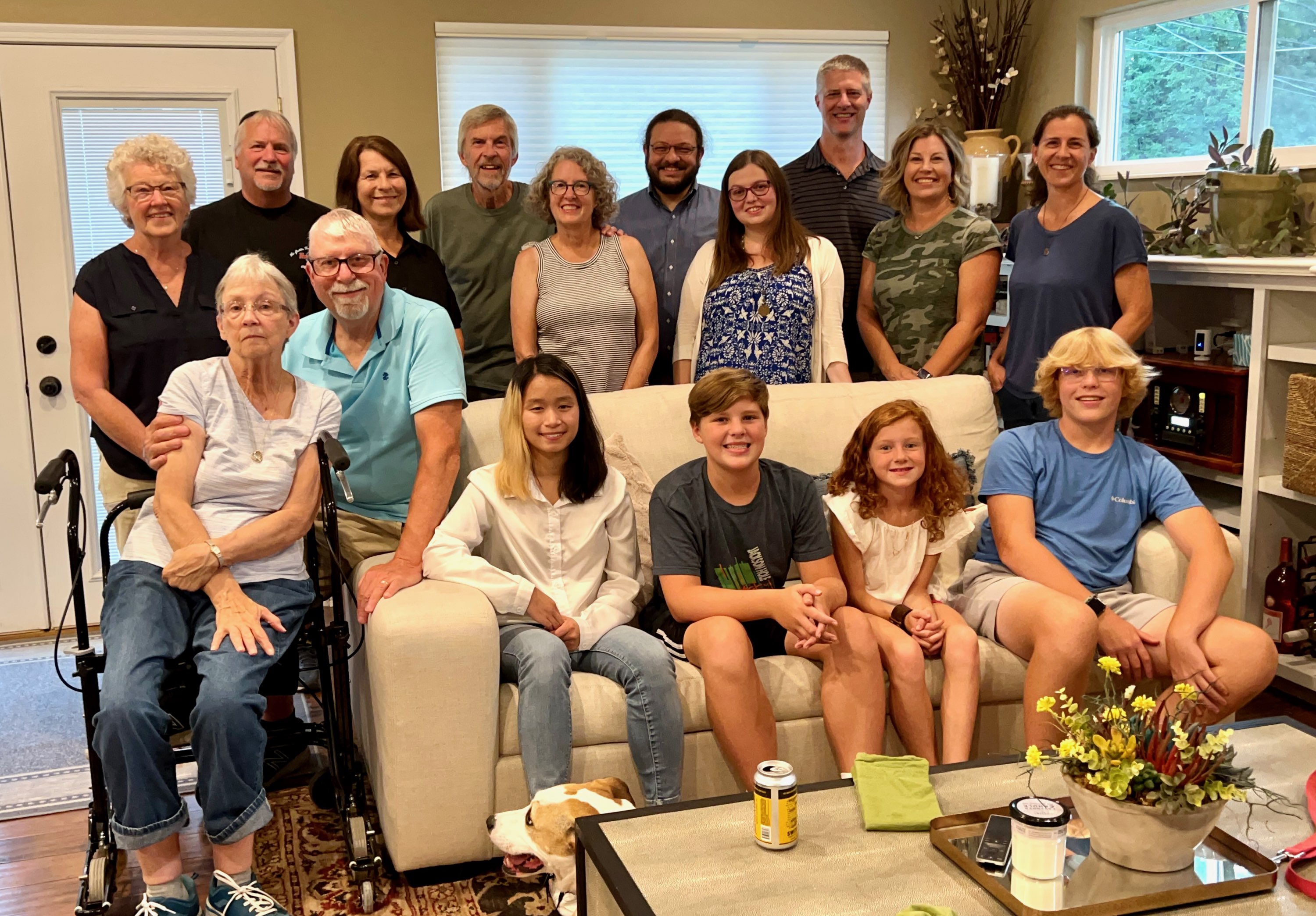
Ray and Shirley passed through town a few days ago. We gathered at Sarah’s house with as many folks as we could conjure up. Not all of your kids were there but some were. Betty and Herb came from Brooksville. Andy was not there but Kyle and Julie were. It was a great time. Ray took a picture:
An empathetic and caring atmosphere for your partner with Parkinson and dementia, like a good marriage, must be created. In the art of marriage the little things are the big things. The same is true for care partnering. Small things are meaningful to both.
It is never being too old to hold hands. Physical touch is a comfort. Holding hands and helping someone you love up a step or into the car or into a chair at the restaurant is a sign of love. Doing those things without complaint and without request is a sign of grace. Look for grace in your life.
Remembering to say, “I love you” at least once each day to a spouse who is also graced with a chronic disease is reassuring. She did not ask for this disease. Reassure her that she is not an annoyance to you by saying this often. As a care partner there will be times when you do not feel that way in that moment, breathe deep and remember how it was and use those thoughts to see her as she is now.
Never go to sleep angry. Anger is available every day. It has no place in the bedroom at night. (This may be the hardest lesson to learn.) Just remember that everything seems worse at night. Sleep later into the morning hours. There is always light after the darkness.
Discussing and having a mutual sense of values and common objectives that are important to the partner who is burdened with Parkinson is essential for helping her to manage the disease. Occasionally anxiety creeps into my thoughts and voice. When that happens I become a naggy care pusher and not a helpful encouraging care partner. If you can, resist becoming a naggy care pusher.
We are standing together facing the world. This is a joint effort. (A platitude – many hands make for light work.) Care partnering is forming a circle of love that gathers in the whole family. It gathers in your circle of friends. It affects the person with Parkinson directly both physically and sometimes mentally. Parkinson is a change. Parkinson is not a purgatory.
Care partnering is speaking words of appreciation and demonstrating gratitude in thoughtful ways. These words are exchanged in both directions. These words are not expected. These words are freely given.
Care-giving has the capacity to forgive and forget. Give each other an atmosphere in which each can grow. Share your thoughts and ideas with each other.
Find room for the things of the spirit. And when the spirit moves, search for the good and the beautiful. Keep on the lookout for those “Aha” moments to learn from.
As it is with marriage, care-giving is not only partnering with the right helpmate. It is being the right partner. Parkinson’s sucks is the phrase Michael J. Fox uses. By helping each other PD sucks less.
It occurred to me this morning as I was reaching for the Cheerios that lots of tiny things have changed in our life together. Not all of them are Parkinson changes. All can seem associated with Parkinson. I will stop using the possessive and leave Parkinson by itself.
Starting with Cheerios, Cheryl rarely ate Cheerios until recently. The why of that thought is unknown. It may or may not be a parkinson. Before Cheerios she was a huge fan of Life cereal. So much so that I was buying Life cereal in the four box collection from Boxed Up online. For several months perhaps a year and a half it was Life cereal, some dried cherries on top and orange juice. Then it suddenly switched to Frosted Mini-Wheat cereal but only for a couple weeks. Sticking with the heart healthy ideas I bought some Cheerios for myself on day as I passed through IGA shopping for the other things on my list. They were quickly adopted by Cheryl as a breakfast option. Cheerios is the current choice virtually every morning now.
A Partial List of Changes:
cars
house
travel
motivation
dementia and support
bicycles
relationships
Morning routine
Sleeping routine
Sleeping
Memory
Intimacy
Me and tea
showering and hygiene
keeping track of meds
adjusting meds
Exercise
Daily chore responsibility
Plumbing
handholds around the house
Emotional response to songs
Financial maintenance
Falling and fainting
Writing
and on and on…
As these changes occurred in our life together I did not take notice of them, I merely rolled with it at the time. I admit to being initially annoyed and sad to see something change away from what it was. Old people like to keep things as they are. The past tense is disappointing but the Beatles broke up in 1970. People move on.
Parkinson symptoms are treated with powerful mind altering chemicals. It is the doctor’s call as to what will help. It is the care partner’s call to observe and listen and respect and help with those drugs. The doctor is global and strategic. Day to day caring is tactical, down-to-earth and immediate.
Scott was here last night to be with Cheryl while I visited my stock club meeting. The fourth Monday of every month is the meeting of our little stock club. We started this little club in 1984. Over time we swelled to 20 members but the past few years attrition and death has shrunk our number to eight. And over the past few years the meetings are more social than business. Where else can eight old men get together and trade war stories about getting old, fortunes missed, grand children achievements, the proper temperature of beer for drinking, Parkinson’s disease, prostate problems, cataracts and hearing issues, but in the backroom of a local watering hole near a railroad track? It is always fun and over the years I have rarely missed it.
Before I left for the meeting Cheryl’s stomach was bugging her a bit as happens occasionally after her 4 pm meds. When I returned I asked her if she had eaten anything. She said yes but behind her Scott shook his head no. She answered my question how she thought I wanted her to answer it.
Eventually about 11:20 pm we went to bed. Over night she was fidgety and got up at 2:30 a.m. to make a list so she would not forget something. I sat her at the kitchen table with subdued lighting and with paper and pencil she worked on her list.
Her list is a business memory. I sat with her and about 3 a.m. she decided to sleep some more and finish later on. Buzzing around in her mind these days is the thought of creating a database of birthdays for the people in her family. Many times and in many instances she has started this task. Just like engineers this thinking starts with a pad and paper. Often sketches are made to indicate data flow and information input. Just like an engineer Cheryl’s notes switch back and forth from cursive to printing. And although she had an urgency about this activity in the very early morning hours, she had no ideas about what it was or what it was for in the daylight hours.
She seems so fragile to me in the morning lately. She is still working on the remnants of some dream as she awakens. This morning she got up and went into the bathroom. I got up also and put clothes on, got some coffee for myself and turned on the CBS news to see if any new wars developed or any movie stars got divorced overnight. About 20 minutes later I went back to check and see if any help was needed or if there were any special breakfast requests. She was seated on the closed toilet waiting for someone to bring more toilet paper. I showed her where the extra rolls were and asked if she wanted cereal for breakfast. Yes was her reply. I returned to the living area.
About ten minutes later I went to check again and she told me she was still waiting for someone to bring toilet paper. The thirty minutes of database design time in the middle of the night messed up her waking pattern.
More and more she seems to have a slow switch from early morning confusion to present. I have not found a solution to any of this confusion and delusion. I listen to her conversation and make a lot of rapid decisions about how to respond. If it seems like she is getting ramped up about someone coming (that I know is not) I try to gently steer her toward the correct thinking. If she is getting fired up about having a family gathering I merely agree with her plans.
On this particular morning she was concerned about whether David was going to show up any minute to cook the Thanksgiving turkey. It took several repeated conversations about date and time but eventually she seemed okay that Thanksgiving day was not today. Over several hours she came to the conclusion that she should take a shower and get ready for her exercise class. Over those same several hours I planted various seeds of the idea about taking a shower and looking for exercise clothes to wear.
Me and how I feel – It is wearying for the care partner to both console and encourage and direct and deflect her delusions and my own background anger (too strong a word – disappointment?; discouragement?; vexation?) with her brain and how it is operating with PD. My question – Why can’t she have the movement issues without the mental disability? (God are you listening? Why her? She has always been a sweet person. Why did you dump this crap on her?)
Observations about my reaction to her needs – (Shit! Not again. This is the same conversation we had 15 minutes ago. whiskey tango foxtrot.) How can I help dear? Cheryl – you can’t help. Perhaps not but let me hold your purse for you while you get out of the car.
Is this genuine love? … To have and to hold from this day forward, for better or for worse… Those where part of the original agreement. Too late to back out now. She looks so sad and distraught when she realizes that she needs me to help her up from the chair because her scoocher is busted. It is heartbreaking.
There is absolutely nothing that goes fast in our life anymore. Do I miss it? My immediate reaction is NOT.
Max throwing his fast ball
I like how the young people emphasize comments by using ALL CAPS. That enables their fast comments about most anything that strikes them.
FAST however is gone from our life with Parkinson. Planning and thoughtfulness and SLOW are the current buzz words in our life.
I have noticed as I get older (I am Old) and drive my wife with PD to various exercise or other social activities that many drivers – not necessarily young drivers – move through traffic fast. What is their hurry?
Even when I am feeling as though I am late for something, I ponder what will be the result if I am later than I expected to the destination – mass, restaurant, exercise, whatever. The end result is similar to removing one’s arm from a bucket of water.
This company wants me to buy a device that pretty much tells me I am not dead yet. I already know that. I run to the store and run to the library and run to the doctor fairly often. I am pretty sure I am still running okay and not dead.
Many people, probably most, spend a great deal of time running here and there. It is ingrained in us. We chide each other if we are not active. But instead of running what if we took a deep breath and stopped to look around at God’s wonder of Spring and the renewal of life. It happens every year. It is truly amazing.
Breathe and notice the world. Run for exercise and health but do it outside where He can show you His wonder.
Stephan T. Patsis is a favorite cartoonist. His signature work, “Pearls Before Swine” is the cartoon in the comic section of the local newspaper that I read first when my wife hands me the funnies and says, “There are some funny funnies today.”
You have to choose to be happy. The goat who is somewhat intellectual and thought provoking tells rat. An absolutely true statement from a smart goat. One does choose to be happy and no one else can make that choice for you.
And whether or not it is clear to you, no doubt the universe is unfolding as it should. Therefore be at peace with God, whatever you conceive Him to be. And whatever your labors and aspirations, in the noisy confusion of life, keep peace in your soul. With all its sham, drudgery and broken dreams, it is still a beautiful world. Be cheerful. Strive to be happy. – Desiderata by Max Hermann
Cheryl went to high school with Rosie. Rosie went on to become a Sister of St. Francis. Cheryl went to the prom with me and four years later we married.
Yesterday after many scheduling issues we hooked up for lunch. Cheryl was moving very slow that afternoon. Rosie moved very slow with her and very gently held her arm into the restaurant and over to the table. In conversation, Rosie, the quiet calm and gentle person that she is with her own health issues, gently took Cheryl down a memory lane of remembrances from their high school years to their current time.
I slowed a bit and observed. Slow and gentle were Rosie’s movements, her companionship, her conversation. I learned something.
When we got home Cheryl rested for a bit.
I realized that Cheryl needs to go at her own pace. I always knew that she did but I did not always observe that pace or make myself slow to her pace. Cheryl’s pace is principally Parkinson slow with occasion spurts of Parkinson fidget and sprinkled with Parkinson frantic and a little normal motion and conversation.
She did not seem really very tired or ready to go to bed at what I think of as her normal ordinary bed time of 9:30 – 10 PM. I tried to exercise what I had observed earlier in the day and suggested we play a card game or work a puzzle for a while. She said let’s play Uno. We played with half the deck. She shuffled the cards and asked, Does everyone get seven? I said yes and she did not deal any extra players. Uno for those who do not know has a simple theme. Follow the color or follow the number. She could do that for about an hour or so. She began to notice on her own when she could not tell the difference between red and green. She declared herself tired about 11:30 PM and we got ready for bed. She slept soundly for several hours — all at her own pace.
Rosie taught me something. Let Cheryl set the pace. And if she is not around, think about letting God set the pace. Life is peaceful at Godspeed. Life at warp-speed requires quick reactions and having your shields up at all times.